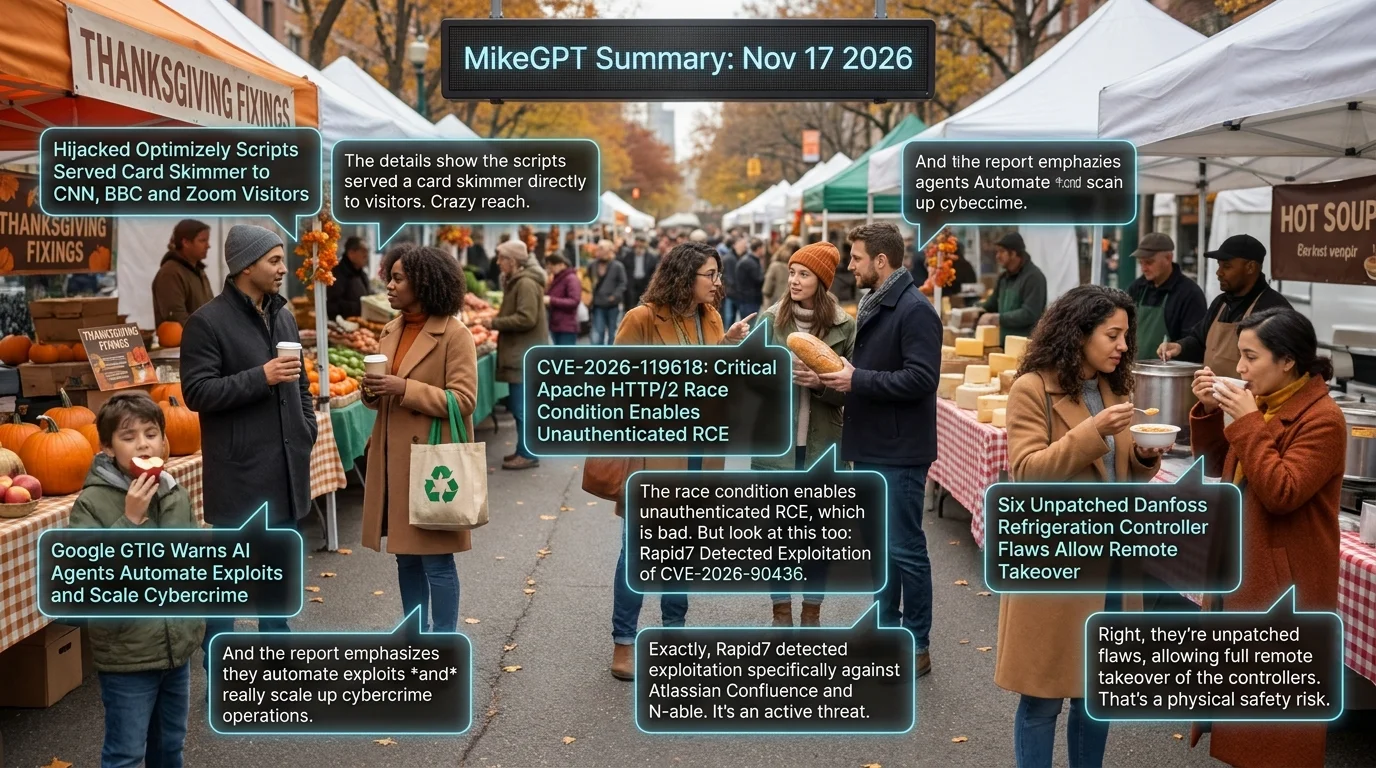
Tuesday, November 17, 2026

MikeGPT CyberSecurity

“Playbook for the Secure Enterprise”

MikeGPT Daily Threat Rundown

Heroes, your curated look at the current cybersecurity landscape for November 17, 2026.

Critical Threats

Hijacked Optimizely Scripts Served Card Skimmer to CNN, BBC and Zoom Visitors

    Attackers exploited a flaw in Optimizely Web Experimentation to inject malicious code, including card skimmers and iOS exploit kits, into the websites of at least 178 major organizations. Affected brands include CNN, BBC, Zoom, Salesforce, and Equifax.

    Business Impact

    If our marketing or web teams use Optimizely, our customers could be infected with malware or have their payment cards skimmed directly from our site, leading to massive class-action lawsuits, PCI-DSS fines, and total loss of consumer trust.

    Recommended Action

    Ask your IT team: Do any of our web properties load Optimizely scripts, and have we verified their integrity with the vendor's latest security advisory?

    General Enterprise The Hacker News ↗
Google GTIG Warns AI Agents Automate Exploits and Scale Cybercrime

    Google's Threat Intelligence Group warns that attackers are utilizing autonomous AI agents, including the Artex framework, to automate exploits and scale intrusions at unprecedented speeds. These AI-driven threats sacrifice stealth for speed, moving past traditional manual typing to automate credential theft and lateral movement.

    Business Impact

    If these AI-driven attacks breach our perimeter, they can move laterally and steal credentials in minutes rather than days, leading to massive data theft, immediate operational paralysis, and severe regulatory fines.

    Recommended Action

    Ask your IT team: Are we utilizing behavioral or AI-driven detection tools capable of identifying machine-speed attacks, and have we reviewed the new ARTEX signature packs?

    General Enterprise Security Affairs ↗

A critical CVSS 9.8 vulnerability in Apache HTTP Server's mod_http2 module allows attackers to execute arbitrary code remotely without any authentication. Exploitation leads to full server compromise on any server with HTTP/2 enabled.

Business Impact

If exploited, attackers gain full control over our web servers, allowing them to steal sensitive customer data, deface our brand, or pivot into our internal network, resulting in catastrophic revenue loss and breach notification mandates.

Recommended Action

Ask your IT team: Do we have Apache HTTP/2 enabled on any public-facing servers, and have we applied the emergency patch for this race condition?

CVE-2026-119618 General Enterprise Orca Security ↗

Rapid7 has detected active exploitation of a critical unsafe reflection vulnerability in Apache Axis 1.x, targeting Atlassian Confluence Data Center and N-able N-central instances for unauthenticated remote code execution.

Business Impact

If our collaboration or IT management tools are compromised, attackers gain the keys to our internal documentation and IT infrastructure, leading to widespread ransomware deployment, intellectual property theft, and total operational downtime.

Recommended Action

Ask your IT team: Are our Atlassian Confluence Data Center or N-able N-central instances exposed to the internet, and have we patched CVE-2026-90436?

CVE-2026-90436 General Enterprise CVE.org ↗

High Severity

Six unpatched vulnerabilities in Danfoss AK-SM800A refrigeration controllers allow remote attackers to take over the systems without authentication. No patch is currently available, even in the newest firmware version 5.4.0.

Business Impact

If exploited in our facilities, attackers could manipulate temperature controls, leading to massive spoilage of physical inventory, supply chain disruption, and significant financial write-offs.

Recommended Action

Ask your IT team: Are any of our facility refrigeration controllers connected to the internet, and can we isolate them behind a VPN immediately?

General Enterprise The Hacker News ↗

A new attack campaign is targeting cryptocurrency hardware wallet users by tricking them into installing ConnectWise ScreenConnect, a legitimate remote-support application. This enables attackers to take full remote control of the victim's machine.

Business Impact

If employees fall for this on corporate devices, attackers gain persistent remote access to our network, bypassing traditional malware defenses and enabling corporate espionage or ransomware deployment.

Recommended Action

Ask your IT team: Do we restrict the installation of unapproved remote management tools like ScreenConnect on corporate endpoints?

General Enterprise Security Boulevard ↗

A sophisticated campaign dubbed Operation ShadowCloud is utilizing cloud service-based backdoors, specifically the GitDoor malware, to target government networks across Asia and Africa. The attackers drop diverse shellcode families onto compromised hosts to maintain persistence.

General Enterprise Kaspersky Securelist ↗
Check Point Reports on TSMC Data Breach

    TSMC, a major Taiwanese semiconductor manufacturer, has confirmed a data breach in the latest weekly threat intelligence report. The breach highlights ongoing risks to critical manufacturing supply chains and intellectual property.

    General Enterprise Check Point Research ↗

Security experts advise organizations receiving DDoS ransom notes to verify the threat and test their configured protections before the attacker's deadline. The note itself does not prove the attacker's capability to disrupt services.

Other Noteworthy

A sophisticated campaign dubbed Operation ShadowCloud is utilizing cloud service-based backdoors, specifically the GitDoor malware, to target government networks across Asia and Africa. The attackers drop diverse shellcode families onto compromised hosts to maintain persistence.

General Enterprise Kaspersky Securelist ↗
Check Point Reports on TSMC Data Breach

    TSMC, a major Taiwanese semiconductor manufacturer, has confirmed a data breach in the latest weekly threat intelligence report. The breach highlights ongoing risks to critical manufacturing supply chains and intellectual property.

    General Enterprise Check Point Research ↗

Security experts advise organizations receiving DDoS ransom notes to verify the threat and test their configured protections before the attacker's deadline. The note itself does not prove the attacker's capability to disrupt services.

Executive Briefing

Trump Administration Moves to Block China From Indirect Access to American AI Technology

A new rule requires overseas data centers serving companies in countries like China, Russia, and Iran to identify their end users, aiming to block indirect access to American AI technology. This signals a tightening regulatory environment for global cloud providers and multinational enterprises.

SecurityWeek · 8:00 PM ·
Build, Run, Secure: The Cyber Leaders Who Own Both Technology and Security

Organizations are increasingly merging technology delivery and security leadership roles to better manage trade-offs between speed, cost, reliability, and risk. This structural shift aims to align competing priorities in fast-paced development environments.

Security Boulevard · 2:58 PM ·

Vendor Spotlight

Cloudflare

Why Cloudflare Today: Cloudflare’s edge compute, Web Application Firewall, and Zero Trust capabilities provide immediate mitigation against today's critical Apache HTTP/2 RCE (CVE-2026-119618), the surge in Artex-powered autonomous AI agent attacks, and unauthenticated remote takeovers of exposed OT/IoT infrastructure.

CVE-2026-119618: Critical Apache HTTP/2 Race Condition Enables Unauthenticated Remote Code Execution
1. Threat — CVE-2026-119618 (Apache HTTP/2 Race Condition RCE) allowing unauthenticated remote code execution on servers with HTTP/2 enabled.
2. Cloudflare Product(s) — WAF (Web Application Firewall)
3. Configuration Guidance — Dashboard → Security → WAF → Managed Rules. Ensure the "Cloudflare Managed Ruleset" is deployed and set to block high-risk CVEs. Additionally, to virtually patch before a specific signature is released: Dashboard → Security → WAF → Custom Rules → Create rule to block anomalous HTTP/2 traffic patterns or specific exploit payloads targeting mod_http2.
4. Coverage Assessment — Strong

Artex-Powered AI Agents Automating Exploits and Credential Theft
1. Threat — Chinese threat actors utilizing the Artex agentic AI framework and autonomous AI agents to rapidly automate exploits, steal credentials, and scale intrusions (as reported by Google GTIG and seen in the Barracuda breach).
2. Cloudflare Product(s) — Bot Management, WAF (Web Application Firewall)
3. Configuration Guidance — Dashboard → Security → Bots → Configure Bot Management. Set the action for "Definitely automated" (Bot Score 1-29) to Block or Managed Challenge to halt autonomous agent scripts. Dashboard → Security → WAF → Custom Rules → Create rule: cf.bot_management.score < 30 and http.request.uri.path contains "/login" set to Block to specifically prevent credential theft by AI agents.
4. Coverage Assessment — Strong

Prompt Injection Targeting AI Agents
1. Threat — Prompt injection vulnerabilities allowing attackers to alter the behavior of artificial intelligence systems and cause AI agents to go rogue (highlighted by Rein Security).
2. Cloudflare Product(s) — Firewall for AI, AI Gateway
3. Configuration Guidance — Dashboard → AI → AI Gateway. Route your AI application's API calls through the gateway endpoint. Then, Dashboard → Security → WAF → Firewall for AI. Enable "Prompt Injection" detection and set the action to Block to intercept malicious instructions before they reach your LLM.
4. Coverage Assessment — Strong

Unpatched Danfoss and Copeland Refrigeration Controller Flaws
1. Threat — Six unpatched vulnerabilities in Danfoss AK-SM800A and active probing of end-of-life Copeland refrigeration controllers allowing remote takeover without login.
2. Cloudflare Product(s) — Cloudflare Tunnel, Zero Trust (Cloudflare Access)
3. Configuration Guidance — Dashboard → Zero Trust → Networks → Tunnels. Install cloudflared on the OT network to create an outbound-only connection, allowing you to close all inbound firewall ports and remove the controllers from the public internet. Then, Dashboard → Zero Trust → Access → Applications. Create a policy requiring strict Identity Provider (IdP) authentication and MFA before any user can reach the controller's management interface.
4. Coverage Assessment — Integration-Dependent (Network isolation is strong standalone, but device posture checks require integration).
5. Integration Note — Integrate with CrowdStrike or SentinelOne via Cloudflare Zero Trust to enforce device posture checks, ensuring only corporate-managed, malware-free devices can access the OT network tunnels.

PHP2Shell RCE Vulnerabilities
1. Threat — Critical RCE vulnerabilities affecting PHP environments (PHP2Shell) uncovered by AI.
2. Cloudflare Product(s) — WAF (Web Application Firewall)
3. Configuration Guidance — Dashboard → Security → WAF → Managed Rules. Enable the "Cloudflare PHP Managed Ruleset" and set the action to Block. Dashboard → Security → WAF → Custom Rules → Create rule: http.request.uri.query contains "system(" or http.request.uri.query contains "exec(" to block common PHP shell execution attempts.
4. Coverage Assessment — Strong

Detection & Response

Detection & Response Kit (4 items) ▾

⚠️ Disclaimer: Test all detection logic in non-production environments before deployment.

1. Vendor Platform Configuration - Cloudflare

# Cloudflare Configuration Guidance # Generated: 2026-11-17 12:01:11 # Configuration expressions: # . 4. **Coverage Assessment** — **Strong** --- **Artex-Powered AI Agents Automating Exploits and Credential Theft** 1. **Threat** — Chinese threat actors utilizing the Artex agentic AI framework and autonomous AI agents to rapidly automate exploits, steal credentials, and scale intrusions (as reported by Google GTIG and seen in the Barracuda breach). 2. **Cloudflare Product(s)** — **Bot Management**, **WAF (Web Application Firewall)** 3. **Configuration Guidance** — Dashboard → Security → Bots → Configure Bot Management. Set the action for "Definitely automated" (Bot Score 1-29) to # WAF/Firewall rule expression: cf.bot_management.score < 30 and http.request.uri.path contains "/login" # to specifically prevent credential theft by AI agents. 4. **Coverage Assessment** — **Strong** --- **Prompt Injection Targeting AI Agents** 1. **Threat** — Prompt injection vulnerabilities allowing attackers to alter the behavior of artificial intelligence systems and cause AI agents to go rogue (highlighted by Rein Security). 2. **Cloudflare Product(s)** — **Firewall for AI**, **AI Gateway** 3. **Configuration Guidance** — Dashboard → AI → AI Gateway. Route your AI application's API calls through the gateway endpoint. Then, Dashboard → Security → WAF → Firewall for AI. Enable "Prompt Injection" detection and set the action to # to intercept malicious instructions before they reach your LLM. 4. **Coverage Assessment** — **Strong** --- **Unpatched Danfoss and Copeland Refrigeration Controller Flaws** 1. **Threat** — Six unpatched vulnerabilities in Danfoss AK-SM800A and active probing of end-of-life Copeland refrigeration controllers allowing remote takeover without login. 2. **Cloudflare Product(s)** — **Cloudflare Tunnel**, **Zero Trust (Cloudflare Access)** 3. **Configuration Guidance** — Dashboard → Zero Trust → Networks → Tunnels. Install # on the OT network to create an outbound-only connection, allowing you to close all inbound firewall ports and remove the controllers from the public internet. Then, Dashboard → Zero Trust → Access → Applications. Create a policy requiring strict Identity Provider (IdP) authentication and MFA before any user can reach the controller's management interface. 4. **Coverage Assessment** — **Integration-Dependent** (Network isolation is strong standalone, but device posture checks require integration). 5. **Integration Note** — Integrate with **CrowdStrike** or **SentinelOne** via Cloudflare Zero Trust to enforce device posture checks, ensuring only corporate-managed, malware-free devices can access the OT network tunnels. --- **PHP2Shell RCE Vulnerabilities** 1. **Threat** — Critical RCE vulnerabilities affecting PHP environments (PHP2Shell) uncovered by AI. 2. **Cloudflare Product(s)** — **WAF (Web Application Firewall)** 3. **Configuration Guidance** — Dashboard → Security → WAF → Managed Rules. Enable the "Cloudflare PHP Managed Ruleset" and set the action to # . Dashboard → Security → WAF → Custom Rules → Create rule: # Dashboard navigation paths: # Dashboard → Security → WAF → Managed Rules. Ensure the "Cloudflare Managed Ruleset" is deployed and set to block high-risk CVEs. Additionally, to virtually patch before a specific signature is released: Dashboard → Security → WAF → Custom Rules → Create rule to block anomalous HTTP/2 traffic patterns or specific exploit payloads targeting # Dashboard → Security → Bots → Configure Bot Management. Set the action for "Definitely automated" (Bot Score 1-29) to # Dashboard → Security → WAF → Custom Rules → Create rule: # Dashboard → AI → AI Gateway. Route your AI application's API calls through the gateway endpoint. Then, Dashboard → Security → WAF → Firewall for AI. Enable "Prompt Injection" detection and set the action to # Dashboard → Zero Trust → Networks → Tunnels. Install # Dashboard → Zero Trust → Access → Applications. Create a policy requiring strict Identity Provider (IdP) authentication and MFA before any user can reach the controller's management interface. # Dashboard → Security → WAF → Managed Rules. Enable the "Cloudflare PHP Managed Ruleset" and set the action to # Dashboard → Security → WAF → Custom Rules → Create rule:

2. YARA Rule for Artex AI Framework &amp; Autonomous Agents

rule APT_AI_Agent_Artex_Framework { meta: description = "Detects artifacts associated with the Artex AI framework and autonomous AI agents like CyberStrikeAI and PentAGI" author = "Threat Rundown" date = "2026-11-17" reference = "https://securityaffairs.com/?p=203260" severity = "high" tlp = "white" strings: $s1 = "ARTEX_EXEC_PAYLOAD" ascii wide $s2 = "CyberStrikeAI_Agent_Init" ascii wide $s3 = "PentAGI_Lateral_Module" ascii wide $s4 = "HexStrike_Exploit_Chain" ascii wide $s5 = "WhiteArmor_Evasion_Routine" ascii wide $s6 = "PHP2Shell_Backdoor_Connect" ascii wide $h1 = { 41 52 54 45 58 5f 41 47 45 4e 54 00 } // ARTEX_AGENT condition: any of ($s*) or $h1 }

3. SIEM Query — Exploitation and AI Agent Correlation

index=security sourcetype="suricata" OR sourcetype="waf" cve_id IN ("CVE-2026-119618", "CVE-2026-90436", "CVE-2026-109618", "CVE-2026-124010") OR signature="*ARTEX*" OR signature="*CyberStrikeAI*" | eval risk_score=case( action=="allowed" AND cve_id=="CVE-2026-119618", 100, action=="allowed" AND signature=="*ARTEX*", 90, action=="blocked", 25, 1==1, 50) | where risk_score >= 50 | table _time, src_ip, dest_ip, http_uri, cve_id, signature, action, risk_score | sort -_time

4. PowerShell Script — Unauthorized Remote Access Tool Detection (ScreenConnect)

$computers = "localhost", "SERVER01", "WKSTN01" $unauthorized_software = "*ScreenConnect*", "*ConnectWise Control*" foreach ($computer in $computers) { if (Test-Connection -ComputerName $computer -Count 1 -Quiet) { Write-Host "Checking $computer for unauthorized remote access tools..." Invoke-Command -ComputerName $computer -ScriptBlock { $installed = Get-ItemProperty HKLM:\Software\Microsoft\Windows\CurrentVersion\Uninstall\* | Where-Object { $_.DisplayName -like "*ScreenConnect*" -or $_.DisplayName -like "*ConnectWise Control*" } if ($installed) { Write-Warning "Unauthorized remote access tool found on $($env:COMPUTERNAME): $($installed.DisplayName)" # Stop the service to prevent remote access Get-Service -Name "ScreenConnect*" -ErrorAction SilentlyContinue | Stop-Service -Force Write-Host "Service stopped. Please initiate incident response." } else { Write-Host "No unauthorized tools found on $($env:COMPUTERNAME)." } } } else { Write-Host "Could not connect to $computer." } }

This rundown should provide a solid overview of the current threat landscape. Thank you to all our cyberheroes for your diligence and hard work. Stay vigilant!