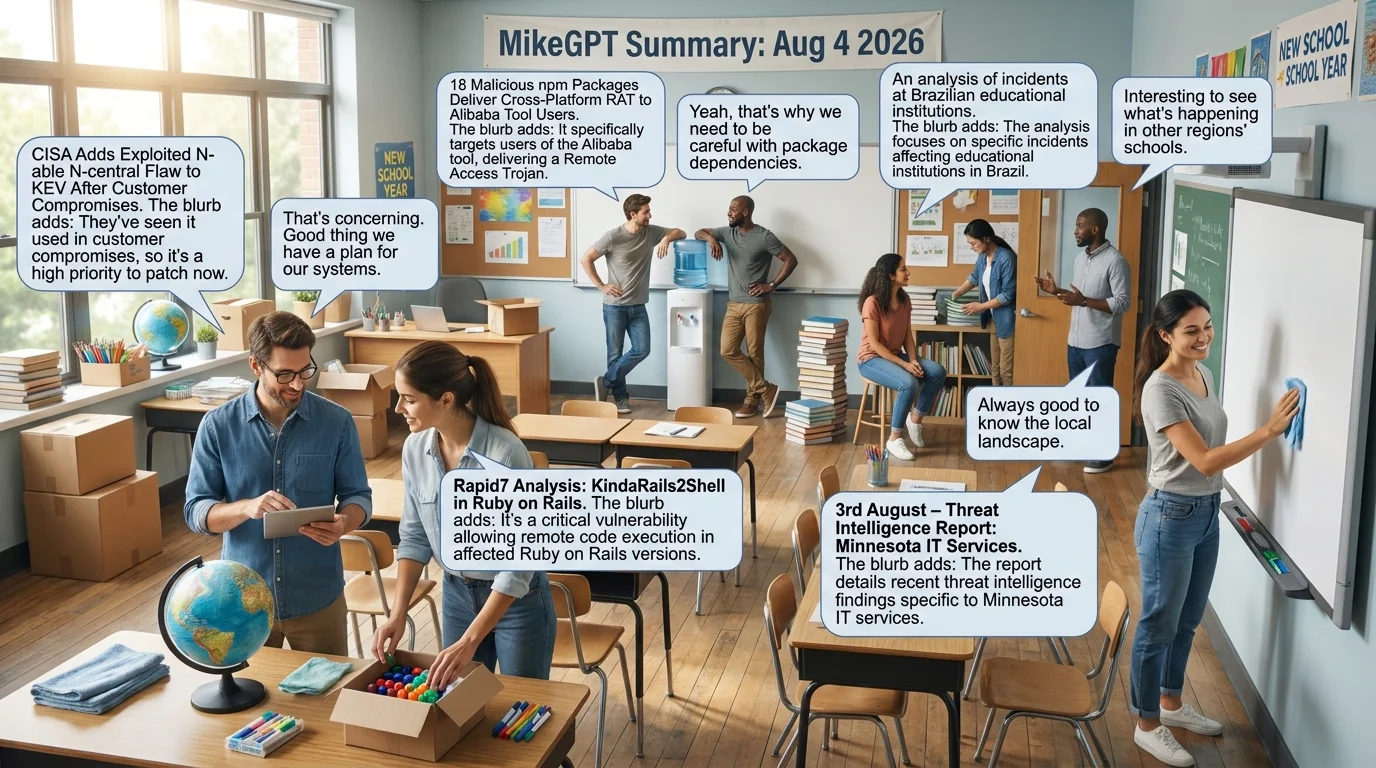
Tuesday, August 4, 2026

MikeGPT CyberSecurity

“Playbook for the Secure Enterprise”

MikeGPT Daily Threat Rundown

Heroes, your curated look at the current cybersecurity landscape for August 04, 2026.

Critical Threats
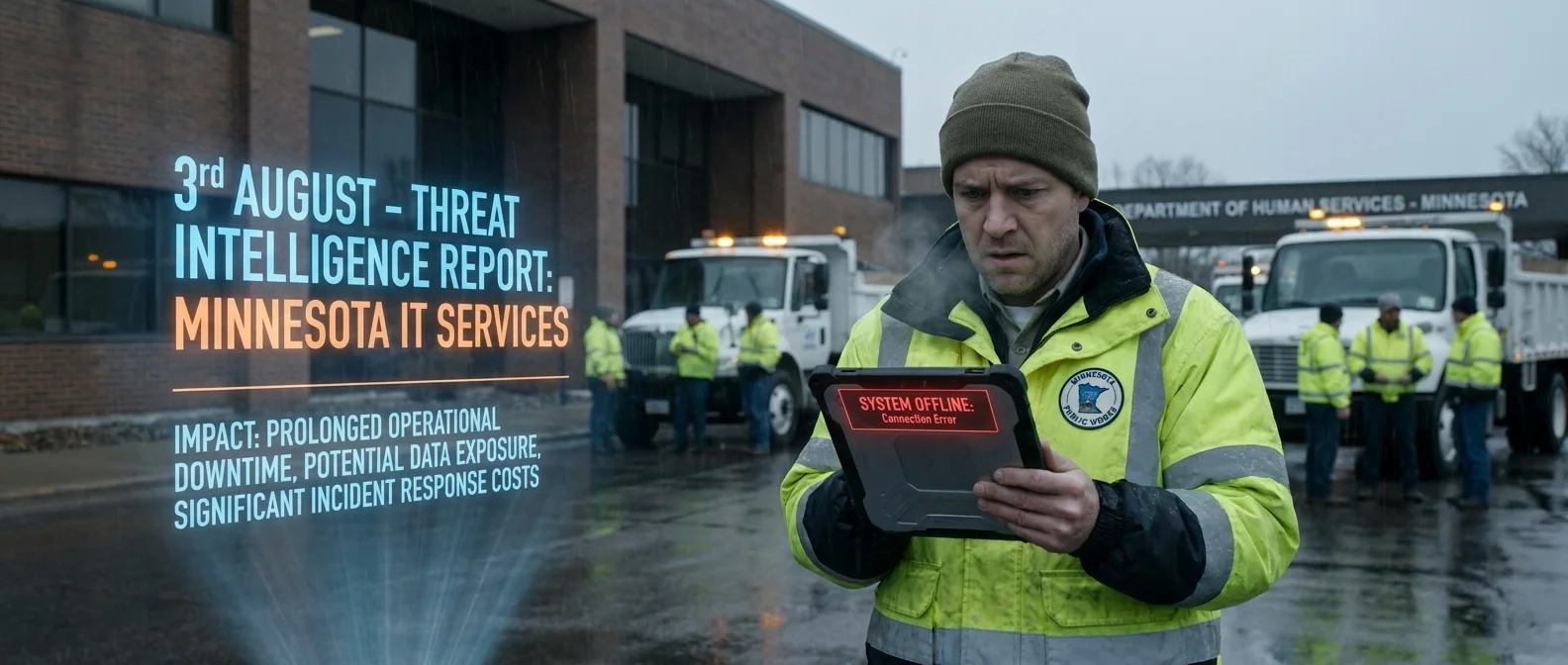
3rd August – Threat Intelligence Report: Minnesota IT Services

    Coordinated cyberattacks have affected Minnesota IT Services, impacting more than just local infrastructure and highlighting ongoing aggressive threats to state and enterprise networks.

    Business Impact

    Prolonged operational downtime for critical services, potential data exposure, and significant incident response costs that can severely impact quarterly budgets.

    Recommended Action

    Ask your IT team: Are our public-facing services protected against coordinated intrusion campaigns similar to those targeting state entities?

    General Enterprise Check Point Research ↗

The U.S. Cybersecurity and Infrastructure Security Agency (CISA) has added a high-severity vulnerability in N-able N-central to its Known Exploited Vulnerabilities catalog following reports of active exploitation in the wild. This remote monitoring and management (RMM) flaw is actively being used to compromise customer environments.

Business Impact

If exploited, attackers can gain full administrative control over managed IT environments, leading to massive downstream ransomware deployment, widespread data theft, and severe regulatory penalties for failing to protect client data.

Recommended Action

Ask your IT team: Are we using N-able N-central, and if so, have we applied the latest security patches to prevent exploitation?

CVE-2026-18577 General Enterprise The Hacker News ↗

A critical arbitrary file read vulnerability exists in Ruby on Rails Active Storage applications that use the Vips image processor with untrusted uploads. This allows attackers to read arbitrary files from the host server.

Business Impact

Attackers could read sensitive files from the server, potentially exposing database credentials, customer data, and intellectual property, leading to mandatory breach notifications and loss of customer trust.

Recommended Action

Ask your IT team: Do our web applications use Ruby on Rails with Active Storage and Vips, and have we updated to a secure version?

CVE-2026-66066 General Enterprise Rapid7/GitHub ↗
An analysis of incidents at Brazilian educational institutions

    Educational institutions in Brazil are facing frequent and high-impact cyberattacks due to the massive amount of valuable data they possess. Both public and private schools are being targeted by cybercriminals.

    Business Impact

    Theft of student and faculty PII can lead to severe reputational damage, regulatory fines, and potential class-action lawsuits that threaten the financial stability of the institution.

    Recommended Action

    Ask your IT team: Have we audited our data protection controls and access logs for sensitive personal information recently?

    General Enterprise Kaspersky ↗

High Severity

Cybersecurity researchers discovered malicious npm packages targeting users of Alibaba developer tools with a cross-platform remote access trojan (RAT). This is part of a sophisticated software supply chain attack targeting Chinese-speaking environments.

Business Impact

Compromise of developer environments could allow attackers to inject malicious code into production software, leading to widespread customer breaches and catastrophic brand damage.

Recommended Action

Ask your IT team: Are we auditing our npm dependencies and restricting the use of unverified packages in our development pipeline?

General Enterprise The Hacker News ↗

A crafted prompt to a low-privilege Google ADK agent could be used to pass a malicious hand-off comment to a privileged agent. This vulnerability enabled the exposure of secrets and tampering with pull requests.

Business Impact

Unauthorized access to sensitive corporate secrets and source code tampering could result in intellectual property theft and compromised product integrity, leading to lost competitive advantage.

Recommended Action

Ask your IT team: Are we utilizing AI agents in our development workflows, and have we implemented strict privilege boundaries between them?

General Enterprise SecurityWeek ↗
Model Context Protocol: Can it be the next carrier of AI Security Risks?

    The integration of Large Language Models (LLMs) into internal enterprise systems via the Model Context Protocol (MCP) introduces new vectors for AI security risks. Enterprises are racing to plug LLMs into CRMs, databases, and SaaS platforms without adequate safeguards.

    Business Impact

    Improperly secured AI integrations could allow unauthorized data access or manipulation across corporate databases, leading to massive data breaches and compliance violations.

    Recommended Action

    Ask your IT team: Have we conducted a security review of any internal AI models connected to our corporate databases or SaaS platforms?

    General Enterprise Kratikal ↗

Executive Briefing

Visa to Acquire Fraud Intelligence Firm BioCatch for $2.4 Billion

Visa's massive acquisition highlights the growing importance of behavioral and device intelligence in combating digital fraud, account takeovers, and scams. This signals a major industry shift toward behavioral biometrics as a core pillar of financial security.

SecurityWeek · 3:32 PM ·
Horizon3 Raises $250 Million to Fund Continuing Growth

A massive venture capital investment in Horizon3 underscores the critical market demand for automated penetration testing and proactive security validation. Enterprises are increasingly investing in continuous threat exposure management over point-in-time assessments.

SecurityWeek · 1:00 PM ·
FOMO in the SOC: Where AI Platforms like Claude Actually Fit

Security leaders are feeling the pressure to adopt AI tools like Claude, Codex, and Cursor. The conversation has evolved from theoretical AI to practical SOC applications, specifically in writing detections, investigating alerts, and automating repetitive incident response work.

The Hacker News · 11:30 AM ·

Vendor Spotlight

Tenable

Specialization: Vulnerability and Exposure Management

Why Tenable Today: With CISA adding the high-severity N-able N-central flaw to its Known Exploited Vulnerabilities (KEV) catalog following active customer compromises, organizations urgently need to identify exposed infrastructure. Tenable provides industry-leading vulnerability scanning and exposure management to quickly detect this specific RMM flaw across complex IT environments before attackers can exploit it.

Key Capability: Continuous vulnerability scanning and CISA KEV prioritization

Recommended Actions:
1. Navigate to Tenable Vulnerability Management Console → Explore → Findings
2. Navigate to Tenable Vulnerability Management Console → Scans → Create Scan → Advanced Network Scan
3. Navigate to Tenable Vulnerability Management Console → Dashboards → Add Dashboard → Search 'CISA Known Exploited'

Verification Steps:
- Verify scanner plugin sets are fully updated before running the targeted discovery scan by navigating to Settings → Sensors.
- After the IT team patches the N-central server, navigate to the original finding in Explore → Findings, select the vulnerability, and click 'Launch Remediation Scan'.

Learn More About Tenable ↗

Detection & Response

Detection & Response Kit (4 items)

⚠️ Disclaimer: Test all detection logic in non-production environments before deployment.

1. Vendor Platform Configuration - Tenable

# Actionable Guidance for Tenable # Generated: 2026-08-04 11:00:54 # Step 1: Navigate to Tenable Vulnerability Management Console → Explore → Findings # Purpose: Identify existing exposed N-able N-central infrastructure using historical scan data # Expected: By applying the filter 'Vulnerability.CVE is equal to [Insert specific N-able CVE, e.g., CVE-2024-2806]' or 'Plugin Name contains N-able N-central', you will generate a list of currently known vulnerable assets and their exact IP/hostname. # Step 2: Navigate to Tenable Vulnerability Management Console → Scans → Create Scan → Advanced Network Scan # Purpose: Actively probe the environment with the latest plugin set to discover unpatched or shadow IT N-central servers # Expected: A newly executed scan targeting management subnets or external IPs, resulting in an updated vulnerability report that confirms the presence or absence of the N-able flaw. # Step 3: Navigate to Tenable Vulnerability Management Console → Dashboards → Add Dashboard → Search 'CISA Known Exploited' # Purpose: Track the remediation progress of this specific flaw alongside other actively exploited vulnerabilities # Expected: A populated dashboard providing a high-level visual overview of all CISA KEV exposures, allowing security teams to prioritize the N-able remediation based on active threat intelligence. # Verification Steps: # - Verify scanner plugin sets are fully updated before running the targeted discovery scan by navigating to Settings → Sensors. # Expected: The 'Last Updated' timestamp for all active Nessus scanners reflects a time within the last 24 hours, ensuring the specific N-able N-central plugin is present. # - After the IT team patches the N-central server, navigate to the original finding in Explore → Findings, select the vulnerability, and click 'Launch Remediation Scan'. # Expected: The scan completes successfully and the vulnerability state for the N-able N-central asset automatically transitions from 'Active' to 'Fixed' in the Tenable console.

2. YARA Rule for Extracted Threat Indicators (Privilege Escalation & Malware)

rule Detect_Extracted_Threat_Indicators { meta: description = "Detects extracted malware indicators including Potato privilege escalation tools and specific RATs" author = "Threat Rundown" date = "2026-08-04" reference = "https://kasperskycontenthub.com/securelist/?p=120803" severity = "high" tlp = "white" strings: $s1 = "GodPotato" ascii wide nocase $s2 = "SweetPotato" ascii wide nocase $s3 = "BadPotato" ascii wide nocase $s4 = "CaptiveCrunch" ascii wide nocase $s5 = "OWAReaper" ascii wide nocase $s6 = "StealthLoader" ascii wide nocase $s7 = "DragonForce" ascii wide nocase condition: any of ($s*) }

3. SIEM Query — Suspicious IT Tool Usage (PsExec/AnyDesk)

index=security sourcetype="WinEventLog:Security" OR sourcetype="Sysmon" (EventCode=4688 OR EventCode=1) (Image="*\\PsExec.exe" OR Image="*\\PsExecSvc.exe" OR Image="*\\AnyDesk.exe") | eval risk_score=case( match(CommandLine, "(?i)-s|-x|\\\\\\d{1,3}\\.\\d{1,3}\\.\\d{1,3}\\.\\d{1,3}"), 100, match(ParentImage, "(?i)cmd\.exe|powershell\.exe|wscript\.exe"), 75, 1==1, 25) | where risk_score >= 75 | table _time, host, user, Image, CommandLine, ParentImage, risk_score | sort -_time

4. PowerShell Script — Hunt for Extracted Malware Artifacts

$computers = "localhost" $malwareNames = @("CaptiveCrunch", "OWAReaper", "StealthLoader", "GodPotato", "SweetPotato", "BadPotato") foreach ($computer in $computers) { if (Test-Connection -ComputerName $computer -Count 1 -Quiet) { Write-Host "Checking $computer for suspicious processes..." # Check running processes $processes = Get-Process -ComputerName $computer -ErrorAction SilentlyContinue foreach ($proc in $processes) { foreach ($malware in $malwareNames) { if ($proc.Name -match $malware) { Write-Warning "[!] Suspicious process found on $computer: $($proc.Name) (PID: $($proc.Id))" } } } # Check for PsExecSvc service $svc = Get-Service -ComputerName $computer -Name "PsExecSvc" -ErrorAction SilentlyContinue if ($svc) { Write-Warning "[!] PsExecSvc is installed on $computer. Verify if this is authorized." } } }

This rundown should provide a solid overview of the current threat landscape. Thank you to all our cyberheroes for your diligence and hard work. Stay vigilant!