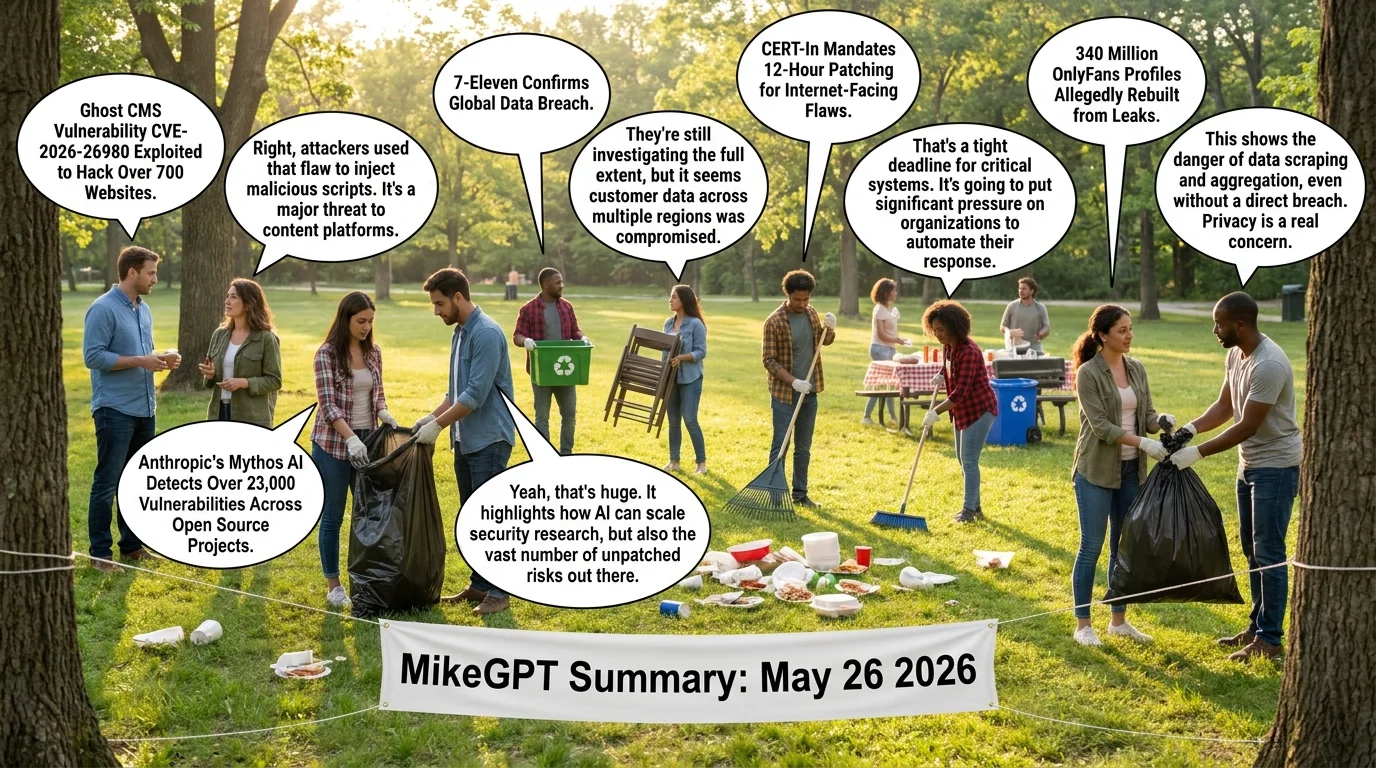
Tuesday, May 26, 2026

MikeGPT CyberSecurity

“Playbook for the Secure Enterprise”

MikeGPT Daily Threat Rundown

Heroes, your curated look at the current cybersecurity landscape for May 26, 2026.

Critical Threats

7-Eleven Confirms Global Data Breach

    Global convenience store chain 7-Eleven has confirmed a data breach following unauthorized access to its systems, as detailed in recent threat intelligence reports. This highlights the ongoing targeting of massive retail networks by sophisticated threat actors.

    Business Impact

    A breach of this scale exposes the company to massive regulatory fines, class-action lawsuits from affected customers, and significant brand devaluation.

    Recommended Action

    Ask your IT team: Have we reviewed our third-party risk management policies and ensured our retail point-of-sale networks are properly segmented?

    General Enterprise Check Point Research ↗
Ghost CMS Vulnerability CVE-2026-26980 Exploited to Hack Over 700 Websites

    Attackers are actively exploiting a patched flaw in Ghost CMS to push ClickFix and FakeCaptcha attacks, compromising over 700 sites including major universities like Harvard and Oxford. This widespread exploitation demonstrates how quickly threat actors weaponize known vulnerabilities against high-profile targets.

    Business Impact

    If exploited, attackers can hijack web traffic and distribute malware to visitors, leading to severe reputational damage, potential liability for downstream infections, and immediate loss of customer trust.

    Recommended Action

    Ask your IT team: Are we running Ghost CMS, and if so, have we applied the latest security patches to mitigate CVE-2026-26980?

Anthropic

    Anthropic's Mythos Preview model has identified tens of thousands of high and critical-severity flaws across 1,000 open-source projects, highlighting significant patching obstacles in the software industry. The sheer volume of AI-discovered vulnerabilities threatens to overwhelm traditional vulnerability management programs.

    Business Impact

    Undiscovered vulnerabilities in open-source dependencies can lead to sudden, widespread supply chain compromises, resulting in operational downtime, data breaches, and massive incident response costs.

    Recommended Action

    Ask your IT team: Do we have a Software Bill of Materials (SBOM) to track our open-source dependencies, and how quickly can we patch newly discovered flaws?

    General Enterprise SecurityWeek ↗

The Indian Computer Emergency Response Team has issued strict new guidelines requiring organizations to patch critical internet-exposed vulnerabilities within 12 hours to combat AI-assisted attacks. This represents a drastic acceleration in regulatory expectations for vulnerability management.

Business Impact

Failure to comply with these aggressive new regulatory timelines could result in severe operational penalties, legal sanctions, and increased liability in the event of a breach.

Recommended Action

Ask your IT team: Can our current vulnerability management program support a 12-hour turnaround for critical internet-facing patches?

General Enterprise The Hacker News ↗
340 Million OnlyFans Profiles Allegedly Rebuilt from Leaks

    A threat actor is selling a massive dataset of 340 million OnlyFans-linked profiles, constructed by correlating public data and old breaches rather than a direct hack of the platform. This demonstrates how attackers are weaponizing aggregated historical data to create high-value target lists.

    Business Impact

    While not a direct breach, the aggregation of this data creates severe privacy risks for users, potentially leading to extortion, targeted phishing, and significant brand damage for the associated platform.

    Recommended Action

    Ask your IT team: Are we monitoring the dark web for aggregated datasets that might expose our employees or customers to targeted social engineering?

    General Enterprise Security Affairs ↗

High Severity

The North Korea-linked Lazarus Group is targeting financial and cryptocurrency organizations with RemotePE, a cross-platform, memory-only Remote Access Trojan designed to evade traditional file-based detection. This fileless approach leaves almost no forensic traces behind.

Business Impact

Successful deployment of this stealthy malware can lead to catastrophic financial theft, loss of cryptocurrency assets, and complete compromise of critical financial infrastructure without triggering standard alarms.

Recommended Action

Ask your IT team: Do our endpoint detection tools have the capability to detect fileless, memory-only malware execution?

General Enterprise The Hacker News ↗

A massive supply chain attack dubbed 'Megalodon' has infected over 5,500 GitHub repositories using fake automated commits to inject malicious workflows that steal credentials and CI secrets. This highlights the severe vulnerability of automated development pipelines.

Business Impact

Compromised CI/CD pipelines can allow attackers to inject malicious code into production software, leading to massive downstream customer breaches and devastating loss of intellectual property.

Recommended Action

Ask your IT team: Have we audited our GitHub Actions workflows and secured our CI/CD pipeline secrets against unauthorized automated commits?

General Enterprise SecurityWeek ↗
Admins of Bulletproof Hosting Service Used by Russian Hackers Arrested

    Authorities in the Netherlands have seized 800 servers and arrested two co-owners of Dutch hosting companies that provided bulletproof infrastructure for Russia-aligned threat actors. This infrastructure was used to carry out cyberattacks and disinformation campaigns inside the EU.

    Business Impact

    While a positive takedown, the disruption of these services may cause threat actors to rapidly shift infrastructure, potentially leading to unpredictable spikes in cyberattacks as they re-establish operations.

    Recommended Action

    Ask your IT team: Are we updating our threat intelligence feeds to monitor for new infrastructure spun up by displaced Russia-aligned threat groups?

    General Enterprise SecurityWeek ↗

As cyberattacks rise, the Reserve Bank of India has tightened security and compliance rules, prompting the release of updated audit checklists for financial institutions. This reflects a global trend of financial regulators demanding stricter cybersecurity adherence.

General Enterprise Kratikal ↗

The weekly cybersecurity recap highlights ongoing struggles with unpatched servers, resurrected bugs, and supply chain vulnerabilities across the industry. It serves as a reminder of the persistent operational challenges in maintaining basic security hygiene.

Other Noteworthy

As cyberattacks rise, the Reserve Bank of India has tightened security and compliance rules, prompting the release of updated audit checklists for financial institutions. This reflects a global trend of financial regulators demanding stricter cybersecurity adherence.

General Enterprise Kratikal ↗

The weekly cybersecurity recap highlights ongoing struggles with unpatched servers, resurrected bugs, and supply chain vulnerabilities across the industry. It serves as a reminder of the persistent operational challenges in maintaining basic security hygiene.

Executive Briefing

Google I/O 2026: The Agentic Web Just Went Into Production

Google's release of a full agent stack, including Gemini 3.5 Flash and WebMCP, signals a massive shift toward an "Agentic Web," requiring security leaders to rethink identity, access, and automated threat models as AI agents begin interacting autonomously.

Security Boulevard · 3:30 PM ·
BSides312 2026: Security Basics Under New Pressure

Discussions at BSides312 emphasized that in an era of AI-assisted development, foundational security principles like trust, identity, and access management are more critical than ever to prevent systemic failures.

Security Boulevard · 12:34 PM ·

Vendor Spotlight

SentinelOne

Specialization: Endpoint Detection & Response (EDR)

Why SentinelOne Today: SentinelOne's Singularity platform features advanced behavioral AI and memory exploit mitigation specifically designed to detect fileless malware and in-memory execution. This directly addresses the Lazarus Group's use of the stealthy RemotePE memory-only RAT to evade traditional file-based detection at targeted financial and cryptocurrency organizations.

Key Capability: Behavioral AI and memory scanning for fileless threats

Recommended Actions:
1. Navigate to SentinelOne Console → Sentinels → Policies → Protection Mode
2. Navigate to SentinelOne Console → Sentinels → Policies → Engines
3. Navigate to SentinelOne Console → Visibility → Hunt

Verification Steps:
- Navigate to Sentinels → Endpoints and filter by 'Pending Policy' to ensure the strict Protection and Engine settings have propagated.
- Monitor the Incidents → Threats dashboard specifically filtering for 'Engine: Behavioral' or 'Engine: Exploit'.

Learn More About SentinelOne ↗

Detection & Response

Detection & Response Kit (4 items) ▾

⚠️ Disclaimer: Test all detection logic in non-production environments before deployment.

1. Vendor Platform Configuration - SentinelOne

# Actionable Guidance for SentinelOne # Generated: 2026-05-26 11:00:44 # Step 1: Navigate to SentinelOne Console → Sentinels → Policies → Protection Mode # Purpose: Ensure the agent is actively blocking fileless and in-memory threats like RemotePE rather than just alerting. # Expected: Both 'Malicious' and 'Suspicious' threat levels are set to 'Protect', enabling automated mitigation of behavioral anomalies and memory exploits. # Step 2: Navigate to SentinelOne Console → Sentinels → Policies → Engines # Purpose: Verify that 'Behavioral AI' and 'Anti-Exploitation / Fileless' engines are toggled ON. # Expected: The Singularity agent is explicitly configured to monitor process memory for reflective DLL injection, process hollowing, and unauthorized memory allocations typical of the Lazarus Group's RemotePE. # Step 3: Navigate to SentinelOne Console → Visibility → Hunt # Purpose: Proactively hunt for in-memory execution anomalies using Deep Visibility query: `IndicatorName In Contains Anycase ("Process Hollowing", "Reflective PE", "Memory Allocation Anomaly")` # Expected: Identification of any currently compromised endpoints where RemotePE might be running stealthily in memory, allowing for immediate network isolation. # Verification Steps: # - Navigate to Sentinels → Endpoints and filter by 'Pending Policy' to ensure the strict Protection and Engine settings have propagated. # Expected: All critical endpoints show a 'Synced' policy status with active Behavioral and Anti-Exploitation engines. # - Monitor the Incidents → Threats dashboard specifically filtering for 'Engine: Behavioral' or 'Engine: Exploit'. # Expected: Any execution attempts of RemotePE are automatically killed and quarantined, generating a 'Mitigated' incident with a full attack storyline.

2. YARA Rule for ClickFix, Megalodon, and Associated Campaigns

rule Detect_ClickFix_Megalodon_Campaigns { meta: description = "Detects artifacts related to ClickFix, FakeCaptcha, and Megalodon supply chain attacks" author = "Threat Rundown" date = "2026-05-26" reference = "https://www.securityweek.com/?p=46614" severity = "high" tlp = "white" strings: $s1 = "ClickFix" ascii wide $s2 = "FakeCaptcha" ascii wide $s3 = "Megalodon" ascii wide $s4 = "NoName057" ascii wide $s5 = "YellowKey" ascii wide $s6 = "Kimwolf" ascii wide $s7 = "UnDefend" ascii wide $s8 = "RedSun" ascii wide $s9 = "Stark" ascii wide $h1 = { 4D 5A 90 00 03 00 00 00 } condition: any of ($s*) or $h1 }

3. SIEM Query — Ghost CMS CVE-2026-26980 Exploitation Attempts

index=web sourcetype="access_combined" OR sourcetype="waf" (uri="*CVE-2026-26980*" OR useragent="*ClickFix*" OR useragent="*FakeCaptcha*") | eval risk_score=case( match(uri, "CVE-2026-26980"), 100, match(useragent, "ClickFix"), 80, match(useragent, "FakeCaptcha"), 80, 1==1, 25) | where risk_score >= 80 | table _time, src_ip, dest_ip, uri, useragent, risk_score | sort -_time

4. PowerShell Script — Megalodon and UnDefend Artifact Check

$computers = "localhost", "SERVER01", "WKSTN01" foreach ($computer in $computers) { if (Test-Connection -ComputerName $computer -Count 1 -Quiet) { Write-Host "Checking $computer for Megalodon and UnDefend artifacts..." # Check for suspicious processes related to extracted indicators $suspicious = Get-Process -ComputerName $computer -ErrorAction SilentlyContinue | Where-Object { $_.ProcessName -match "Megalodon|UnDefend|Kimwolf|RedSun|YellowKey" } if ($suspicious) { Write-Warning "Suspicious process found on $computer : $($suspicious.ProcessName)" } else { Write-Host "No immediate threats detected on $computer." } } }

This rundown should provide a solid overview of the current threat landscape. Thank you to all our cyberheroes for your diligence and hard work. Stay vigilant!