Thursday, May 7, 2026

MikeGPT CyberSecurity

“Playbook for the Secure Enterprise”

MikeGPT Daily Threat Rundown

Heroes, your curated look at the current cybersecurity landscape for May 07, 2026.

Critical Threats

Exploitation of PAN-OS Captive Portal Zero-Day for Unauthenticated RCE

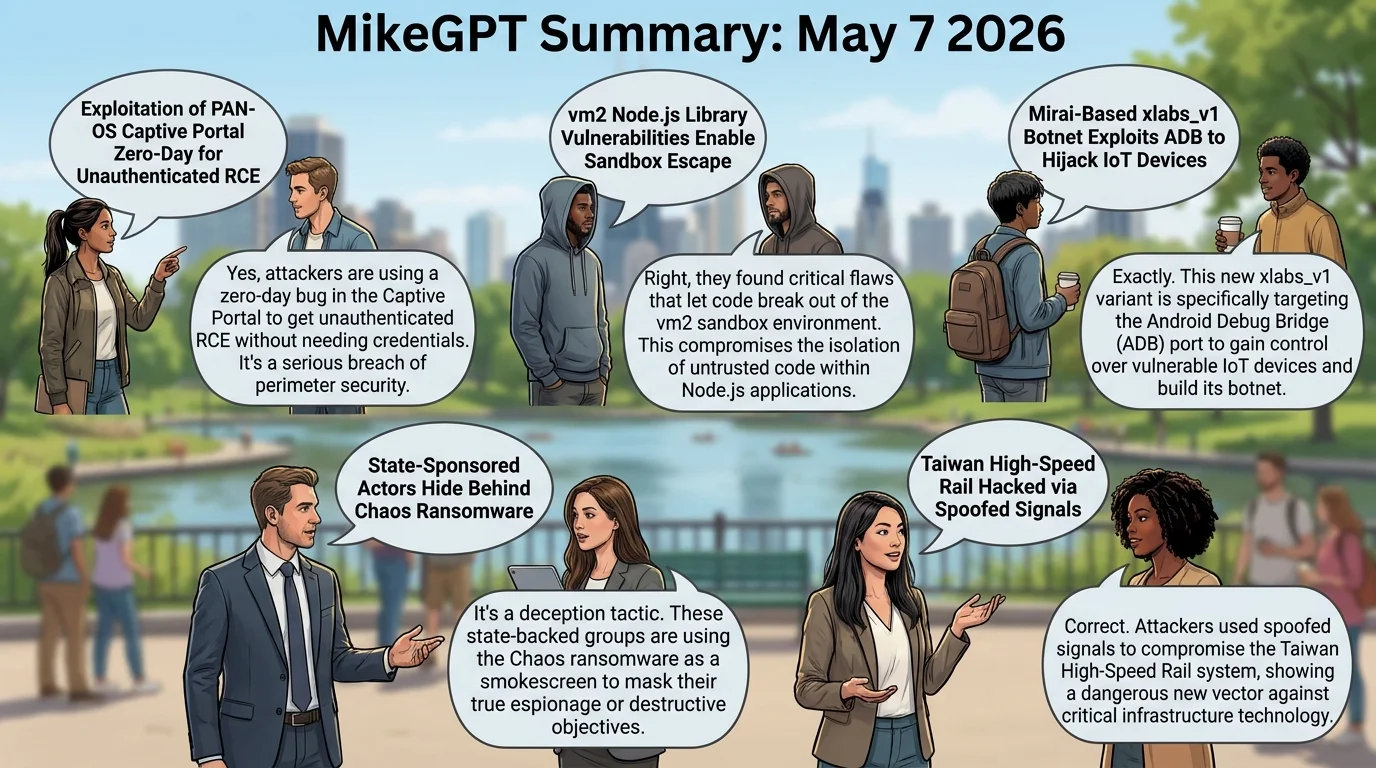
    CISA has added a critical buffer overflow vulnerability in the Palo Alto Networks PAN-OS User-ID Authentication Portal to its Known Exploited Vulnerabilities catalog. Threat actors are actively exploiting this zero-day flaw to achieve unauthenticated remote code execution.

    Business Impact

    Compromise of edge firewalls grants attackers unfettered access to the corporate network, leading to massive data exfiltration, ransomware deployment, and severe regulatory penalties from resulting breaches.

    Recommended Action

    Ask your IT team: Are our Palo Alto firewalls exposing the Captive Portal to the public internet, and have we applied the emergency vendor patches?

    CVE-2026-0300 General Enterprise Unit 42 ↗

A dozen critical security vulnerabilities have been disclosed in the open-source vm2 Node.js library. These flaws allow bad actors to break out of secure sandboxes and execute arbitrary code on susceptible systems.

Business Impact

Exploited application servers can lead to unauthorized access to backend databases, intellectual property theft, and prolonged service outages affecting customer trust and revenue.

Recommended Action

Ask your development team: Are we using the vm2 library in our Node.js applications, and have we updated to a secure version or alternative?

General Enterprise The Hacker News ↗

A new Mirai-derived botnet named xlabs_v1 is targeting internet-exposed devices running Android Debug Bridge (ADB). The botnet enlists these compromised devices into a network capable of executing massive distributed denial-of-service (DDoS) attacks.

Business Impact

Enslaved corporate devices can be used to launch attacks against third parties, resulting in ISP blacklisting, legal liability, and significant bandwidth costs.

Recommended Action

Ask your IT team: Are any of our corporate Android devices or IoT endpoints exposing ADB ports to the public internet?

General Enterprise The Hacker News ↗
State-Sponsored Actors Hide Behind Chaos Ransomware

    Sophisticated state-sponsored threat actors are using the Chaos ransomware-as-a-service (RaaS) banner as a false flag to obscure targeted espionage operations. Forensics reveal the intrusion is highly targeted rather than a standard financially motivated attack.

    Business Impact

    Beyond standard extortion costs, this indicates highly targeted corporate espionage, risking the loss of core intellectual property and severe national security compliance breaches.

    Recommended Action

    Ask your security team: Are our threat hunting procedures tuned to detect advanced persistent threat (APT) behaviors even during standard ransomware incidents?

    General Enterprise Rapid7 ↗
Taiwan High-Speed Rail Hacked via Spoofed Signals

    A student successfully spoofed signals to trigger an emergency alarm on the Taiwan high-speed rail system, stopping four trains for nearly an hour and exposing a major critical infrastructure security gap.

    Business Impact

    Physical disruption of operational technology (OT) leads to massive revenue loss, public safety risks, and intense regulatory scrutiny for infrastructure operators.

    Recommended Action

    Ask your OT security team: Have we isolated our critical operational networks from external signal spoofing and unauthorized access?

    General Enterprise Security Affairs ↗

High Severity

Attackers are increasingly abusing legitimate mechanisms like screensavers to target trusted software and signed components. Recent reporting reveals that certificate authority DigiCert was targeted using this difficult-to-detect entry point.

Business Impact

Compromise of certificate authorities or trusted signing components can invalidate corporate trust chains, leading to widespread application failures and severe reputational damage.

Recommended Action

Ask your IT team: Are we monitoring for anomalous execution of legacy Windows components like screensavers (.scr files) across our endpoints?

General Enterprise Seceon ↗

Malicious Python packages on the Python Package Index (PyPI) are stealthily delivering the ZiChatBot malware to Windows and Linux systems. The malware abuses Zulip APIs to establish command and control.

Business Impact

Supply chain infections via developer tools can compromise entire product lines, leading to customer breaches, source code theft, and massive remediation costs.

Recommended Action

Ask your development team: Do we have software composition analysis (SCA) tools in place to block malicious PyPI packages before they enter our environment?

General Enterprise The Hacker News ↗

Executive Briefing

AI Tools Expose PostgreSQL and MariaDB Flaws Hidden for Decades

AI-assisted analysis is revolutionizing vulnerability research, recently uncovering critical flaws in PostgreSQL and MariaDB that remained hidden for over 20 years. This highlights the dual-use nature of AI in both discovering legacy vulnerabilities and potentially arming threat actors.

Security Boulevard · 6:02 PM ·
AWS Releases ISO/IEC 42001:2023 Compliance Guide for AI Systems

AWS has published practical guidance for organizations to design and operate Artificial Intelligence Management Systems (AIMS) in compliance with the new ISO/IEC 42001:2023 standard, providing a crucial roadmap for secure enterprise AI adoption.

AWS · 7:39 PM ·
The Passwordless Future Has a Password Problem

While passkeys promise a more secure authentication model, the transition remains complex. Organizations must strategically plan their migration to fully eliminate legacy password vulnerabilities rather than just layering new technologies on top of old ones.

Security Boulevard · 8:10 PM ·

Vendor Spotlight

Mandiant

Specialization: Threat Intelligence & Incident Response

Why Mandiant Today: The intelligence regarding state-sponsored actors operating under the guise of the Chaos ransomware-as-a-service (RaaS) group requires advanced threat hunting and attribution capabilities. Mandiant's deep expertise in incident response and frontline threat intelligence allows organizations to look past standard ransomware indicators and identify sophisticated state-sponsored forensic tracks.

Key Capability: Advanced threat actor attribution and forensic analysis

Recommended Actions:
1. Navigate to Mandiant Advantage Console → Threat Intelligence → Threat Actors → Search
2. Navigate to Mandiant Advantage Console → Security Validation → Library → Actors
3. Navigate to Mandiant Advantage Console → Managed Defense → Hunt → Create Hunt

Verification Steps:
- Review the Security Validation Evaluation Results dashboard for the executed state-sponsored actor simulation.
- Verify that the exported YARA and Snort rules from Mandiant Threat Intelligence are successfully ingested and active in the organization's EDR and network IDS/IPS.

Learn More About Mandiant ↗

Detection & Response

Detection & Response Kit (4 items)

⚠️ Disclaimer: Test all detection logic in non-production environments before deployment.

1. Vendor Platform Configuration - Mandiant

# Actionable Guidance for Mandiant # Generated: 2026-05-07 11:01:05 # Step 1: Navigate to Mandiant Advantage Console → Threat Intelligence → Threat Actors → Search # Purpose: Identify overlapping TTPs between Chaos RaaS and known state-sponsored actors (e.g., specific UNC groups) to extract advanced network and endpoint IOCs. # Expected: A curated list of advanced IOCs, YARA rules, and MITRE ATT&CK mappings specific to the state-sponsored actor's pre-ransomware deployment behaviors (e.g., living-off-the-land techniques, custom loaders). # Step 2: Navigate to Mandiant Advantage Console → Security Validation → Library → Actors # Purpose: Safely simulate the underlying state-sponsored actor's lateral movement, credential access, and persistence techniques to validate current security controls against the true threat, not just the Chaos payload. # Expected: A detailed evaluation report highlighting which SIEM/EDR controls successfully blocked or alerted on the advanced TTPs, and identifying any coverage gaps in the pre-encryption phases. # Step 3: Navigate to Mandiant Advantage Console → Managed Defense → Hunt → Create Hunt # Purpose: Proactively search endpoint telemetry for sophisticated forensic tracks associated with the state-sponsored actor's specific toolset. # Expected: Identification of hidden persistence mechanisms, anomalous PowerShell execution, or lateral movement artifacts that standard AV/EDR solutions may have missed. # Verification Steps: # - Review the Security Validation Evaluation Results dashboard for the executed state-sponsored actor simulation. # Expected: SIEM and EDR successfully generate high-fidelity alerts for the pre-encryption phases (e.g., credential access, C2 beaconing) rather than just triggering on the final Chaos ransomware payload. # - Verify that the exported YARA and Snort rules from Mandiant Threat Intelligence are successfully ingested and active in the organization's EDR and network IDS/IPS. # Expected: Security tools show active matching capabilities for the state-sponsored actor's specific toolset and infrastructure, with zero parsing errors in the SIEM.

2. YARA Rule for Chaos Ransomware & Malicious Tooling

rule APT_Chaos_Ransomware_Tooling { meta: description = "Detects indicators associated with Chaos ransomware and related state-sponsored tooling (React2Shell, Clawdbot)" author = "Threat Rundown" date = "2026-05-07" reference = "https://securityaffairs.com/?p=191780" severity = "high" tlp = "white" strings: $s1 = "Chaos" ascii wide $s2 = "React2Shell" ascii wide $s3 = "Clawdbot" ascii wide $s4 = "ZiChatBot" ascii wide $h1 = { 4D 5A 90 00 03 00 00 00 } condition: uint16(0) == 0x5A4D and any of ($s*) }

3. SIEM Query — PAN-OS Captive Portal Exploitation (CVE-2026-0300)

index=firewall sourcetype="pan:traffic" OR sourcetype="pan:threat" (cve="CVE-2026-0300" OR signature="*Buffer Overflow*" OR app="captive-portal") | eval risk_score=case( action="allowed" AND inbound_interface="external", 100, action="blocked", 25, 1==1, 50) | where risk_score >= 50 | stats count min(_time) as firstTime max(_time) as lastTime by src_ip, dest_ip, app, action, risk_score | convert ctime(firstTime) ctime(lastTime) | sort -risk_score

4. PowerShell Script — Detect Anomalous Screensaver (.scr) Execution

$computers = "localhost" foreach ($computer in $computers) { if (Test-Connection -ComputerName $computer -Count 1 -Quiet) { Write-Host "Checking $computer for anomalous .scr executions..." # Query Windows Event Logs for Process Creation (Event ID 4688) involving .scr files $events = Get-WinEvent -ComputerName $computer -FilterHashtable @{ LogName='Security'; Id=4688 } -MaxEvents 1000 -ErrorAction SilentlyContinue | Where-Object { $_.Message -match "\.scr" -and $_.Message -notmatch "System32" } if ($events) { Write-Warning "Anomalous screensaver execution detected on $computer!" $events | Select-Object TimeCreated, Message | Format-Table -AutoSize } else { Write-Host "No anomalous .scr executions found on $computer." } } }

This rundown should provide a solid overview of the current threat landscape. Thank you to all our cyberheroes for your diligence and hard work. Stay vigilant!