Monday, April 20, 2026

MikeGPT CyberSecurity

“Playbook for the Secure Enterprise”

MikeGPT Daily Threat Rundown

Heroes, your curated look at the current cybersecurity landscape for April 20, 2026.

Critical Threats
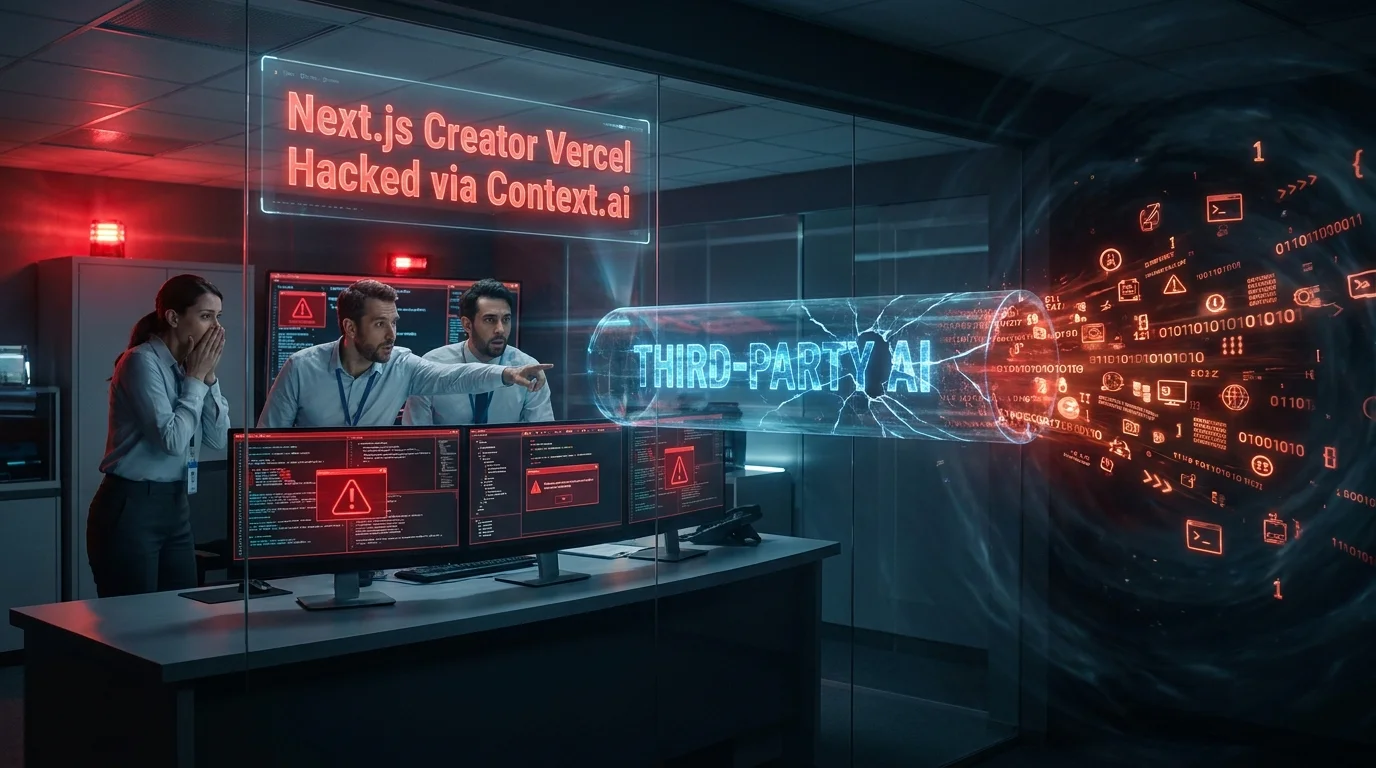
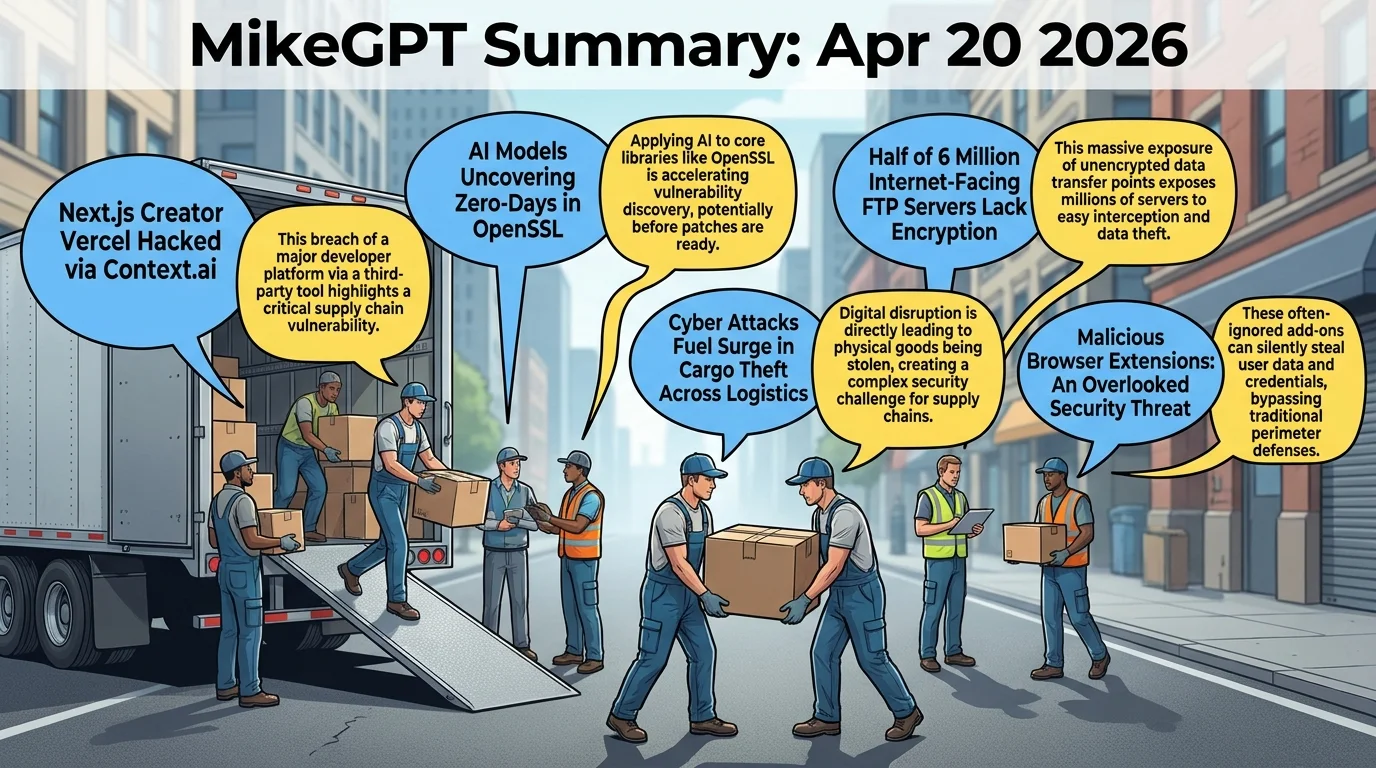
Next.js Creator Vercel Hacked via Context.ai

    Vercel has confirmed a major security breach involving their third-party AI platform, Context.ai, which led to the threat actor ShinyHunters attempting to sell the stolen data for $2 million. Vercel's CEO Guillermo Rauch has publicly detailed the attack chain, highlighting the severe risks of third-party AI integrations.

    Business Impact

    A breach of this magnitude exposes proprietary code, customer configurations, and potentially sensitive user data, leading to immediate regulatory scrutiny, loss of enterprise trust, and severe financial penalties.

    Recommended Action

    Ask your IT team: Are we utilizing Vercel or Context.ai in our development pipeline, and have we rotated all associated API keys and credentials?

    General Enterprise SecurityWeek ↗
AI Models Uncovering Zero-Days in OpenSSL

    Advanced, unreleased AI models like Anthropic's Claude Mythos (Project Glasswing) and others have reportedly identified up to 12 zero-day vulnerabilities in core infrastructure components like OpenSSL without human intervention. This represents a paradigm shift where AI can autonomously generate exploits for foundational internet security protocols.

    Business Impact

    If threat actors leverage similar AI capabilities before patches are available, organizations face immediate, undefendable exploitation of foundational cryptographic libraries, risking total data compromise and catastrophic operational downtime.

    Recommended Action

    Ask your IT team: Do we have an emergency patching protocol for zero-day vulnerabilities in core libraries like OpenSSL, and is our network segmentation robust enough to contain a breach?

    General Enterprise SharedSecurity ↗

Hackers are actively infiltrating logistics and trucking firms to steal cargo and divert payments. Researchers have observed threat actors targeting these companies to facilitate physical theft, linking cyberattacks directly to organized crime and rising supply chain losses.

Business Impact

Compromised logistics systems lead to direct physical theft of goods, disrupted supply chains, massive financial losses, and breached vendor contracts that can permanently damage business relationships.

Recommended Action

Ask your IT team: Have we audited the cybersecurity posture of our primary logistics and shipping partners recently, and are our payment diversion controls strictly enforced?

General Enterprise Security Affairs ↗

High Severity

Research shows that approximately 3 million internet-facing FTP servers are still running without encryption. The continued use of this half-century-old protocol exposes enterprises to credential harvesting and man-in-the-middle attacks.

Business Impact

Transmitting data over unencrypted channels guarantees that any intercepted proprietary information, customer data, or credentials can be read in plain text, triggering immediate compliance violations (GDPR, HIPAA) and data loss.

Recommended Action

Ask your IT team: Do we have any legacy FTP servers exposed to the internet, and can we mandate SFTP or disable them entirely by the end of the week?

General Enterprise SecurityWeek ↗
Malicious Browser Extensions: An Overlooked Security Threat

    Threat actors are increasingly using malicious browser extensions to bypass traditional security controls and access sensitive Software-as-a-Service (SaaS) application data directly from the user's authenticated session.

    Business Impact

    Compromised extensions can silently siphon corporate data from authenticated SaaS sessions, bypassing multi-factor authentication and leading to silent, prolonged data exfiltration and intellectual property theft.

    Recommended Action

    Ask your IT team: Do we enforce a strict allowlist for browser extensions on all corporate devices, and are we monitoring for unauthorized add-ons?

    General Enterprise Grip Security ↗

Executive Briefing

Compensation vs. Burnout: The New Retention Calculus

High turnover and burnout are reshaping the 2026 cybersecurity landscape. Security leaders are being forced to prioritize compensation adjustments, AI integration to reduce workload, and mental health initiatives to retain top talent amidst an escalating threat environment.

Security Boulevard · 6:51 AM ·

Vendor Spotlight

Digital.ai

Specialization: Application Security and DevSecOps

Why Digital.ai Today: With the emergence of AI-driven exploit generation tools like Anthropic's Claude Mythos, developers are increasingly concerned about desktop and web application security. Digital.ai's application security solutions help defend against these advanced threats by preventing reverse engineering and tampering, making it significantly harder for automated AI models to discover and exploit zero-day vulnerabilities in compiled code.

Key Capability: Application shielding, code obfuscation, and runtime application self-protection (RASP) to defend against reverse engineering and tampering.

Recommended Actions:
1. Navigate to Digital.ai App Security Portal → Protection Blueprints → [Select Application] → Guard Configuration
2. Navigate to Digital.ai App Security Portal → Protection Blueprints → [Select Application] → Environmental Checks
3. Navigate to Digital.ai Threat Analytics Console → Alert Policies → Add Policy

Verification Steps:
- Analyze the protected binary or web bundle using standard reverse engineering tools (e.g., Ghidra, IDA Pro, or browser dev tools)
- Simulate a dynamic attack by attaching a debugger (e.g., x64dbg or Chrome DevTools) to the protected application in a staging environment

Learn More About Digital.ai ↗

Detection & Response

Detection & Response Kit (4 items)

⚠️ Disclaimer: Test all detection logic in non-production environments before deployment.

1. Vendor Platform Configuration - Digital.ai

# Actionable Guidance for Digital.ai # Generated: 2026-04-20 11:01:19 # Step 1: Navigate to Digital.ai App Security Portal → Protection Blueprints → [Select Application] → Guard Configuration # Purpose: Address AI-driven static analysis by enabling advanced Control Flow Obfuscation and String Encryption Guards # Expected: Compiled code structure and literal strings are randomized and encrypted, preventing AI models from mapping application logic, extracting API keys, or identifying vulnerable functions. # Step 2: Navigate to Digital.ai App Security Portal → Protection Blueprints → [Select Application] → Environmental Checks # Purpose: Prevent AI-assisted dynamic analysis and runtime manipulation # Expected: Anti-Debug, Anti-Tamper (Checksum), and Hook Detection Guards are injected into the binary or web bundle, causing the app to safely terminate or report if an automated exploit tool attaches to the process. # Step 3: Navigate to Digital.ai Threat Analytics Console → Alert Policies → Add Policy # Purpose: Detect automated probing and fuzzing attempts typical of AI exploit generation tools # Expected: Real-time alerts are configured for repeated 'Guard Triggered' or 'App Compromise' events originating from the same IP, user session, or device fingerprint. # Verification Steps: # - Analyze the protected binary or web bundle using standard reverse engineering tools (e.g., Ghidra, IDA Pro, or browser dev tools) # Expected: The decompiler fails to reconstruct meaningful control flow, and sensitive strings/API endpoints are completely obfuscated, confirming resilience against static AI ingestion. # - Simulate a dynamic attack by attaching a debugger (e.g., x64dbg or Chrome DevTools) to the protected application in a staging environment # Expected: The application detects the debugger, triggers the configured defensive action (e.g., graceful exit or crash), and successfully logs a threat event in the Threat Analytics Console.

2. YARA Rule for ShinyHunters / Context.ai Breach Artifacts

rule Detect_ShinyHunters_Vercel_Artifacts { meta: description = "Detects artifacts related to the ShinyHunters breach of Vercel and Context.ai" author = "Threat Rundown" date = "2026-04-20" reference = "https://www.securityweek.com/?p=46153" severity = "high" tlp = "white" strings: $s1 = "ShinyHunters" ascii wide nocase $s2 = "Context" ascii wide fullword $s3 = "Lumma" ascii wide nocase condition: any of ($s*) }

3. SIEM Query — Automated Reconnaissance of Security.txt

index=web sourcetype="access_combined" uri_path IN ("/.well-known/security.txt", "/security.txt", "security.txt") | eval risk_score=case( status=200 AND http_user_agent="python-requests*", 100, status=404, 25, 1==1, 50) | stats count by src_ip, uri_path, http_user_agent, risk_score | where risk_score >= 50 AND count > 5 | table src_ip, uri_path, http_user_agent, count, risk_score | sort -risk_score

4. PowerShell Script — Unencrypted FTP Exposure Check

# Checks local network segments for exposed unencrypted FTP services (Port 21) $computers = "localhost", "SERVER01", "FTP-LEGACY-01" foreach ($computer in $computers) { if (Test-Connection -ComputerName $computer -Count 1 -Quiet) { Write-Host "Checking $computer for Port 21 (FTP)..." try { $tcpClient = New-Object System.Net.Sockets.TcpClient $tcpClient.Connect($computer, 21) if ($tcpClient.Connected) { Write-Warning "[!] Unencrypted FTP (Port 21) is OPEN on $computer. Immediate remediation required per FTP encryption threat intelligence." $tcpClient.Close() } } catch { Write-Host "[+] Port 21 is closed or filtered on $computer." } } else { Write-Host "[-] $computer is unreachable." } }

This rundown should provide a solid overview of the current threat landscape. Thank you to all our cyberheroes for your diligence and hard work. Stay vigilant!