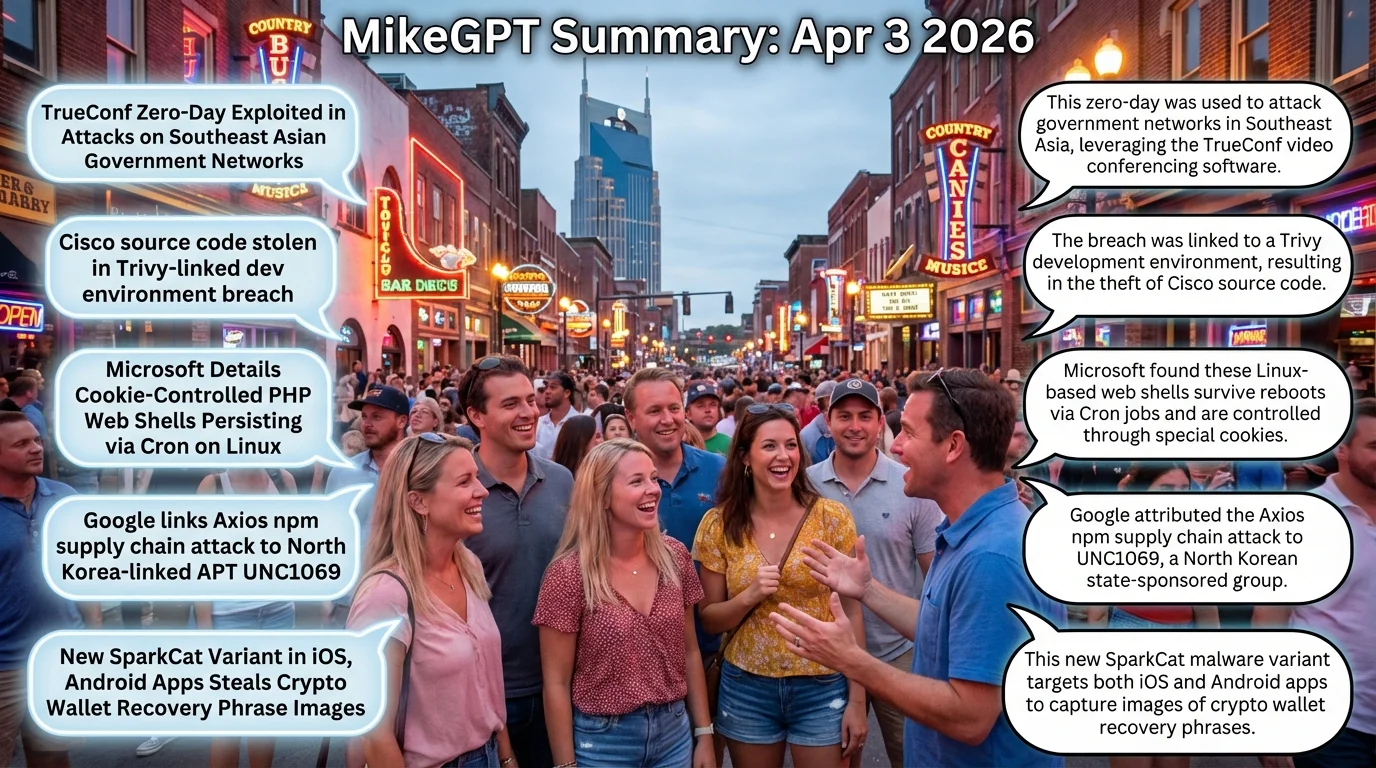
Friday, April 3, 2026

MikeGPT CyberSecurity

“Playbook for the Secure Enterprise”

MikeGPT Daily Threat Rundown

Heroes, your curated look at the current cybersecurity landscape for April 03, 2026.

Critical Threats

TrueConf Zero-Day Exploited in Attacks on Southeast Asian Government Networks

    A high-severity zero-day vulnerability in the TrueConf client video conferencing software is being actively exploited in the wild. Dubbed "TrueChaos," the campaign specifically targets government entities in Southeast Asia by leveraging a lack of integrity checks.

    Business Impact

    If exploited, attackers gain unauthorized access to sensitive internal communications and network infrastructure. This could lead to severe data exfiltration, international regulatory fallout, and complete loss of trust from government partners and clients.

    Recommended Action

    Ask your IT team: Are we utilizing TrueConf software in our environment, and have we applied the latest emergency patches or isolated the application from critical networks?

    CVE-2026-3502 General Enterprise The Hacker News ↗
Cisco source code stolen in Trivy-linked dev environment breach

    Threat actors breached Cisco's internal development environment using credentials stolen during the recent Trivy supply chain attack. The attackers successfully exfiltrated source code belonging to Cisco and its customers.

    Business Impact

    The theft of proprietary source code destroys competitive advantage and provides attackers with blueprints to find future vulnerabilities in your products, exposing both your company and your clients to downstream attacks.

    Recommended Action

    Ask your IT team: Have we rotated all credentials associated with our development environments, particularly those linked to Trivy scanners?

    General Enterprise Lifeboat ↗

Threat actors are utilizing HTTP cookies as a covert control channel for PHP-based web shells on Linux servers. By avoiding URL parameters, attackers achieve remote code execution and establish persistence through cron jobs while evading traditional detection.

Business Impact

Undetected persistent access allows attackers to quietly siphon corporate data, deploy ransomware, or use your infrastructure for further attacks, resulting in massive incident response costs and potential class-action lawsuits.

Recommended Action

Ask your IT team: Are we monitoring Linux server cron jobs for unauthorized modifications, and can our web application firewalls inspect HTTP cookies for malicious payloads?

General Enterprise The Hacker News ↗

Google has attributed the recent malicious modification of the popular Axios HTTP client library for JavaScript to UNC1069, a North Korean advanced persistent threat group. The supply chain attack is financially motivated.

Business Impact

Integrating compromised code into your applications could expose your customers' financial data directly to state-sponsored actors, leading to devastating regulatory fines, loss of intellectual property, and catastrophic brand damage.

Recommended Action

Ask your development team: Have we audited our JavaScript dependencies for compromised versions of the Axios library, and do we have software bill of materials (SBOM) tracking in place?

General Enterprise Security Affairs ↗

High Severity

New SparkCat Variant in iOS, Android Apps Steals Crypto Wallet Recovery Phrase Images

    A new variant of the SparkCat malware has bypassed security checks to enter the Apple App Store and Google Play Store. The trojan specifically targets mobile devices to steal images containing cryptocurrency wallet recovery phrases.

    Business Impact

    If employees use compromised devices, attackers could pivot from personal crypto theft to stealing corporate credentials stored on the device, leading to a broader enterprise breach and compliance violations.

    Recommended Action

    Ask your IT team: Do we enforce mobile device management (MDM) policies that restrict the installation of unapproved applications on devices accessing corporate data?

    General Enterprise The Hacker News ↗
Drift Loses $285 Million in Durable Nonce Social Engineering Attack Linked to DPRK

    The Solana-based decentralized exchange Drift Protocol was drained of $285 million following a novel social engineering attack involving durable nonces. The attack, which occurred on April 1, has been linked to North Korean threat actors.

    Business Impact

    Direct financial theft of this magnitude can bankrupt an organization overnight, trigger immediate regulatory investigations, and permanently destroy investor and customer confidence.

    Recommended Action

    Ask your security team: Are our financial authorization protocols resilient against advanced social engineering, and do we require multi-party computation for large transactions?

    General Enterprise The Hacker News ↗
A laughing RAT: CrystalX combines spyware, stealer, and prankware features

    A new Malware-as-a-Service (MaaS) dubbed CrystalX is being actively promoted in private Telegram chats. The Trojan combines remote access, credential stealing, and prankware capabilities across three subscription tiers.

    Business Impact

    Endpoint compromise via CrystalX can lead to stolen employee credentials and corporate espionage, resulting in intellectual property loss and costly incident response engagements.

    Recommended Action

    Ask your IT team: Do our endpoint detection and response (EDR) tools block unauthorized remote access tools, and are we monitoring Telegram traffic on corporate networks?

    General Enterprise Securelist ↗

Executive Briefing

What CISOs Should Expect from AI Powered MDR in 2026

Rapid7 CEO Corey Thomas highlights that while AI hype outpaces reality in some areas, it is genuinely transforming security operations by improving productivity in software development and automating routine defense tasks. Security leaders must focus on visibility and practical AI applications rather than theoretical capabilities.

Rapid7 Experts on Experts · 1:00 PM ·
A Taxonomy of Cognitive Security

Renowned security expert Bruce Schneier highlights emerging frameworks around cognitive security, cognitive hacking, and "reality pentesting." As social engineering attacks like the $285M Drift Protocol hack become more sophisticated, organizations must expand their threat models to include cognitive manipulation.

Schneier on Security · 9:59 AM ·

Vendor Spotlight

Vendor

AlgoSec (Specialized Vendor)

Specialization: Network Security Policy Management (NSPM)

Why AlgoSec Today: AlgoSec's network security policy management is critical for containing breaches like the Cisco development environment compromise and the TrueConf zero-day. By enforcing strict microsegmentation and validating firewall rules, it prevents attackers from moving laterally across the network once an initial server or application is compromised.

Key Capability: Automated network segmentation and firewall policy enforcement to restrict lateral movement.

Recommended Actions:
1. Navigate to AlgoSec Firewall Analyzer (AFA) → Risks → Risky Rules
2. Navigate to AlgoSec Firewall Analyzer (AFA) → Network Map → Traffic Simulation Query
3. Navigate to AlgoSec FireFlow → New Request → Traffic Change Request

Verification Steps:
- Generate a new AFA Device Report for the firewalls segmenting the vulnerable environment.
- Re-run the AFA Traffic Simulation Query from the vulnerable segment to critical internal zones.

Learn More About AlgoSec ↗

Detection & Response

Detection & Response Kit (4 items)

⚠️ Disclaimer: Test all detection logic in non-production environments before deployment.

1. Vendor Platform Configuration - AlgoSec

# Actionable Guidance for AlgoSec # Generated: 2026-04-03 21:22:51 # Step 1: Navigate to AlgoSec Firewall Analyzer (AFA) → Risks → Risky Rules # Purpose: Identify overly permissive rules (e.g., 'Any' source/destination/service) that could allow lateral movement from compromised development environments or vulnerable applications like TrueConf. # Expected: A prioritized list of high-risk firewall rules across the network fabric that violate least-privilege principles and require immediate tightening. # Step 2: Navigate to AlgoSec Firewall Analyzer (AFA) → Network Map → Traffic Simulation Query # Purpose: Simulate lateral movement paths by querying traffic from the vulnerable application segment (Source) to critical internal networks (Destination) across all ports. # Expected: A visual path analysis showing exactly which firewalls, routers, and specific rules currently permit unauthorized traffic between the compromised segment and critical assets. # Step 3: Navigate to AlgoSec FireFlow → New Request → Traffic Change Request # Purpose: Initiate a zero-trust policy update to drop unauthorized traffic and enforce strict microsegmentation around the affected application servers. # Expected: An automated, risk-analyzed change request that designs and pushes restrictive firewall rules to the relevant enforcement points without breaking legitimate application traffic (AppViz integration). # Verification Steps: # - Generate a new AFA Device Report for the firewalls segmenting the vulnerable environment. # Expected: The previously identified risky rules are marked as removed or modified, and the overall device risk score is measurably reduced. # - Re-run the AFA Traffic Simulation Query from the vulnerable segment to critical internal zones. # Expected: The query result explicitly shows a 'Blocked' status, confirming that lateral movement paths have been successfully severed.

2. YARA Rule for UNC1069 / SparkCat Indicators

rule APT_UNC1069_SparkCat_Campaign_April2026 { meta: description = "Detects artifacts associated with UNC1069 and SparkCat malware variants" author = "Threat Rundown" date = "2026-04-04" reference = "https://thehackernews.com/2026/04/new-sparkcat-variant-in-ios-android.html" severity = "high" tlp = "white" strings: $s1 = "%PROGRAMDATA%\\wt.exe" ascii wide nocase $s2 = "setup.js" ascii wide $s3 = "SparkCat" ascii wide $s4 = "UNC1069" ascii wide $s5 = "WAVESHAPER" ascii wide $s6 = "SILKBELL" ascii wide $s7 = "ZshBucket" ascii wide $h1 = { e1 0b 1f a8 4f 1d 64 81 62 5f 74 1b 69 89 27 80 14 0d 4e 0e 77 69 e7 49 1e 5f 4d 89 4c 2e 0e 09 } // SHA256 representation condition: any of ($s*) or $h1 }

3. SIEM Query — UNC1069 Network & WebShell Activity

index=security sourcetype="pan:traffic" OR sourcetype="suricata" OR sourcetype="f5:bigip:asm" (dest_ip="142.11.206.73" OR uri_path="*/6202033*" OR url="*sfrclak*") | eval risk_score=case( dest_ip=="142.11.206.73", 100, uri_path LIKE "%6202033%", 85, 1==1, 50) | where risk_score >= 50 | table _time, src_ip, dest_ip, uri_path, url, risk_score | sort -_time

4. PowerShell Script — Detect UNC1069 Persistence Mechanism

$computers = "localhost" $maliciousFile = "$env:PROGRAMDATA\wt.exe" $maliciousHash = "e10b1fa84f1d6481625f741b69892780140d4e0e7769e7491e5f4d894c2e0e09" foreach ($computer in $computers) { if (Test-Connection -ComputerName $computer -Count 1 -Quiet) { Write-Host "Checking $computer for UNC1069 artifacts..." if (Test-Path $maliciousFile) { $fileHash = (Get-FileHash $maliciousFile -Algorithm SHA256).Hash if ($fileHash -eq $maliciousHash) { Write-Host "[CRITICAL] Confirmed UNC1069 payload found at $maliciousFile on $computer!" -ForegroundColor Red # Uncomment to auto-quarantine: # Rename-Item -Path $maliciousFile -NewName "$maliciousFile.quarantine" } else { Write-Host "[WARNING] Suspicious file found at $maliciousFile but hash mismatch." -ForegroundColor Yellow } } else { Write-Host "[OK] No artifacts found on $computer." -ForegroundColor Green } } }

This rundown should provide a solid overview of the current threat landscape. Thank you to all our cyberheroes for your diligence and hard work. Stay vigilant!