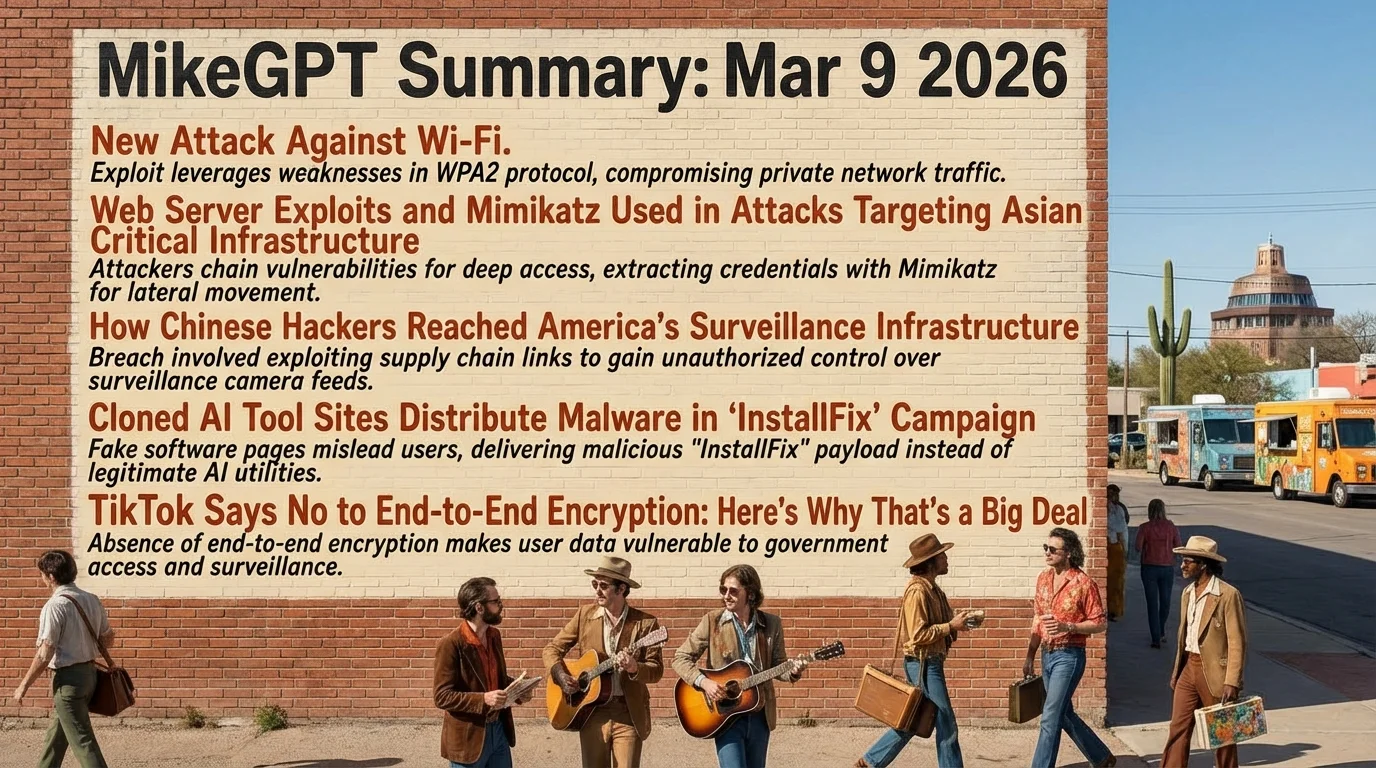
Monday, March 9, 2026

MikeGPT CyberSecurity

“Playbook for the Secure Enterprise”

MikeGPT Daily Threat Rundown

Heroes, your curated look at the current cybersecurity landscape for Mar 09, 2026.

Critical Threats

New Attack Against Wi-Fi

    A novel Wi-Fi attack dubbed "AirSnitch" exploits core features in Layers 1 and 2 of the wireless protocol, specifically targeting the failure to bind and synchronize a client properly. This represents a fundamental flaw in how wireless networks handle client connections.

    Business Impact

    Attackers within physical proximity could intercept sensitive corporate communications, steal intellectual property, and bypass standard network perimeter defenses, leading to compliance breaches and data exposure.

    Recommended Action

    Ask your IT team: "Are we monitoring our corporate wireless networks for Layer 1/2 synchronization anomalies, and do we require VPNs even on internal Wi-Fi?"
    General Enterprise Schneier on Security ↗
Web Server Exploits and Mimikatz Used in Attacks Targeting Asian Critical Infrastructure

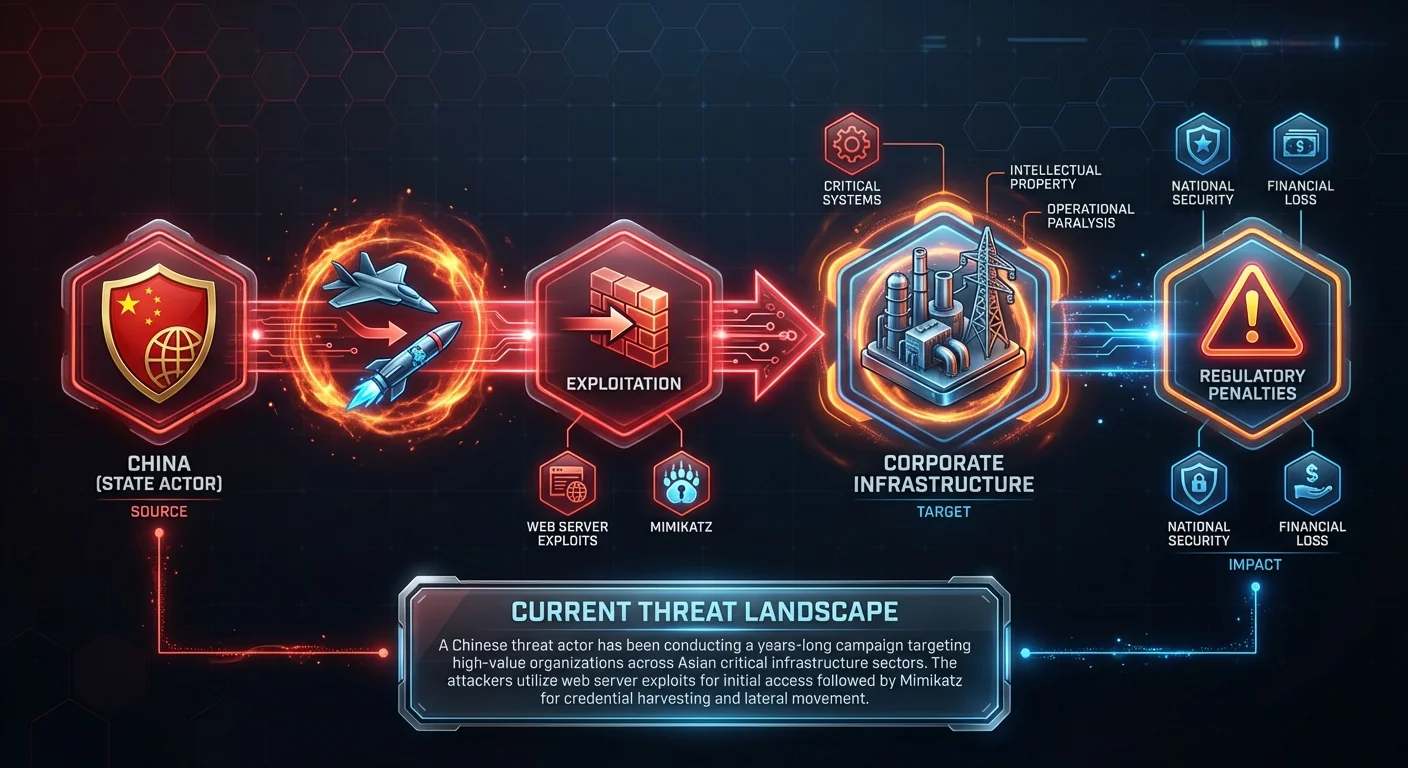
    A Chinese threat actor has been conducting a years-long campaign targeting high-value organizations across Asian critical infrastructure sectors. The attackers utilize web server exploits for initial access followed by Mimikatz for credential harvesting and lateral movement.

    Business Impact

    State-sponsored compromise of critical systems can lead to total loss of intellectual property, prolonged operational paralysis, and severe national security or regulatory repercussions.

    Recommended Action

    Ask your IT team: "Do our endpoint detection tools actively block credential dumping tools like Mimikatz, and are our web servers isolated from core internal networks?"

    General Enterprise The Hacker News ↗

High Severity

​​How Chinese Hackers Reached America’s Surveillance Infrastructure

    Chinese government-linked hackers successfully breached the FBI's Digital Collection System Network (DSCNet), a highly sensitive infrastructure used to manage court-authorized surveillance operations. The intrusion was first detected in mid-February 2026.

    Business Impact

    While primarily a government issue, organizations interacting with law enforcement or handling sensitive federal contracts face immense risk of collateral data exposure, leading to loss of government contracts and severe reputational harm.

    Recommended Action

    Ask your IT team: "Are our networks that interface with federal or law enforcement entities strictly segmented and monitored for advanced persistent threat (APT) activity?"

    General Enterprise Centraleyes ↗
Cloned AI Tool Sites Distribute Malware in ‘InstallFix’ Campaign

    Threat actors are creating cloned webpages of popular AI tools to distribute malware via the "InstallFix" campaign. The malicious sites replace legitimate installation commands with malicious ones to compromise users seeking AI utilities.

    Business Impact

    Employees inadvertently downloading this malware can introduce ransomware or info-stealers into the corporate environment, resulting in costly data breaches, operational downtime, and extortion payments.

    Recommended Action

    Ask your IT team: "Do we have web filtering policies in place to block newly registered or uncategorized domains, specifically those mimicking AI tools?"

    General Enterprise SecurityWeek ↗

TikTok has officially declined to implement end-to-end encryption (E2EE) for direct messages on its platform, citing child safety concerns. This bucks the industry trend and leaves user communications accessible to the platform and potentially third parties.

Business Impact

If employees use TikTok on corporate devices or discuss business matters on the platform, the lack of encryption exposes the company to corporate espionage, data leaks, and violation of privacy regulations.

Recommended Action

Ask your IT team: "Does our Mobile Device Management (MDM) policy prohibit the installation of unencrypted consumer messaging apps on devices handling corporate data?"

General Enterprise Shared Security ↗

Cisco has engineered a bidirectional integration between Cisco XDR and Splunk Enterprise Security. This integration automates escalations and investigation workflows to unify analyst collaboration across platforms.

General Enterprise Cisco Blogs ↗

The rapid pace of SaaS development is pushing organizations to transition from traditional testing methods to AI-powered Quality Assurance. This shift aims to maintain security and functionality amidst increasingly frequent release cycles.

General Enterprise ISHIR ↗
Can the Security Platform Finally Deliver for the Mid-Market?

    Mid-market organizations are facing increased pressure from business partners to meet enterprise-level security standards due to supply chain attack risks. Consolidated security platforms are being evaluated as a potential enabler for these organizations.

    General Enterprise The Hacker News ↗

Other Noteworthy

Cisco has engineered a bidirectional integration between Cisco XDR and Splunk Enterprise Security. This integration automates escalations and investigation workflows to unify analyst collaboration across platforms.

General Enterprise Cisco Blogs ↗

The rapid pace of SaaS development is pushing organizations to transition from traditional testing methods to AI-powered Quality Assurance. This shift aims to maintain security and functionality amidst increasingly frequent release cycles.

General Enterprise ISHIR ↗
Can the Security Platform Finally Deliver for the Mid-Market?

    Mid-market organizations are facing increased pressure from business partners to meet enterprise-level security standards due to supply chain attack risks. Consolidated security platforms are being evaluated as a potential enabler for these organizations.

    General Enterprise The Hacker News ↗

Executive Briefing

Secure agentic AI for your Frontier Transformation

Microsoft has announced Wave 3 of Microsoft 365 Copilot and Microsoft Agent 365, pushing the boundaries of autonomous AI in the enterprise. Security leaders must prepare governance frameworks for these highly privileged, autonomous "agentic" AI systems.

Microsoft Security Blog · 1:00 PM ·
How AI Assistants are Moving the Security Goalposts

The rise of autonomous AI agents with deep access to user computers, files, and online services is fundamentally altering the enterprise threat model. Security teams must adapt to environments where non-human identities possess extensive operational privileges.

KrebsOnSecurity · 11:35 PM ·
112 or 22 to 2: Who Moved the Vulnerability Cheese?

AI code scanning is generating massive volumes of potential vulnerabilities, but the real challenge lies in filtering the noise. The disruption in the vulnerability lifecycle is moving from discovery to the rapid prioritization of truly exploitable flaws.

Security Boulevard · 9:25 AM ·

Vendor Spotlight

Cloudflare

Why Cloudflare Today: Cloudflare's edge security and Zero Trust architecture directly mitigate today's active web application exploits, including the critical React2Shell vulnerability and ongoing mass-scanning campaigns, while shielding vulnerable infrastructure like Cisco SD-WAN management interfaces from public exposure.

Web Server Exploits and Mimikatz Targeting Critical Infrastructure
1. Threat — Nation-state campaigns targeting Asian critical infrastructure using web server exploits for initial access, followed by Mimikatz for credential dumping.
2. Cloudflare Product(s)WAF (Web Application Firewall), Zero Trust (Cloudflare Access)
3. Configuration Guidance — Dashboard → Security → WAF → Managed Rules. Enable the OWASP Core Ruleset to block the initial web server compromise vectors. To prevent lateral movement using stolen credentials, navigate to Dashboard → Zero Trust → Settings → WARP Client → Device posture to enforce endpoint security checks.
4. Coverage AssessmentIntegration-Dependent
5. Integration Note — Cloudflare stops the initial web server exploit at the edge, but post-compromise credential dumping (Mimikatz) and lateral movement require endpoint protection. Integrate CrowdStrike or SentinelOne via the Zero Trust dashboard to enforce strict device posture checks, ensuring compromised endpoints cannot access internal applications even if credentials are stolen.

Detection & Response

Detection & Response Kit (4 items)

⚠️ Disclaimer: Test all detection logic in non-production environments before deployment.

1. Vendor Platform Configuration - Cloudflare

# Cloudflare Configuration Guidance # Generated: 2026-03-09 15:09:53 # Configuration expressions: # WAF/Firewall rule expression: http.request.uri.path contains ".env" or http.request.uri.path contains "wp-config.php" # Dashboard navigation paths: # Dashboard → Security → WAF → Managed Rules. Ensure the "Cloudflare Managed Ruleset" is enabled and set to block high-confidence RCE and injection payloads. For immediate zero-day mitigation before managed rules update, navigate to Dashboard → Security → WAF → Custom Rules → Create rule targeting specific React2Shell payload indicators (verify in current dashboard for specific CVE payload signatures). # Dashboard → Security → WAF → Custom Rules → Create rule: # Dashboard → Security → Bots → Configure Bot Management to block requests with low bot scores by creating a WAF Custom Rule: # Dashboard → Zero Trust → Networks → Tunnels. Route traffic to the Cisco SD-WAN management interfaces through a Cloudflare Tunnel to eliminate inbound public IP exposure. Then, navigate to Dashboard → Zero Trust → Access → Applications to place the management interface behind Cloudflare Access, requiring strong IdP authentication before any network routing to the vulnerable device occurs. # Dashboard → Security → WAF → Managed Rules. Enable the OWASP Core Ruleset to block the initial web server compromise vectors. To prevent lateral movement using stolen credentials, navigate to Dashboard → Zero Trust → Settings → WARP Client → Device posture to enforce endpoint security checks.

2. YARA Rule for AirSnitch & InstallFix Campaign Indicators

rule Detect_AirSnitch_InstallFix_Campaign { meta: description = "Detects artifacts related to the AirSnitch Wi-Fi attack and cloned AI tool malware campaigns" author = "Threat Rundown" date = "2026-03-09" reference = "https://www.schneier.com/blog/archives/2026/03/new-attack-against-wi-fi.html" severity = "medium" tlp = "white" strings: $s1 = "AirSnitch" ascii wide $s2 = "Malware" ascii wide $s3 = "User" ascii wide $h1 = { 4D 5A 90 00 03 00 00 00 04 00 00 00 FF FF 00 00 } condition: any of ($s*) or $h1 }

3. SIEM Query — Cisco SD-WAN Auth Bypass & Mimikatz Execution

index=security sourcetype="cisco:iosxe" OR sourcetype="wineventlog:security" "CVE-2026-20127" OR "auth bypass" OR "mimikatz" | eval risk_score=case( signature=="CVE-2026-20127" AND action=="allowed", 100, process_name=="*mimikatz*", 100, signature=="CVE-2022-22965", 80, 1==1, 25) | where risk_score >= 50 | table _time, src_ip, dest_ip, user, process_name, signature, risk_score | sort -_time

4. PowerShell Script — InstallFix Malware Artifact Discovery

$computers = "localhost", "SERVER01", "WKSTN01" foreach ($computer in $computers) { if (Test-Connection -ComputerName $computer -Count 1 -Quiet) { Write-Host "Checking $computer for InstallFix campaign artifacts..." # Checking common drop locations for cloned AI tool malware $malwarePath = "\\$computer\C$\Users\Public\Downloads\InstallFix.exe" if (Test-Path $malwarePath) { Write-Warning "[!] Malware indicator found on $computer at $malwarePath" # Uncomment to remediate: # Remove-Item -Path $malwarePath -Force } else { Write-Host "[+] Clean: No indicators found on $computer." } } }

This rundown should provide a solid overview of the current threat landscape. Thank you to all our cyberheroes for your diligence and hard work. Stay vigilant!