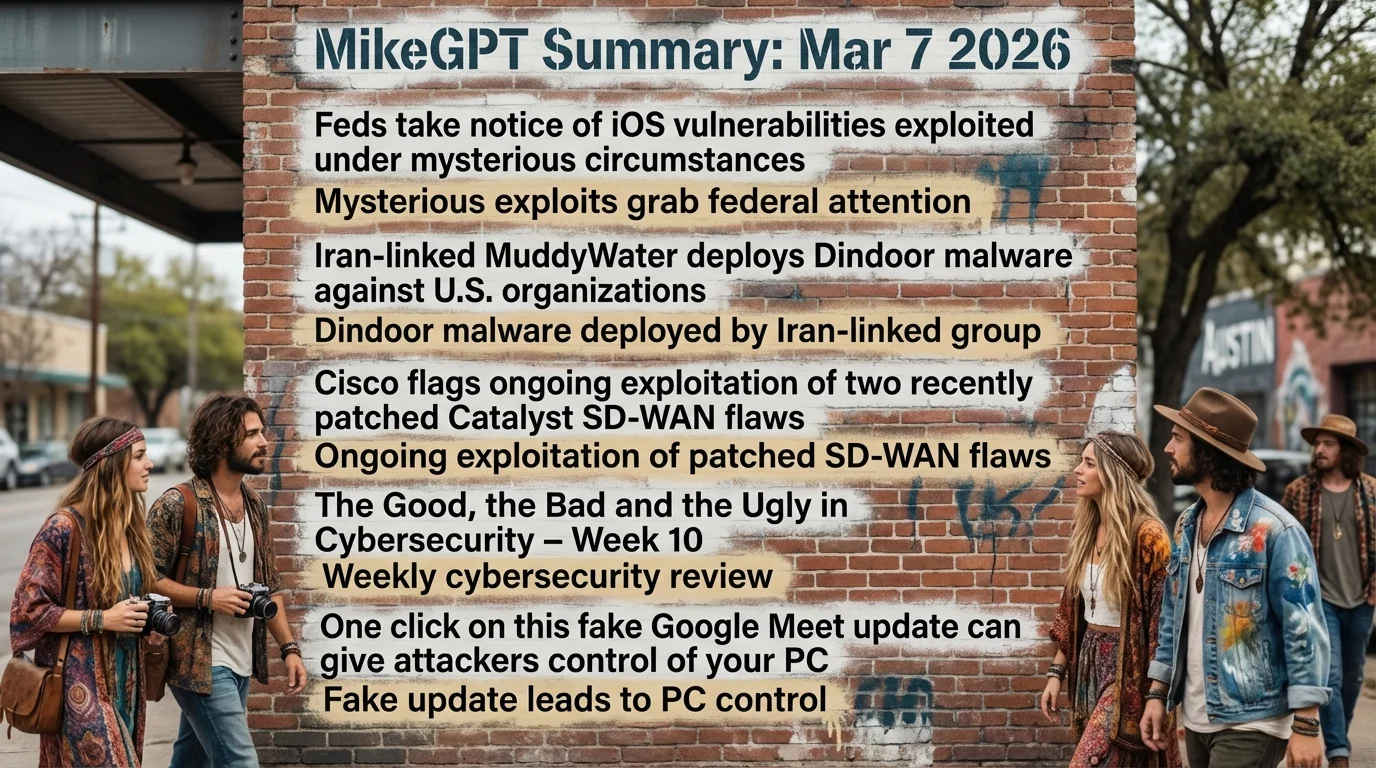
Saturday, March 7, 2026

MikeGPT CyberSecurity

“Playbook for the Secure Enterprise”

MikeGPT Daily Threat Rundown

Heroes, your curated look at the current cybersecurity landscape for Mar 07, 2026.

Critical Threats

Feds take notice of iOS vulnerabilities exploited under mysterious circumstances

    CISA has ordered federal agencies to patch three critical iOS vulnerabilities that were actively exploited over a 10-month span by three distinct hacking groups. These flaws are now part of the Known Exploited Vulnerabilities (KEV) catalog.

    Business Impact

    Unpatched executive and employee mobile devices could be silently compromised, exposing confidential communications, multi-factor authentication tokens, and proprietary business data to nation-state or mercenary actors.

    Recommended Action

    Ask your IT team: Does our Mobile Device Management (MDM) policy enforce immediate updates for iOS devices, and are we blocking non-compliant devices from accessing corporate resources?
    General Enterprise Ars Technica ↗
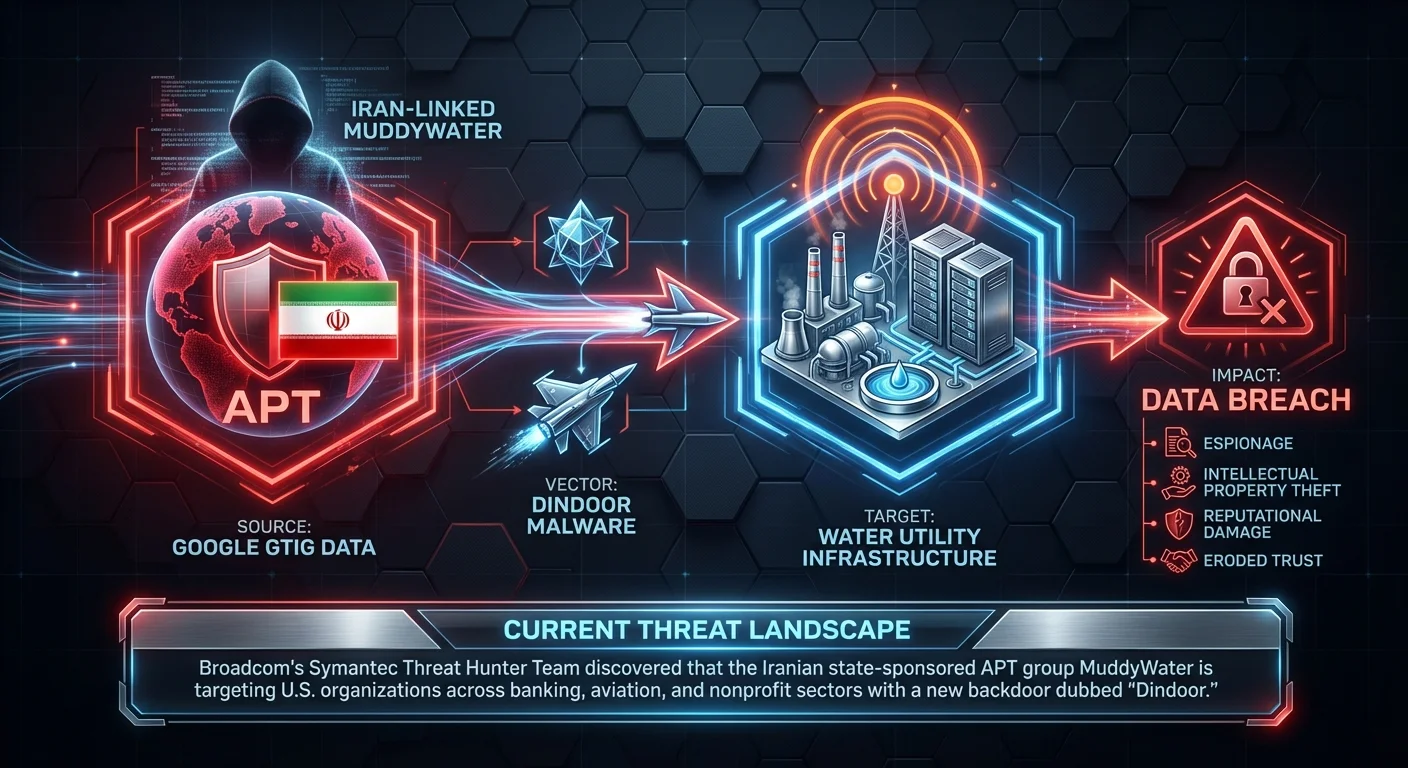
Iran-linked MuddyWater deploys Dindoor malware against U.S. organizations

    Broadcom's Symantec Threat Hunter Team discovered that the Iranian state-sponsored APT group MuddyWater is targeting U.S. organizations across banking, aviation, and nonprofit sectors with a new backdoor dubbed "Dindoor."

    Business Impact

    A successful breach by an advanced persistent threat (APT) can result in long-term espionage, catastrophic intellectual property theft, and severe reputational damage that can erode customer trust and shareholder value.

    Recommended Action

    Ask your IT team: Have we ingested the latest threat intelligence indicators for the Dindoor malware, and are our endpoint detection systems actively hunting for this specific backdoor?

    General Enterprise Security Affairs ↗

Cisco has issued an urgent warning that threat actors are actively exploiting two recently patched vulnerabilities in its Catalyst SD-WAN software. These flaws allow attackers to compromise network infrastructure and potentially intercept or disrupt enterprise traffic.

Business Impact

If exploited, attackers could gain unauthorized control over enterprise wide-area networks, leading to massive operational downtime, interception of sensitive corporate data, and severe regulatory penalties for failing to secure critical infrastructure.

Recommended Action

Ask your IT team: Have we identified all Cisco Catalyst SD-WAN deployments in our environment, and have the emergency patches for these specific vulnerabilities been applied?

Europol has successfully disrupted Tycoon2FA, a major phishing-as-a-service (PhaaS) platform, along with LeakBase and Phobos Ransomware, in a coordinated international law enforcement operation.

Business Impact

While this disruption temporarily reduces the volume of adversary-in-the-middle (AiTM) attacks, businesses remain at high risk for credential theft and subsequent ransomware deployment if they rely on weak authentication methods.

Recommended Action

Ask your IT team: Are we utilizing phishing-resistant Multi-Factor Authentication (MFA), such as FIDO2 security keys, to protect against advanced credential harvesting platforms?

General Enterprise SentinelOne ↗

High Severity

One click on this fake Google Meet update can give attackers control of your PC

    Researchers have identified a deceptive campaign utilizing fake Google Meet updates to trick victims into enrolling their Windows PCs into an attacker-controlled device management system.

    Business Impact

    If an employee falls for this lure, attackers gain administrative control over the endpoint, allowing them to bypass security controls, deploy ransomware, and exfiltrate sensitive corporate data without triggering traditional malware alerts.

    Recommended Action

    Ask your IT team: Are we restricting standard users from enrolling devices into unapproved Mobile Device Management (MDM) systems, and are we filtering deceptive meeting invites at the email gateway?

    General Enterprise Malwarebytes ↗

Google researchers report that commercial spyware vendors have overtaken nation-state actors as the primary exploiters of zero-day vulnerabilities, marking a significant shift in the threat landscape.

Business Impact

The proliferation of commercial spyware means that highly sophisticated, zero-click attacks are now available to a broader range of adversaries, increasing the likelihood of corporate espionage and targeted executive compromises.

Recommended Action

Ask your IT team: Do we have a specialized mobile threat defense strategy in place for our C-suite and high-risk personnel to detect commercial spyware infections?

General Enterprise Security Boulevard ↗

A new analysis of 136 major third-party breaches reveals that the actual "blast radius" impacted approximately 26,000 additional organizations and up to 433 million individuals, far exceeding initial reports.

Business Impact

Unmonitored supply chain vulnerabilities can lead to catastrophic data exposure, resulting in massive class-action lawsuits, regulatory fines, and loss of business continuity even if your internal systems remain secure.

Recommended Action

Ask your IT team: Are we continuously auditing the security posture of our critical third-party vendors, and do we enforce strict least-privilege access for external partners?

General Enterprise Security Boulevard ↗

A roundup of significant security events includes vulnerabilities in Avira antivirus, a massive data breach affecting 10 million Transport for London users, and geopolitical cyber-physical incidents involving hijacked cameras.

Other Noteworthy

A roundup of significant security events includes vulnerabilities in Avira antivirus, a massive data breach affecting 10 million Transport for London users, and geopolitical cyber-physical incidents involving hijacked cameras.

Executive Briefing

Anthropic and the Pentagon

A major shift in defense contracting has occurred, with OpenAI stepping in and Anthropic stepping out as a supplier of AI technology for the US Department of Defense. This highlights the rapidly evolving landscape of AI governance and national security partnerships.

Schneier on Security · 5:07 PM ·
AI as tradecraft: How threat actors operationalize AI

Microsoft Defender researchers have detailed how threat actors are operationalizing AI as an enabler for cyberattacks, including post-compromise misuse and emerging trends in AI-enabled threats.

W3/Microsoft · 5:00 PM ·

Vendor Spotlight

Cloudflare

Why Cloudflare Today: Today's threat landscape highlights a mix of sophisticated phishing campaigns, active exploitation of exposed network infrastructure, and malware delivery targeting endpoints. Cloudflare's Zero Trust, Email Security, and network-layer protections directly mitigate these vectors by intercepting malicious payloads, blocking phishing infrastructure, and cloaking vulnerable management interfaces from the public internet.

Fake Google Meet Update Malware

  1. Threat — Fake Google Meet update enrolling Windows PCs in an attacker's device management (MDM) system.
  2. Cloudflare Product(s)Cloudflare Gateway, Browser Isolation, Email Security (Area 1)
  3. Configuration Guidance
    To block the initial delivery via email: Dashboard → Email Security → Policies → Ensure anti-phishing and malicious attachment policies are set to "Quarantine".
    To block outbound requests to the malicious payload domains: Dashboard → Zero Trust → Gateway → Policies → DNS → Create rule: Security Categories in "Malware", "Phishing" → Action: Block.
    To execute unknown/risky links safely: Dashboard → Zero Trust → Settings → Browser Isolation → Enable isolation for "Security Risks".
  4. Coverage AssessmentIntegration-Dependent
  5. Integration Note — While Cloudflare prevents the delivery and download of the malicious payload, if a user executes the payload via an unmanaged channel (e.g., a personal USB drive), an endpoint integration like CrowdStrike or SentinelOne is required to detect the malicious MDM enrollment process and block execution on the Windows OS.

Cisco Catalyst SD-WAN Active Exploitation (CVE-2026-20128, CVE-2026-20122)

  1. Threat — Active exploitation in the wild of Cisco Catalyst SD-WAN flaws (CVE-2026-20128 and CVE-2026-20122).
  2. Cloudflare Product(s)Zero Trust (Cloudflare Access), Cloudflare Tunnel, WAF (Web Application Firewall)
  3. Configuration Guidance
    To remove the SD-WAN management interface from the public internet entirely: Dashboard → Zero Trust → Networks → Tunnels → Create a tunnel to the internal SD-WAN IP. Then, Dashboard → Zero Trust → Access → Applications → Add the SD-WAN interface and require strong identity/MFA for access.
    If the interface must remain public: Dashboard → Security → WAF → Managed Rules → Ensure the "Cloudflare Managed Ruleset" is enabled and set to block to catch emerging exploit payloads.
  4. Coverage AssessmentStrong

Tycoon2FA Phishing-as-a-Service (PhaaS)

  1. Threat — Tycoon2FA Phishing-as-a-Service (PhaaS) campaigns targeting user credentials and bypassing 2FA.
  2. Cloudflare Product(s)Email Security (Area 1), Cloudflare Gateway
  3. Configuration Guidance
    Dashboard → Email Security → Risk Analytics → Verify that proactive threat hunting for newly registered domains and credential harvesting links is active.
    Dashboard → Zero Trust → Gateway → Policies → HTTP → Create rule: URL Category in "Phishing" or Domain is newly registered → Action: Block.
  4. Coverage AssessmentStrong

Detection & Response

Detection & Response Kit (4 items)

⚠️ Disclaimer: Test all detection logic in non-production environments before deployment.

1. Vendor Platform Configuration - Cloudflare

# Cloudflare Configuration Guidance # Generated: 2026-03-07 12:01:34 # Configuration expressions: # WAF/Firewall rule expression: ip.dst in {vulnerable_device_subnets} and not ip.src in {trusted_admin_ips} # Dashboard navigation paths: # Dashboard → Email Security → Policies → Ensure anti-phishing and malicious attachment policies are set to "Quarantine". # Dashboard → Zero Trust → Gateway → Policies → DNS → Create rule: # Dashboard → Zero Trust → Settings → Browser Isolation → Enable isolation for "Security Risks". # Dashboard → Zero Trust → Networks → Tunnels → Create a tunnel to the internal SD-WAN IP. Then, Dashboard → Zero Trust → Access → Applications → Add the SD-WAN interface and require strong identity/MFA for access. # Dashboard → Security → WAF → Managed Rules → Ensure the "Cloudflare Managed Ruleset" is enabled and set to block to catch emerging exploit payloads. # Dashboard → Email Security → Risk Analytics → Verify that proactive threat hunting for newly registered domains and credential harvesting links is active. # Dashboard → Zero Trust → Gateway → Policies → HTTP → Create rule: # Dashboard → Magic Firewall → Rules → Create a rule to drop unexpected inbound traffic to the specific ports used by the vulnerable IoT/OT devices. Example expression:

2. YARA Rule for Fake Google Meet Update Lure

rule APT_Fake_Google_Meet_Lure_March2026 { meta: description = "Detects artifacts associated with the fake Google Meet update campaign enrolling devices into rogue MDM" author = "Threat Rundown" date = "2026-03-06" reference = "https://www.malwarebytes.com/blog/threat-intel/2026/03/one-click-on-this-fake-google-meet-update-can-give-attackers-control-of-your-pc" severity = "high" tlp = "white" strings: // Extracted Threat Indicators $ext1 = "Malware" ascii wide nocase $ext2 = "User" ascii wide nocase // Campaign specific indicators $s1 = "GoogleMeetUpdate.exe" ascii wide nocase $s2 = "EnrollmentService" ascii wide $s3 = "MDMEnrollment" ascii wide $s4 = "fake-meet-update" ascii wide $h1 = { 4D 5A 90 00 03 00 00 00 } // MZ header condition: $h1 and (any of ($s*) or all of ($ext*)) }

3. SIEM Query — Rogue MDM Enrollment Detection

index=windows sourcetype="WinEventLog:Microsoft-Windows-DeviceManagement-Enterprise-Diagnostics-Provider/Admin" EventCode=75 OR EventCode=76 OR EventCode=11 | eval risk_score=case( match(Message, "(?i)MDM.*Enrollment.*Successful"), 100, match(Message, "(?i)fake.*meet"), 100, 1==1, 25) | search risk_score >= 100 | lookup approved_mdm_servers mdm_url OUTPUT is_approved | where isnull(is_approved) OR is_approved="false" | table _time, ComputerName, User, Message, risk_score | sort -_time

4. PowerShell Script — Audit Windows MDM Enrollment Status

# Checks endpoints for unauthorized MDM enrollments $computers = "localhost" $approvedMDM = "YourCorporateMDMServer" foreach ($computer in $computers) { if (Test-Connection -ComputerName $computer -Count 1 -Quiet) { Write-Host "Checking MDM Enrollment on $computer..." -ForegroundColor Cyan $mdmPath = "HKLM:\SOFTWARE\Microsoft\Enrollments" if (Test-Path $mdmPath) { $enrollments = Get-ChildItem -Path $mdmPath | Where-Object { $_.Property -contains "DiscoveryServiceFullURL" } foreach ($enrollment in $enrollments) { $url = (Get-ItemProperty -Path $enrollment.PSPath -Name "DiscoveryServiceFullURL").DiscoveryServiceFullURL if ($url -notmatch $approvedMDM) { Write-Host "[!] WARNING: Unauthorized MDM Enrollment found: $url" -ForegroundColor Red Write-Host "Registry Key: $($enrollment.PSPath)" -ForegroundColor Yellow } else { Write-Host "[+] Approved MDM found: $url" -ForegroundColor Green } } } else { Write-Host "No MDM enrollments found on $computer." } } }

This rundown should provide a solid overview of the current threat landscape. Thank you to all our cyberheroes for your diligence and hard work. Stay vigilant!