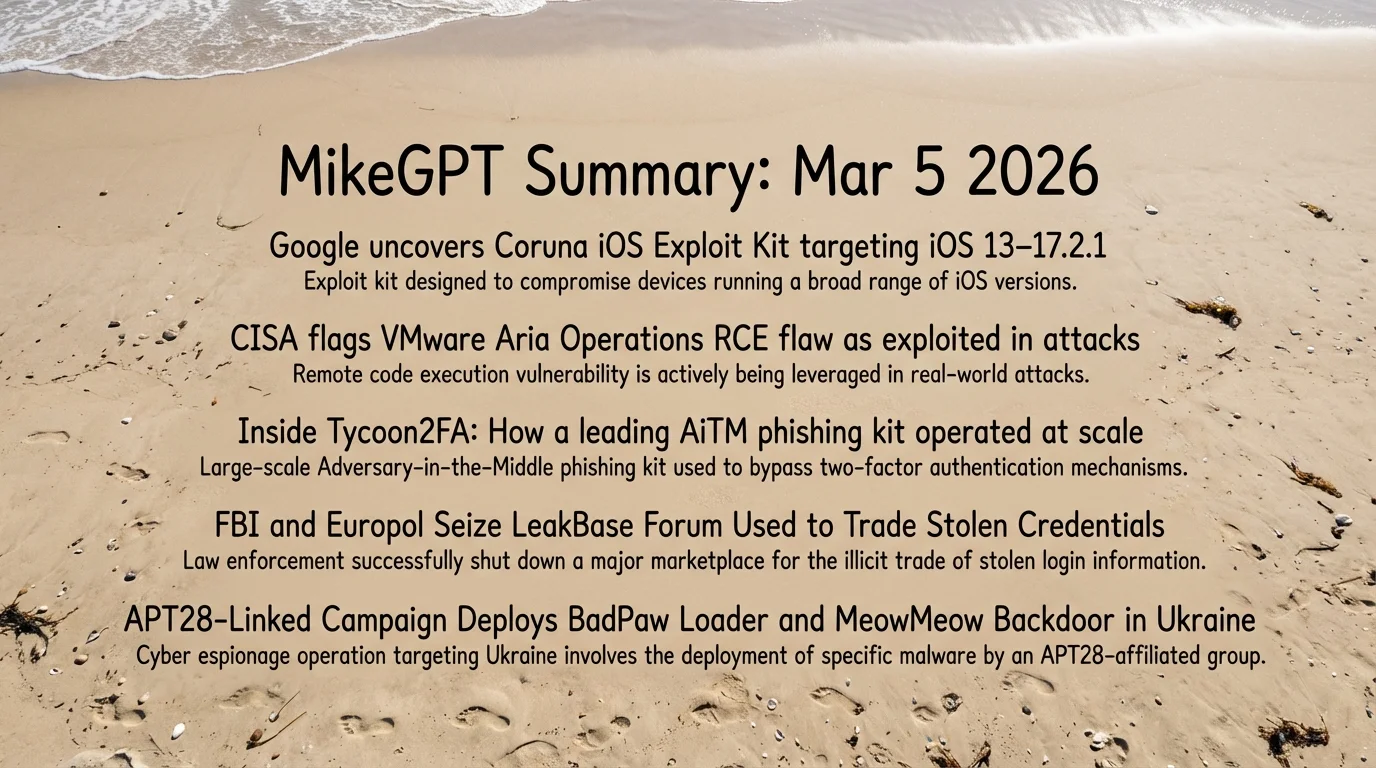
Heroes, your curated look at the current cybersecurity landscape for Mar 05, 2026.
Critical Threats

Google's Threat Intelligence Group has discovered the Coruna iOS exploit kit, which utilizes 23 distinct exploits across five chains to compromise iPhones running iOS 13 through 17.2.1. This highly sophisticated framework allows attackers to gain deep system access on targeted mobile devices.
Business Impact
Compromised mobile devices bypass corporate Mobile Device Management (MDM) controls, leading to unauthorized access to executive communications, multi-factor authentication tokens, and sensitive company data. This exposes the business to severe data breaches, loss of intellectual property, and regulatory penalties.
Recommended Action
Ask your IT team: Have we enforced a minimum OS version of iOS 17.3 or higher for all corporate-connected mobile devices, and are we actively blocking non-compliant devices from accessing company resources?

The U.S. Cybersecurity and Infrastructure Security Agency (CISA) has added a critical remote code execution vulnerability in VMware Aria Operations to its Known Exploited Vulnerabilities catalog. Active exploitation of this flaw allows attackers to execute arbitrary commands on virtualization management infrastructure.
Business Impact
Exploitation allows attackers to seize control of the virtualization management layer, potentially leading to full data center compromise, catastrophic operational downtime, and massive data exfiltration. The resulting business interruption could halt core operations and trigger significant financial losses.
Recommended Action
Ask your IT team: Have we applied the latest security patches to all VMware Aria Operations instances, and are these management interfaces strictly isolated from the public internet?
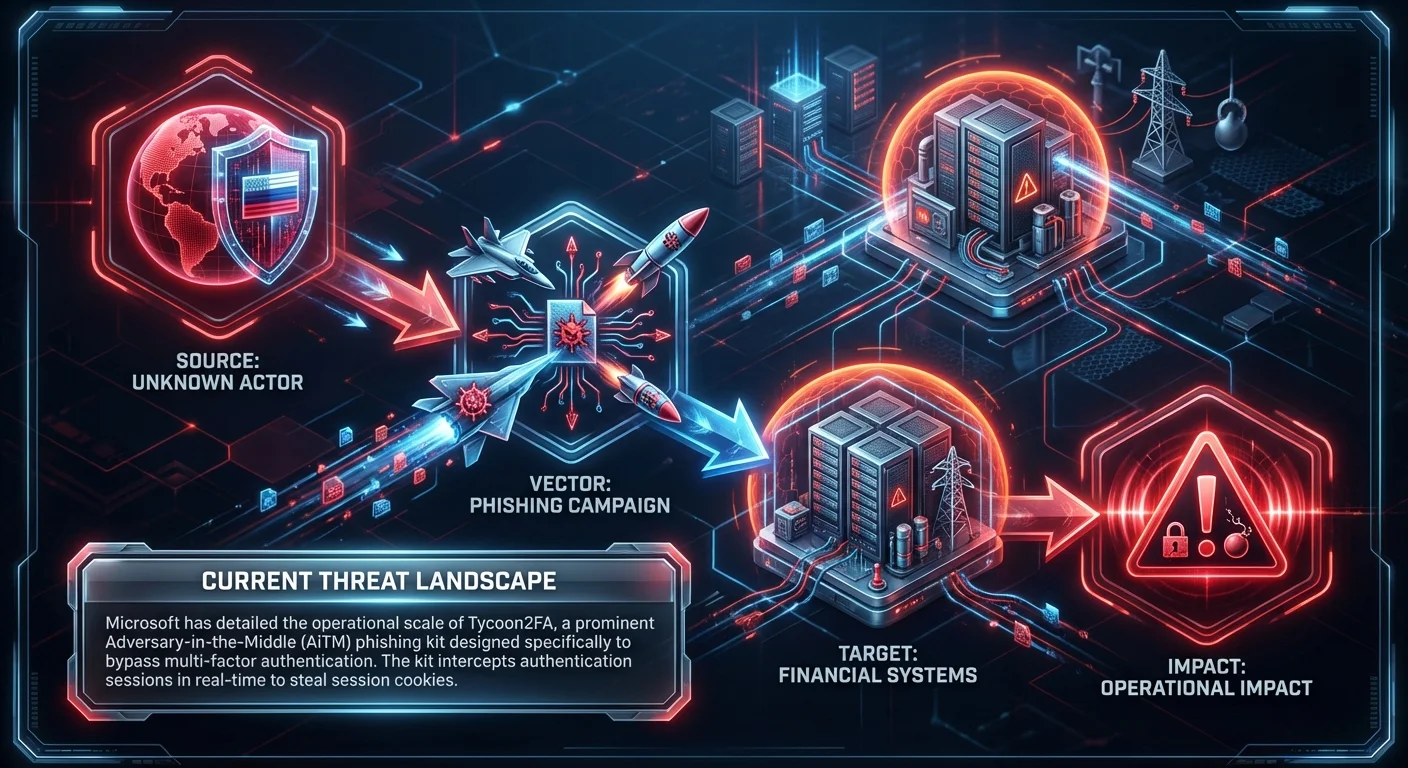
Microsoft has detailed the operational scale of Tycoon2FA, a prominent Adversary-in-the-Middle (AiTM) phishing kit designed specifically to bypass multi-factor authentication. The kit intercepts authentication sessions in real-time to steal session cookies.
Business Impact
Successful AiTM attacks defeat standard MFA protections, allowing attackers to hijack employee sessions, access corporate email, and authorize fraudulent financial transactions. This leads to direct monetary loss, business email compromise (BEC), and potential supply chain fraud.
Recommended Action
Ask your IT team: Are we utilizing FIDO2-compliant hardware keys or phishing-resistant MFA for our most privileged users and executives?

A joint law enforcement operation has dismantled LeakBase, a massive cybercrime forum with over 142,000 members used for trading stolen credentials and cybercrime tools. The seizure disrupts a major hub for initial access brokers and data extortionists.
Business Impact
While a win for law enforcement, the disruption of this marketplace may cause threat actors to aggressively monetize existing stolen corporate credentials before they lose value, temporarily spiking credential stuffing attacks against enterprise portals and customer accounts.
Recommended Action
Ask your IT team: Have we forced a password reset for any corporate accounts identified in recent third-party data breaches, and is our dark web monitoring actively looking for our domains?
High Severity
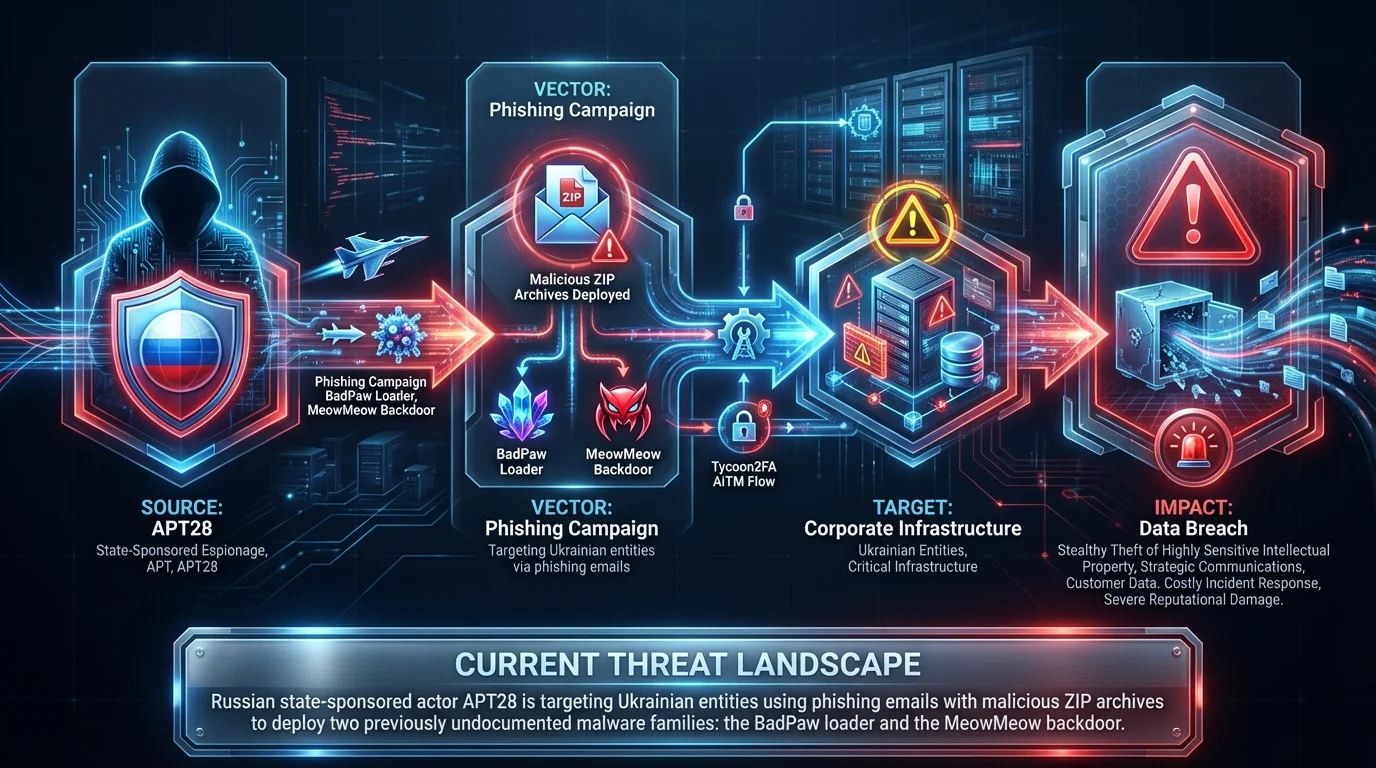
Russian state-sponsored actor APT28 is targeting Ukrainian entities using phishing emails with malicious ZIP archives to deploy two previously undocumented malware families: the BadPaw loader and the MeowMeow backdoor.
Business Impact
State-sponsored espionage can result in the stealthy theft of highly sensitive intellectual property, strategic communications, and customer data. A successful breach by an advanced persistent threat (APT) often requires costly, months-long incident response engagements and causes severe reputational damage.
Recommended Action
Ask your IT team: Are our email security gateways configured to block or quarantine suspicious ZIP archives from external sources, and do we have endpoint detection rules for the BadPaw and MeowMeow indicators?
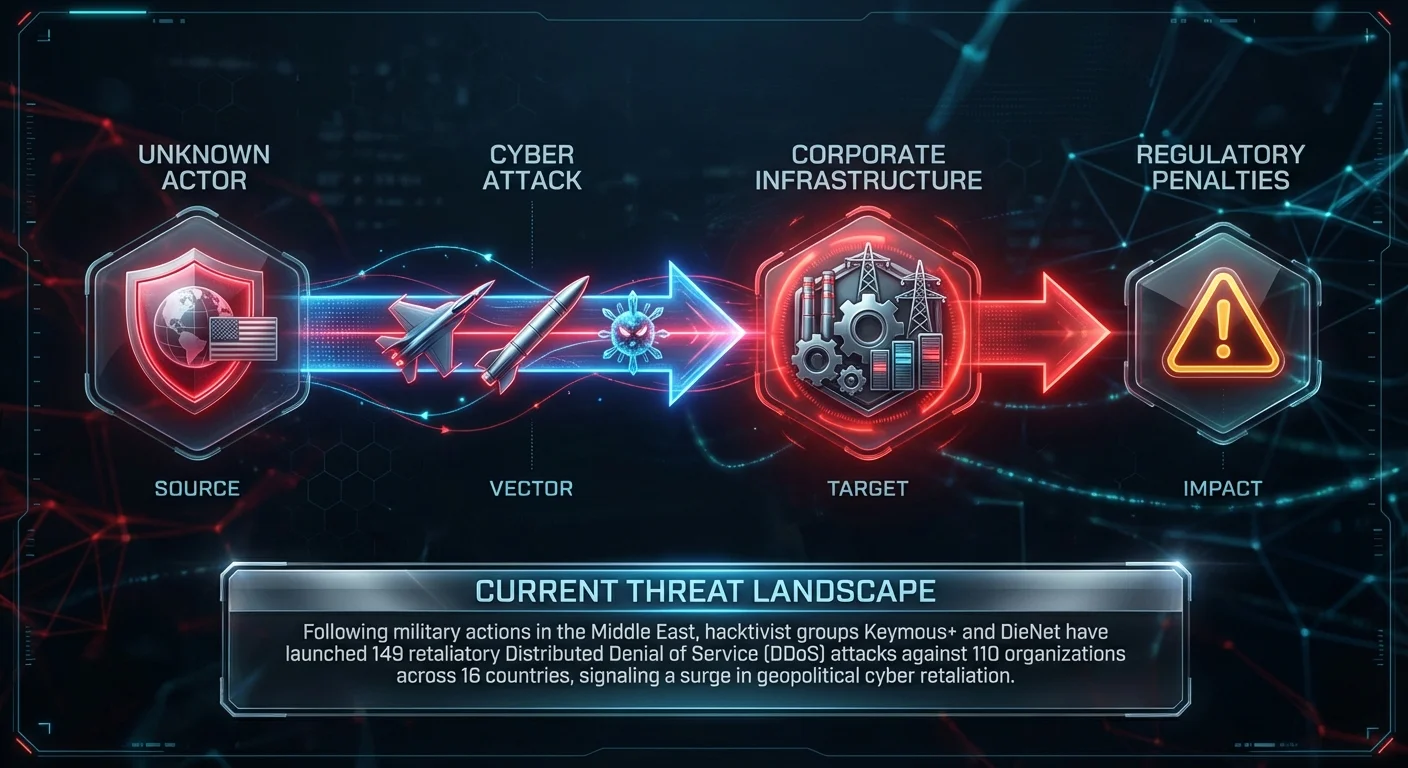
Following military actions in the Middle East, hacktivist groups Keymous+ and DieNet have launched 149 retaliatory Distributed Denial of Service (DDoS) attacks against 110 organizations across 16 countries, signaling a surge in geopolitical cyber retaliation.
Business Impact
Sustained DDoS attacks can take critical customer-facing applications and websites offline. This results in immediate revenue loss, customer frustration, brand degradation, and potential SLA penalties with enterprise clients.
Recommended Action
Ask your IT team: Is our DDoS mitigation service actively monitoring for volumetric attacks, and are our traffic thresholds properly tuned to handle sudden spikes?
Other Noteworthy
Executive Briefing
Following kinetic warfare in the Middle East, cybersecurity experts are warning organizations to brace for Iranian digital counterstrikes. Iran possesses formidable offensive cyber capabilities and is expected to target critical infrastructure and enterprise networks globally in retaliation.
The rise of Agentic AI—systems capable of autonomous decision-making—poses new governance and security challenges. Organizations must evaluate whether they have the right structural and technical support systems to manage the risks associated with autonomous AI agents interacting with corporate data.
As machine-to-machine interactions increase, Non-Human Identities (NHIs) such as API keys, service accounts, and AI agents have become a critical focus for cybersecurity. Securing these identities is paramount to preventing automated, large-scale breaches.
Security teams are struggling to lower their Mean Time to Remediate (MTTR) despite new tools. Strategic implementation of both automation (for repetitive tasks) and orchestration (for complex workflows) is required to effectively reduce organizational risk.
A 2026 market intelligence study reveals that 84% of enterprise security programs are falling behind in implementing Continuous Threat Exposure Management (CTEM). This divide highlights a critical gap between identifying vulnerabilities and effectively managing overall exposure.
Vendor Spotlight
Why Cloudflare Today: Cloudflare’s edge compute and Zero Trust architecture directly neutralizes today's most critical attack vectors, specifically targeting active remote code execution exploits, advanced Adversary-in-the-Middle (AiTM) phishing campaigns, and the automated weaponization of leaked credentials.
VMware Aria Operations RCE (CVE-2026–22719)
- Threat — CISA flagged VMware Aria Operations Remote Code Execution (RCE) flaw (CVE-2026–22719) as actively exploited in the wild.
- Cloudflare Product(s) — WAF (Web Application Firewall), Cloudflare Tunnel
- Configuration Guidance — To patch virtually: Dashboard → Security → WAF → Managed Rules. Ensure the "Cloudflare Managed Ruleset" is enabled and set to "Block" for high-severity RCE signatures.To eliminate the attack surface: Dashboard → Zero Trust → Networks → Tunnels. Route Aria Operations traffic through a secure tunnel to remove the administrative interface from the public internet entirely.
- Coverage Assessment — Strong
Tycoon2FA AiTM Phishing Kit
- Threat — Tycoon2FA Adversary-in-the-Middle (AiTM) phishing kit operating at scale to bypass standard MFA.
- Cloudflare Product(s) — Email Security (Area 1), Zero Trust (Cloudflare Access)
- Configuration Guidance — To block delivery: Dashboard → Email Security → Policies. Ensure anti-phishing and malicious link isolation are enforced.To defeat AiTM MFA bypass: Dashboard → Zero Trust → Access → Applications → [Select App] → Policies. Create a rule requiring hardware keys (which are cryptographically tied to the origin domain and immune to AiTM):
Include: Any Valid Identity,Require: Authentication Method -> WebAuthn. - Coverage Assessment — Strong
APT28 BadPaw Loader and MeowMeow Backdoor
- Threat — APT28 campaign targeting entities with BadPaw Loader and MeowMeow Backdoor via ZIP archive phishing emails.
- Cloudflare Product(s) — Email Security (Area 1), Cloudflare Gateway
- Configuration Guidance — To block the initial vector: Dashboard → Email Security → Settings → Malicious Attachments. Set action to "Quarantine" for suspicious ZIP archives.To sever Command & Control (C2): Dashboard → Zero Trust → Gateway → Firewall Policies → DNS. Create rule:
Security Categories in {Malware, Command & Control, Phishing} -> Block. - Coverage Assessment — Integration-Dependent
- Integration Note — Cloudflare effectively blocks the initial email delivery and outbound C2 callbacks. However, if a user manually transfers the ZIP via USB or an unmonitored channel, on-device execution of the BadPaw loader requires an EDR/XDR partner like CrowdStrike or SentinelOne for endpoint quarantine.
LeakBase Stolen Credentials Weaponization
- Threat — The seizure of the LeakBase forum highlights the massive volume of stolen credentials in circulation, which attackers use for automated credential stuffing and account takeover.
- Cloudflare Product(s) — Bot Management, WAF (Web Application Firewall)
- Configuration Guidance — To detect compromised passwords: Dashboard → Security → WAF → Custom Rules. Create a rule for your authentication endpoints:
http.request.uri.path contains "/login"and toggle on "Check exposed credentials".To stop automated stuffing: Dashboard → Security → Bots. Configure the action for "Definite Bot" (score < 30) to "Block" or "Managed Challenge". - Coverage Assessment — Strong