Wednesday, March 4, 2026

MikeGPT CyberSecurity

“Playbook for the Secure Enterprise”

MikeGPT Daily Threat Rundown

Heroes, your curated look at the current cybersecurity landscape for Mar 04, 2026.

Critical Threats

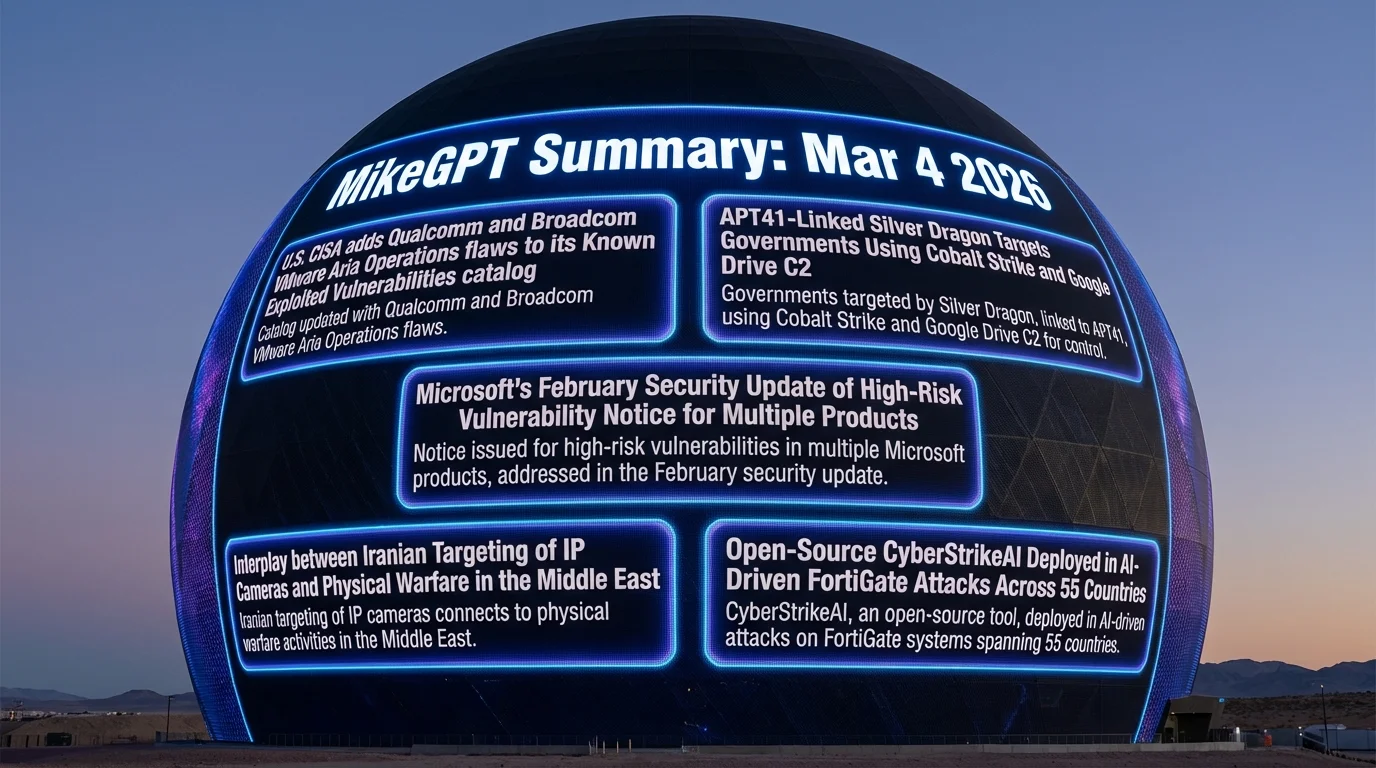
The Cybersecurity and Infrastructure Security Agency (CISA) has added vulnerabilities affecting Qualcomm chipsets and Broadcom's VMware Aria Operations to its Known Exploited Vulnerabilities (KEV) catalog, indicating active in-the-wild exploitation.

Business Impact

Unpatched systems listed in the KEV catalog are actively being targeted by threat actors, which could lead to complete system compromise, operational downtime, and regulatory penalties for non-compliance with federal patching directives.

Recommended Action

Ask your IT team: Have we identified all instances of VMware Aria Operations and Qualcomm chipsets in our environment, and are they patched to the latest vendor-approved versions?

General Enterprise Security Affairs ↗

The advanced persistent threat group Silver Dragon, linked to the Chinese state-sponsored APT41, is targeting government entities in Europe and Southeast Asia using Cobalt Strike and leveraging Google Drive for command and control (C2) communications.

Business Impact

Nation-state espionage campaigns can result in the theft of highly sensitive intellectual property, state secrets, and citizen data, leading to severe reputational damage, loss of competitive advantage, and national security implications.

Recommended Action

Ask your IT team: Are we monitoring outbound network traffic to Google Drive for anomalous data exfiltration patterns, and do we have robust endpoint detection for Cobalt Strike payloads?

General Enterprise The Hacker News ↗

Microsoft has released its February security update addressing 59 vulnerabilities across core products including Windows, Azure, Microsoft Office, and Visual Studio Code, fixing critical privilege escalation and remote code execution flaws.

Business Impact

Exploitation of these core infrastructure vulnerabilities could allow attackers to seize control of enterprise networks, resulting in massive data breaches, ransomware deployment, and extended business interruption.

Recommended Action

Ask your IT team: Has the February Microsoft patch rollout been completed across all endpoints and servers, particularly for internet-facing Azure and Windows assets?

General Enterprise NSFOCUS ↗

Iranian threat actors have intensified their targeting of IP cameras from two specific manufacturers, correlating cyber operations directly with ongoing physical conflicts in the Middle East.

Business Impact

Compromised physical security systems can lead to unauthorized surveillance of corporate facilities, physical breaches, and severe safety risks to personnel, potentially resulting in liability lawsuits and operational shutdowns.

Recommended Action

Ask your IT team: Are our physical security IP cameras segmented from the main corporate network, and have all default credentials been changed?

General Enterprise Check Point Research ↗

An unauthenticated remote code execution vulnerability exists in LangChain LangGraph due to untrusted data deserialization, carrying a high CVSS score of 8.1.

Business Impact

Attackers could execute arbitrary code on AI infrastructure, potentially poisoning AI models, stealing proprietary algorithms, and accessing backend databases, leading to intellectual property loss and regulatory fines.

Recommended Action

Ask your IT team: Are we utilizing LangChain LangGraph in our AI development pipeline, and has the patch for CVE-2026-27794 been applied?

An authenticated Server-Side Request Forgery (SSRF) vulnerability in Trend Micro Apex Central allows remote attackers to disclose sensitive information from the security management server.

Business Impact

Information disclosure from a core security platform could give attackers the blueprints to bypass enterprise defenses, leading to subsequent network-wide compromise and massive data theft.

Recommended Action

Ask your IT team: Have we updated our Trend Micro Apex Central servers to remediate CVE-2025-71207 to prevent unauthorized information disclosure?

An unauthenticated authentication bypass vulnerability in HPE AutoPass License Server allows remote attackers to compromise the system, carrying a CVSS score of 7.3.

Business Impact

Unauthorized access to license servers can disrupt enterprise software operations, causing widespread application failures, productivity losses, and potential breach of software compliance agreements.

Recommended Action

Ask your IT team: Is our HPE AutoPass License Server exposed to the internet, and has CVE-2026-2360 been patched?

Threat actors are using an open-source AI security testing platform called CyberStrikeAI to automate attacks against Fortinet FortiGate appliances across 55 countries.

Business Impact

Automated AI-driven attacks against perimeter firewalls drastically increase the likelihood of a successful breach, potentially leading to ransomware deployment, massive data theft, and millions in recovery costs.

Recommended Action

Ask your IT team: Are our FortiGate appliances running the latest firmware, and are we monitoring for automated AI-driven attack patterns at the perimeter?

General Enterprise The Hacker News ↗

AWS has issued the PiTuKri Type II attestation report covering 183 services, verifying information security compliance for cloud services according to the Finnish Transport and Communications Agency.

Business Impact

Maintaining compliance with international cloud security standards ensures that enterprise data hosted in AWS meets strict regulatory requirements, avoiding compliance fines and maintaining customer trust.

Recommended Action

Ask your compliance team: Do we need to download the latest AWS PiTuKri attestation report via AWS Artifact for our upcoming regulatory audits?

General Enterprise AWS Security Blog ↗

Madison Square Garden confirmed a data breach resulting from the 2025 cybercrime campaign targeting Oracle E-Business Suite environments.

Business Impact

Breaches of core ERP systems like Oracle EBS can expose highly sensitive financial and employee data, leading to class-action lawsuits, regulatory fines, and severe brand damage.

Recommended Action

Ask your IT team: Have we audited our Oracle E-Business Suite for indicators of compromise related to the 2025 campaign, and are all external interfaces secured?

General Enterprise Security Affairs ↗

High Severity

Employees are increasingly using unapproved "Shadow AI" tools, creating massive visibility gaps compared to secure, IT-approved "Managed AI" solutions.

Business Impact

Unregulated use of AI tools can lead to accidental exposure of proprietary company data and intellectual property, violating privacy regulations like GDPR and CCPA and risking competitive advantage.

Recommended Action

Ask your IT team: Do we have a Cloud Access Security Broker (CASB) or web gateway policy in place to detect and block unauthorized generative AI applications?

General Enterprise FireTail ↗

Kaspersky has updated its statistical methodology for tracking mobile malware evolution, highlighting shifting trends in malicious mobile applications targeting enterprise users.

Business Impact

Mobile malware can compromise executive communications and bypass multi-factor authentication, leading to unauthorized access to corporate networks and financial theft.

Recommended Action

Ask your IT team: Are all corporate-issued mobile devices enrolled in our Mobile Device Management (MDM) platform with active mobile threat defense enabled?

General Enterprise Securelist ↗

Organizations are struggling with vulnerability overload, prompting a shift toward Continuous Threat Exposure Management (CTEM) and MITRE INFORM to prioritize real-world attacker gaps.

Business Impact

Failing to prioritize vulnerabilities based on actual threat exposure leads to wasted IT resources and leaves the business vulnerable to the most likely avenues of attack, increasing breach probability.

Recommended Action

Ask your IT team: Are we transitioning our vulnerability management program to a risk-based CTEM approach to focus on exploitable gaps rather than just CVSS scores?

General Enterprise AttackIQ ↗

Data Center Infrastructure Management (DCIM) software is evolving with AI-powered predictive maintenance and hybrid cloud management to address strict data sovereignty requirements.

Business Impact

Non-compliance with international data sovereignty laws can result in massive regulatory fines, forced restructuring of global IT operations, and loss of business in key international markets.

Recommended Action

Ask your IT team: Does our current data center infrastructure management strategy account for strict data residency and sovereignty laws in our operating regions?

General Enterprise Hyperview ↗

Fairwinds Insights has expanded its platform to provide deeper visibility into Kubernetes policy posture, Kyverno integration, and GPU-aware metrics to secure containerized environments.

Business Impact

Misconfigured Kubernetes clusters can expose containerized applications to the internet, leading to data breaches and cryptojacking that drives up cloud computing costs exponentially.

Recommended Action

Ask your IT team: Are we utilizing policy-as-code tools like Kyverno to enforce security guardrails in our Kubernetes environments?

General Enterprise Fairwinds ↗

Malicious PHP packages masquerading as Laravel utilities on Packagist are deploying a cross-platform Remote Access Trojan (RAT) across Windows, macOS, and Linux.

Business Impact

Supply chain attacks via malicious developer packages can embed backdoors directly into corporate software products, leading to devastating breaches of both the company and its customers.

Recommended Action

Ask your IT team: Do we have software composition analysis (SCA) tools in place to detect and block malicious open-source packages in our CI/CD pipeline?

General Enterprise The Hacker News ↗

Executive Briefing

The Convergence of Physical and Cyber Warfare

The recent targeting of IP cameras by Iranian threat actors highlights a growing trend where cyber operations are directly supporting physical warfare and espionage. Executives must recognize that IoT and OT devices (like cameras and industrial controls) are no longer just IT problems; they are critical physical security vulnerabilities. The integration of AI in both offensive tools (like CyberStrikeAI targeting FortiGate) and defensive platforms necessitates a modernization of enterprise security architectures to handle high-speed, automated threats that cross the cyber-physical divide.

Check Point Research · ·

Vendor Spotlight

Cloudflare

Why Cloudflare Today: Cloudflare's Zero Trust, WAF, and CASB solutions provide immediate mitigation against today's critical unauthenticated RCE vulnerabilities, authentication bypasses, and the growing visibility gap of Shadow AI data exposure.

Shadow AI (Unapproved AI Tool Usage)

  1. Threat — Shadow AI (Visibility gap of employees using unapproved/unmanaged AI tools)
  2. Cloudflare Product(s)CASB (Cloud Access Security Broker), Cloudflare Gateway
  3. Configuration Guidance
    Dashboard → Zero Trust → CASB → Discover (Review detected shadow AI SaaS usage).
    To block unapproved tools: Dashboard → Zero Trust → Gateway → Policies → HTTP → Create policy:
    Application Category is "Generative AI" AND Application is not [Your Approved AI List] → Action: Block.
  4. Coverage AssessmentStrong

LangChain LangGraph BaseCache Deserialization RCE (CVE-2026-27794)

  1. Threat — LangChain LangGraph BaseCache Deserialization of Untrusted Data Remote Code Execution (CVE-2026-27794)
  2. Cloudflare Product(s)WAF (Web Application Firewall)
  3. Configuration Guidance
    Dashboard → Security → WAF → Managed Rules → Ensure "Cloudflare Managed Ruleset" is enabled and set to Block for high-confidence malicious payloads.
    To virtually patch the specific application path: Dashboard → Security → WAF → Custom Rules → Create rule:
    http.request.uri.path contains "langgraph" AND cf.threat_score > 50 → Action: Block.
  4. Coverage AssessmentStrong

HPE AutoPass License Server Authentication Bypass (CVE-2026-2360)

  1. Threat — Hewlett Packard Enterprise AutoPass License Server Authentication Bypass (CVE-2026-2360)
  2. Cloudflare Product(s)Zero Trust (Cloudflare Access), Cloudflare Tunnel
  3. Configuration Guidance
    Remove the license server from the public internet entirely.
    Dashboard → Zero Trust → Networks → Tunnels → Create a Cloudflare Tunnel to the HPE server.
    Dashboard → Zero Trust → Access → Applications → Add an Application. Enforce a policy requiring strict Identity Provider (IdP) authentication and MFA before any request can reach the vulnerable AutoPass service.
  4. Coverage AssessmentStrong

APT41-Linked Silver Dragon Public-Facing Exploits & C2

  1. Threat — APT41-Linked Silver Dragon (Initial access via public-facing internet exploits and Google Drive C2 infrastructure)
  2. Cloudflare Product(s)WAF (Web Application Firewall), Cloudflare Gateway
  3. Configuration Guidance
    To block outbound C2 beaconing: Dashboard → Zero Trust → Gateway → Policies → DNS → Create policy:
    Security Categories in "Command and Control", "Malware" → Action: Block.
    To block initial access payloads: Dashboard → Security → WAF → Managed Rules → Enable "Cloudflare Managed Ruleset" to drop known exploit frameworks and Cobalt Strike stagers.
  4. Coverage AssessmentModerate
  5. Integration NoteCrowdStrike or SentinelOne is required for endpoint execution detection (EDR) to stop Cobalt Strike processes on the host, while Cloudflare Gateway handles the network-layer C2 blocking.

Detection & Response

Detection & Response Kit (4 items)

⚠️ Disclaimer: Test all detection logic in non-production environments before deployment.

1. Vendor Platform Configuration - Cloudflare

# Cloudflare Configuration Guidance # Generated: 2026-03-04 12:02:06 # Configuration expressions: # WAF/Firewall rule expression: http.request.uri.path contains "langgraph" # Dashboard navigation paths: # Dashboard → Zero Trust → CASB → Discover (Review detected shadow AI SaaS usage). # Dashboard → Zero Trust → Gateway → Policies → HTTP → Create policy: # Dashboard → Security → WAF → Managed Rules → Ensure "Cloudflare Managed Ruleset" is enabled and set to Block for high-confidence malicious payloads. # Dashboard → Security → WAF → Custom Rules → Create rule: # Dashboard → Zero Trust → Networks → Tunnels → Create a **Cloudflare Tunnel** to the HPE server. # Dashboard → Zero Trust → Access → Applications → Add an Application. Enforce a policy requiring strict Identity Provider (IdP) authentication and MFA *before* any request can reach the vulnerable AutoPass service. # Dashboard → Zero Trust → Gateway → Policies → DNS → Create policy: # Dashboard → Security → WAF → Managed Rules → Enable "Cloudflare Managed Ruleset" to drop known exploit frameworks and Cobalt Strike stagers.

2. YARA Rule for APT41 Silver Dragon & General Malware Payloads

rule APT41_SilverDragon_CobaltStrike_Dropper { meta: description = "Detects potential Silver Dragon Cobalt Strike payloads using extracted indicators" author = "Threat Rundown" date = "2026-03-04" reference = "https://thehackernews.com/2026/03/apt41-linked-silver-dragon-targets.html" severity = "high" tlp = "white" strings: $s1 = "Malware" ascii wide nocase $s2 = "User" ascii wide nocase $s3 = "drive.google.com/uc?id=" ascii wide $h1 = { 4D 5A 90 00 03 00 00 00 } condition: $h1 at 0 and any of ($s*) }

3. SIEM Query — Silver Dragon Google Drive C2 Detection

index=security sourcetype="suricata:eve" OR sourcetype="pan:traffic" (dest_domain="drive.google.com" OR url="*drive.google.com/uc?id=*") | eval risk_score=case( app="cobaltstrike", 100, bytes_out > 5000000 AND dest_domain="drive.google.com", 75, 1==1, 25) | where risk_score >= 50 | stats count, sum(bytes_out) as total_bytes_out by _time, src_ip, dest_ip, dest_domain, risk_score | sort -_time

4. PowerShell Script — Malicious Laravel Package Detection

# Detect malicious Laravel packages (nhattuanbl/lara-helper) deploying RATs $computers = "localhost", "SERVER01", "WKSTN01" foreach ($computer in $computers) { if (Test-Connection -ComputerName $computer -Count 1 -Quiet) { Write-Host "Checking $computer for malicious Laravel packages..." # Check for malicious composer packages in default web directories $composerFiles = Invoke-Command -ComputerName $computer -ScriptBlock { Get-ChildItem -Path "C:\inetpub\wwwroot" -Filter "composer.json" -Recurse -ErrorAction SilentlyContinue | Select-String -Pattern "nhattuanbl/lara-helper" } if ($composerFiles) { Write-Host "[!] WARNING: Malicious Laravel package found on $computer" -ForegroundColor Red Write-Host $composerFiles } else { Write-Host "[+] Clean: No indicators found on $computer" -ForegroundColor Green } } }

This rundown should provide a solid overview of the current threat landscape. Thank you to all our cyberheroes for your diligence and hard work. Stay vigilant!