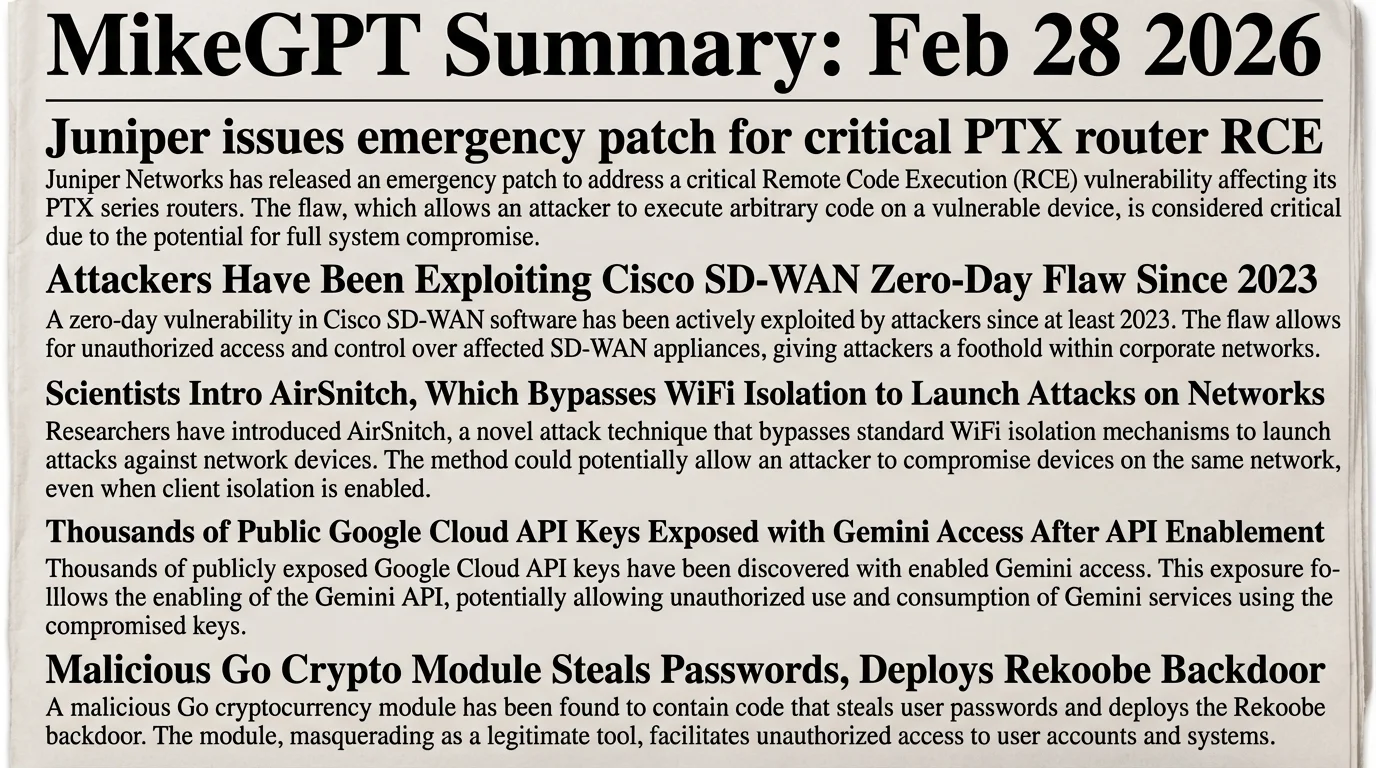
Saturday, February 28, 2026

MikeGPT CyberSecurity

“Playbook for the Secure Enterprise”

MikeGPT Daily Threat Rundown

Heroes, your curated look at the current cybersecurity landscape for Feb 28, 2026.

Critical Threats
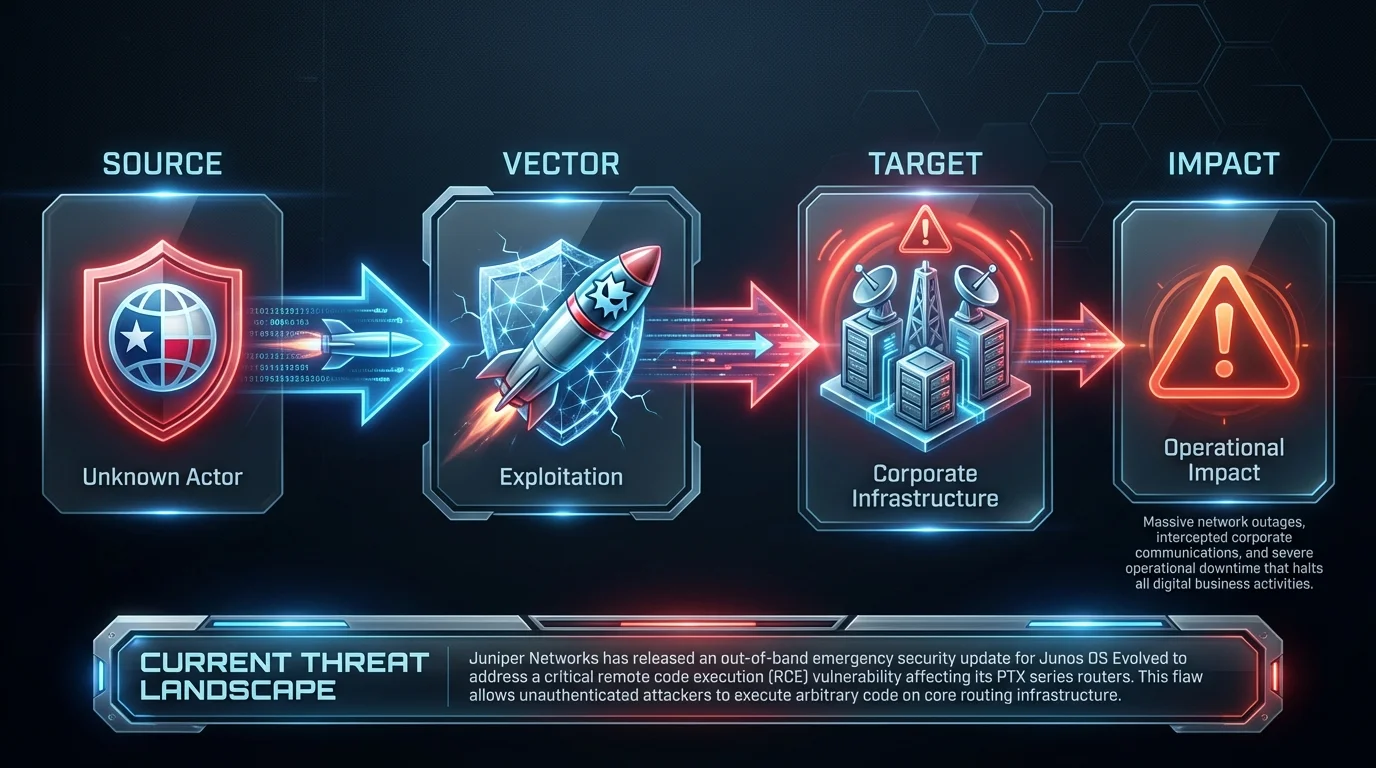
Juniper issues emergency patch for critical PTX router RCE

    Juniper Networks has released an out-of-band emergency security update for Junos OS Evolved to address a critical remote code execution (RCE) vulnerability affecting its PTX series routers. This flaw allows unauthenticated attackers to execute arbitrary code on core routing infrastructure.

    Business Impact

    If exploited, attackers could take full control of core enterprise routing infrastructure, leading to massive network outages, intercepted corporate communications, and severe operational downtime that halts all digital business activities.

    Recommended Action

    Ask your IT team: Have we identified all Juniper PTX routers in our environment, and has the emergency Junos OS Evolved patch been applied immediately?
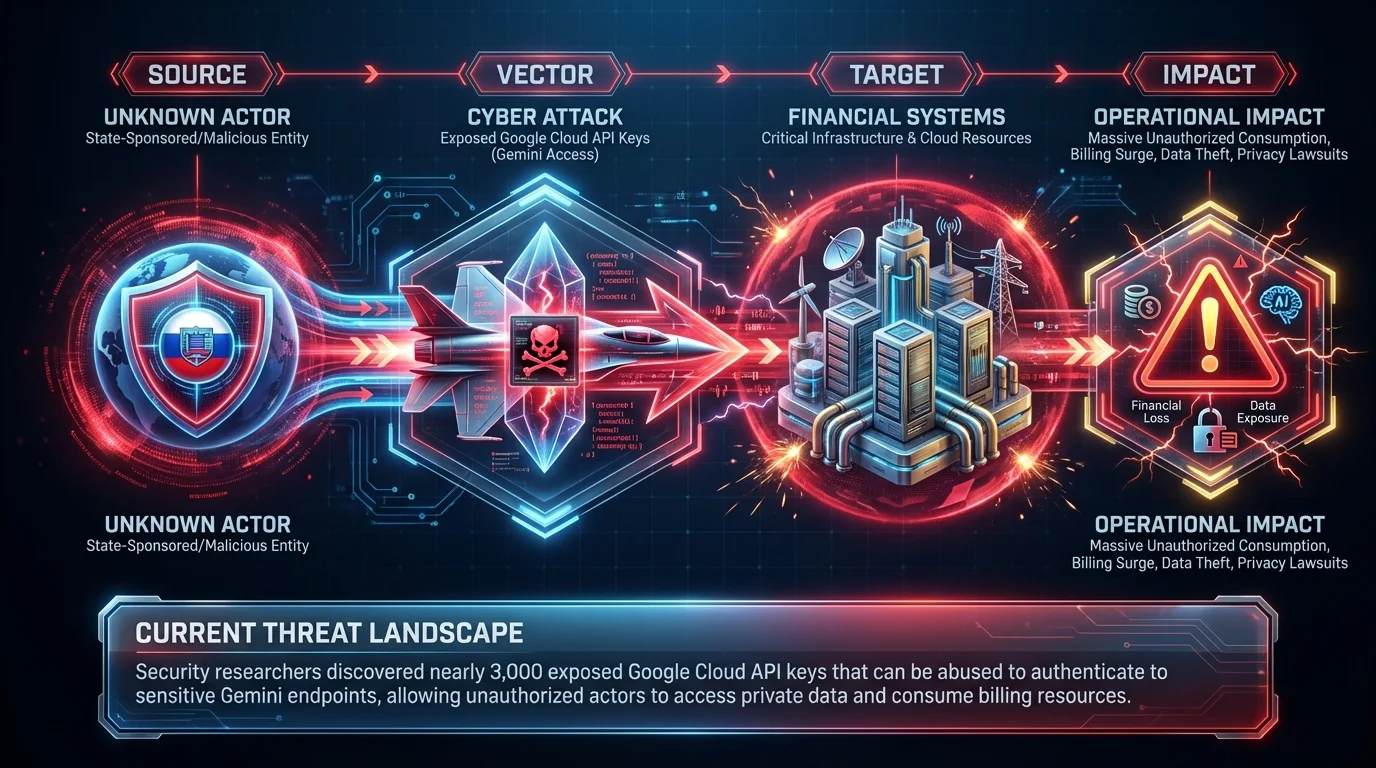
Thousands of Public Google Cloud API Keys Exposed with Gemini Access After API Enablement

    Security researchers discovered nearly 3,000 exposed Google Cloud API keys that can be abused to authenticate to sensitive Gemini endpoints, allowing unauthorized actors to access private data and consume billing resources.

    Business Impact

    Exposed API keys can lead to massive unauthorized cloud consumption bills (financial loss) and the exposure of proprietary AI training data or customer information, triggering privacy lawsuits.

    Recommended Action

    Ask your IT team: Have we scanned our public repositories for hardcoded Google Cloud API keys, and are our active keys properly restricted to specific IP addresses and services?
    General Enterprise The Hacker News ↗

Threat actors have been exploiting a highly sophisticated zero-day vulnerability in Cisco SD-WAN controllers since 2023, allowing them to downgrade device software to vulnerable versions and gain root access.

Business Impact

Compromise of SD-WAN controllers allows attackers to manipulate wide-area network traffic, potentially intercepting sensitive corporate data and causing widespread operational disruption across branch offices.

Recommended Action

Ask your IT team: Have we audited our Cisco SD-WAN controllers for unauthorized software downgrades or indicators of root-level compromise?

General Enterprise Security Boulevard ↗
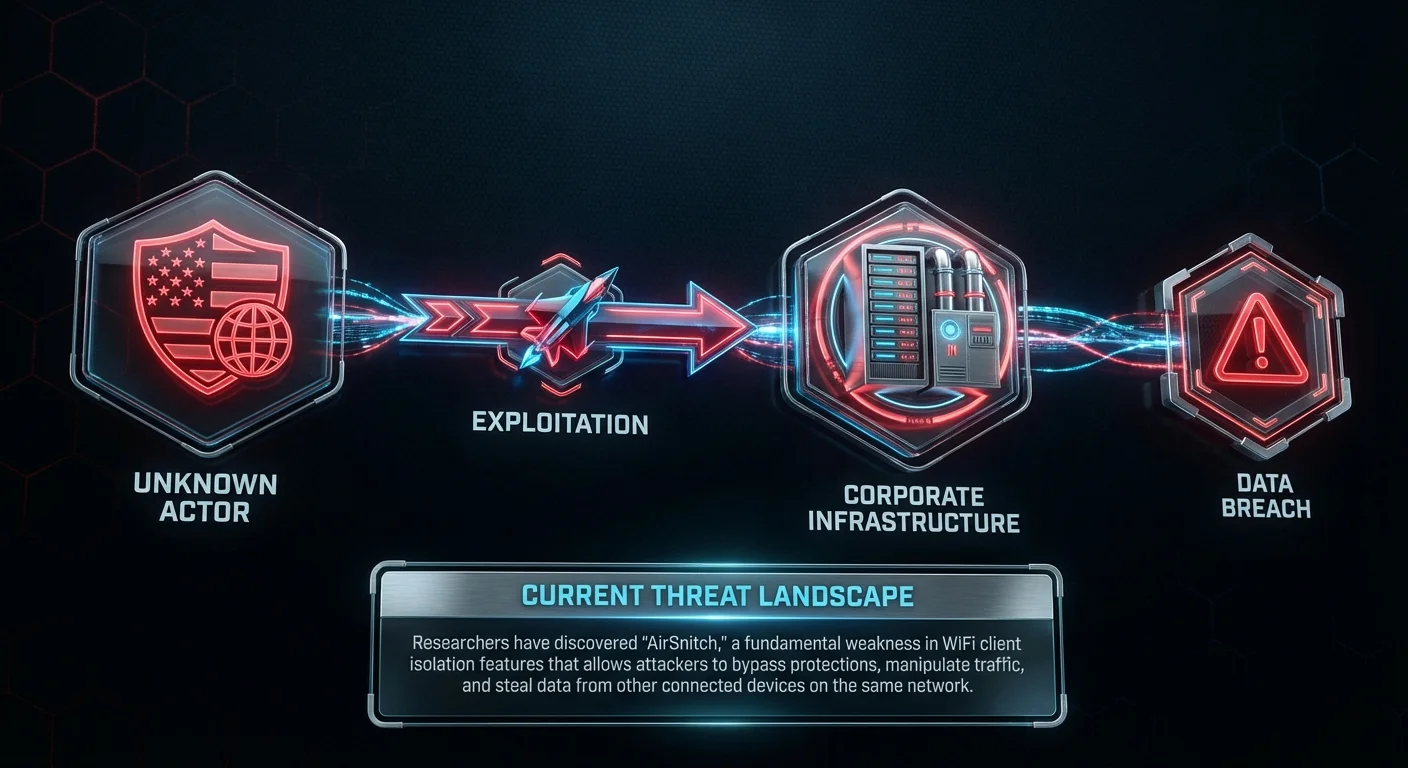
Scientists Intro AirSnitch, Which Bypasses WiFi Isolation to Launch Attacks on Networks

    Researchers have discovered "AirSnitch," a fundamental weakness in WiFi client isolation features that allows attackers to bypass protections, manipulate traffic, and steal data from other connected devices on the same network.

    Business Impact

    Exploitation in corporate or guest networks could lead to the theft of sensitive employee credentials and intellectual property, resulting in breach disclosures and loss of competitive advantage.

    Recommended Action

    Ask your IT team: Does our wireless network infrastructure rely solely on client isolation for security, and what compensating controls are in place to prevent lateral movement?

    General Enterprise Security Boulevard ↗

High Severity

A malicious Go module impersonating the legitimate golang.org/x/crypto codebase has been discovered. It is designed to harvest passwords, establish persistent SSH access, and deploy the Rekoobe Linux backdoor.

Business Impact

Integration of malicious code into corporate applications can lead to supply chain compromises, resulting in unauthorized access to production servers, data breaches, and severe loss of customer trust.

Recommended Action

Ask your IT team: Do our development pipelines verify the authenticity of Go modules, and have we scanned for the malicious github.com/xinfeisoft/crypto package?

General Enterprise The Hacker News ↗
iPhone and iPad are the first consumer devices cleared for NATO ‘RESTRICTED’ classification

    Apple's iPhone and iPad have been officially approved by NATO to handle classified information at the 'RESTRICTED' level. This marks the first time consumer devices have been added to the alliance's Information Assurance Product Catalogue.
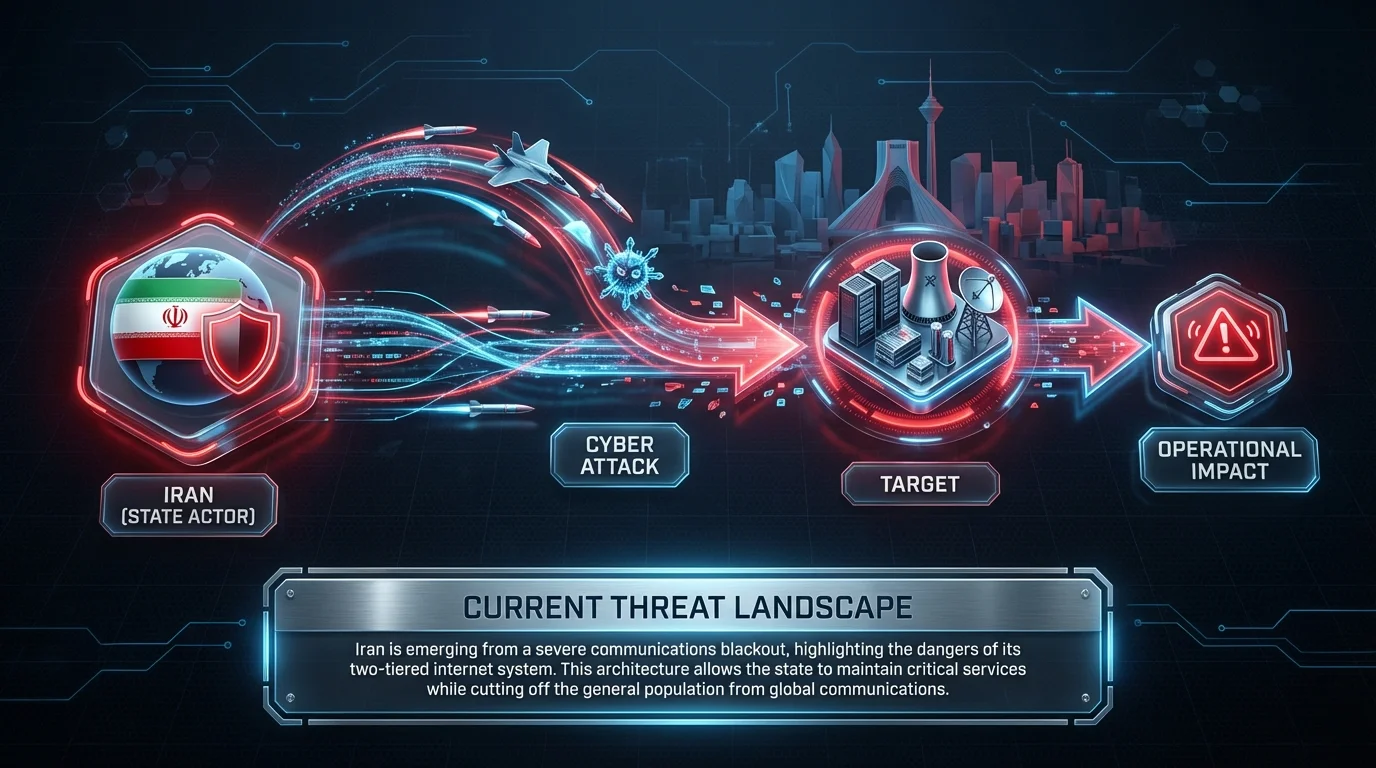
Why Tehran’s Two-Tiered Internet Is So Dangerous

    Iran is emerging from a severe communications blackout, highlighting the dangers of its two-tiered internet system. This architecture allows the state to maintain critical services while cutting off the general population from global communications.

Other Noteworthy

iPhone and iPad are the first consumer devices cleared for NATO ‘RESTRICTED’ classification

    Apple's iPhone and iPad have been officially approved by NATO to handle classified information at the 'RESTRICTED' level. This marks the first time consumer devices have been added to the alliance's Information Assurance Product Catalogue.

Why Tehran’s Two-Tiered Internet Is So Dangerous

    Iran is emerging from a severe communications blackout, highlighting the dangers of its two-tiered internet system. This architecture allows the state to maintain critical services while cutting off the general population from global communications.

Executive Briefing

Top 7 Cloud Scanner for Vulnerabilities in 2026

As cloud environments grow more complex, vulnerability management must evolve beyond simply finding CVEs to shrinking exploitable paths faster than business changes occur. Selecting the right cloud vulnerability scanner is critical for maintaining a secure enterprise posture.

Kratikal · 12:49 PM ·
Claude Code Security Crashed the Market Because We’re Defending the Wrong Thing

The release of Anthropic's Claude Code Security has caused a structural shift in the cybersecurity market by applying massive context windows to vetted codebases. This highlights a transition from standard pattern-matching to deeper, AI-driven contextual security analysis.

Security Boulevard · 6:37 PM ·
Zero Trust Architecture: The Technical Blueprint

Zero Trust requires a specific set of architectural components working in unison, including policy engines, identity fabrics, device trust, microsegmentation, and continuous monitoring. Understanding this blueprint is essential for successful enterprise implementation.

Security Boulevard · 4:08 PM ·
Why 70% of AI Projects Fail & How Forward Deployed Engineers Change the Equation

Despite growing budgets and board expectations, enterprise AI adoption faces a 70% failure rate. Forward-deployed engineers and robust security integrations are becoming necessary to translate AI initiatives into measurable business outcomes.

ISHIR · 4:05 PM ·

Vendor Spotlight

Vendor

FireTail (Specialized Vendor)

Specialization: API Security Posture Management

Why FireTail Today: FireTail specializes in comprehensive API security, making them highly relevant to the recent exposure of thousands of Google Cloud API keys granting unauthorized access to Gemini endpoints. Their platform helps organizations discover, monitor, and secure their APIs to prevent exactly this type of credential abuse and data exposure.

Key Capability: Continuous API discovery and inline threat protection to detect and block unauthorized access via compromised API keys.

Recommended Actions: 1. Navigate to FireTail Console → Posture Management → Security Findings 2. Navigate to FireTail Console → API Inventory → Traffic Monitoring 3. Navigate to FireTail Console → Policies → Rule Configuration

Verification Steps: - Query the Traffic Monitoring dashboard for the specific compromised API key strings or associated client IDs - Trigger a manual Posture Management scan and review the updated Security Findings report

Learn More About FireTail ↗

Detection & Response

Detection & Response Kit (4 items)

⚠️ Disclaimer: Test all detection logic in non-production environments before deployment.

1. Vendor Platform Configuration - FireTail

# Actionable Guidance for FireTail # Generated: 2026-02-28 12:01:16 # Step 1: Navigate to FireTail Console → Posture Management → Security Findings # Purpose: Identify exposed or hardcoded Google Cloud/Gemini API keys across monitored environments and API specifications # Expected: A filtered list of vulnerabilities categorized under 'Exposed Credentials' or 'Hardcoded Secrets', pinpointing the exact APIs and repositories requiring immediate key rotation. # Step 2: Navigate to FireTail Console → API Inventory → Traffic Monitoring # Purpose: Detect anomalous runtime usage or unauthorized access attempts using compromised Gemini API keys # Expected: Visibility into traffic patterns, allowing you to identify abnormal spikes in request volumes, unusual source IPs, or unexpected geographic locations utilizing the exposed keys. # Step 3: Navigate to FireTail Console → Policies → Rule Configuration # Purpose: Deploy a runtime blocking policy to intercept and drop requests using the known compromised API keys # Expected: Immediate enforcement of a custom security rule that blocks malicious traffic at the API gateway/agent level, returning a 401 Unauthorized or 403 Forbidden response. # Verification Steps: # - Query the Traffic Monitoring dashboard for the specific compromised API key strings or associated client IDs # Expected: Zero successful requests (HTTP 200) using the revoked keys; any lingering attempts should register as blocked (HTTP 401/403) # - Trigger a manual Posture Management scan and review the updated Security Findings report # Expected: Previously identified 'Exposed Credentials' alerts for the Google Cloud/Gemini keys are marked as resolved or no longer present

2. YARA Rule for Exposed Cloud API Abuse Artifacts

rule Detect_GCP_Gemini_API_Abuse_Artifacts { meta: description = "Detects artifacts related to unauthorized Google Cloud API key abuse targeting Gemini endpoints" author = "Threat Rundown" date = "2026-02-28" reference = "https://thehackernews.com/2026/02/thousands-of-public-google-cloud-api.html" severity = "high" tlp = "white" strings: // Extracted Threat Indicators $uri1 = "/files" ascii wide $uri2 = "/cachedContents" ascii wide // Contextual indicators for Gemini API $api_context1 = "generativelanguage.googleapis.com" ascii wide $api_context2 = "key=" ascii wide // Hex pattern for common API key prefix (AIza) $h1 = { 41 49 7a 61 } condition: ($h1 and any of ($uri*)) or (any of ($uri*) and any of ($api_context*)) }

3. SIEM Query — GCP Gemini API Abuse Detection

index=cloud_audit sourcetype="gcp:cloudauditlogs" (httpRequest.requestUrl="*/files*" OR httpRequest.requestUrl="*/cachedContents*") | eval risk_score=case( status.code >= 400 AND status.code < 500, 100, httpRequest.userAgent="*Malware*", 100, 1==1, 25) | where risk_score >= 50 | stats count by _time, principalEmail, callerIp, httpRequest.requestUrl, risk_score | sort -_time

4. PowerShell Script — Audit Local Git Repositories for Hardcoded Keys

# Scans local developer directories for potential Google Cloud API keys (AIza prefix) $searchPath = "C:\Users\*\Documents\GitHub\*" $pattern = "AIza[0-9A-Za-z-_]{35}" Write-Host "Starting scan for exposed Google Cloud API keys in local repositories..." $matches = Select-String -Path "$searchPath\*.*" -Pattern $pattern -AllMatches -ErrorAction SilentlyContinue if ($matches) { Write-Host "[!] WARNING: Potential hardcoded API keys found!" -ForegroundColor Red foreach ($match in $matches) { Write-Host "File: $($match.Path) | Line: $($match.LineNumber)" } } else { Write-Host "[+] No hardcoded API keys detected in scanned paths." -ForegroundColor Green }

This rundown should provide a solid overview of the current threat landscape. Thank you to all our cyberheroes for your diligence and hard work. Stay vigilant!