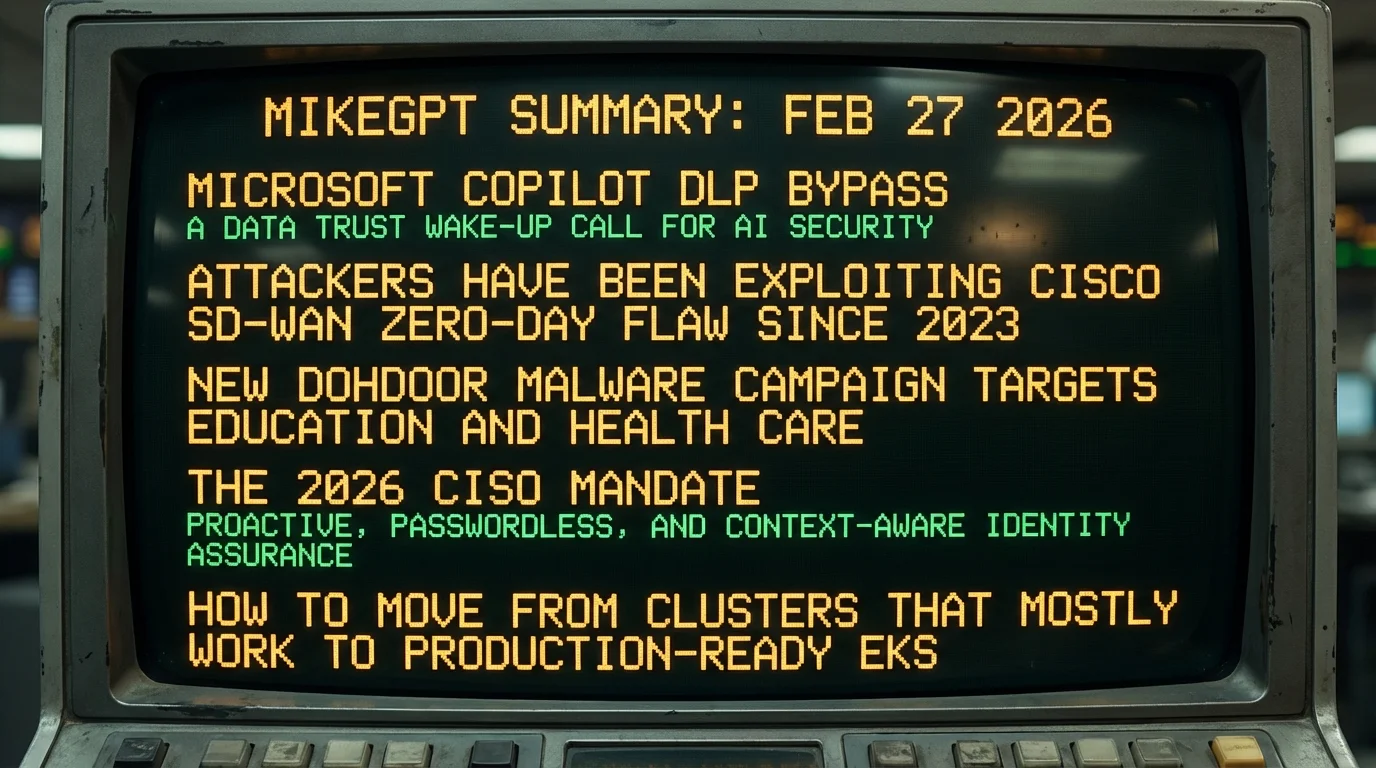
Friday, February 27, 2026

MikeGPT CyberSecurity

“Playbook for the Secure Enterprise”

MikeGPT Daily Threat Rundown

Heroes, your curated look at the current cybersecurity landscape for Feb 27, 2026.

Critical Threats

Microsoft Copilot DLP Bypass: A Data Trust Wake-Up Call for AI Security

    A confirmed bug in Microsoft Copilot allows the AI to surface and summarize emails marked as confidential, effectively bypassing existing Data Loss Prevention (DLP) controls. This exposes a critical gap in native enterprise AI data protection mechanisms.

    Business Impact

    If exploited internally, employees could access highly confidential executive communications or sensitive HR data, leading to insider trading risks, privacy violations, and loss of intellectual property.

    Recommended Action

    Ask your IT team: Have we reviewed our Microsoft Copilot deployment for DLP bypass vulnerabilities, and are we using third-party AI data security controls?
    General Enterprise Mind.io ↗
Attackers Have Been Exploiting Cisco SD-WAN Zero-Day Flaw Since 2023

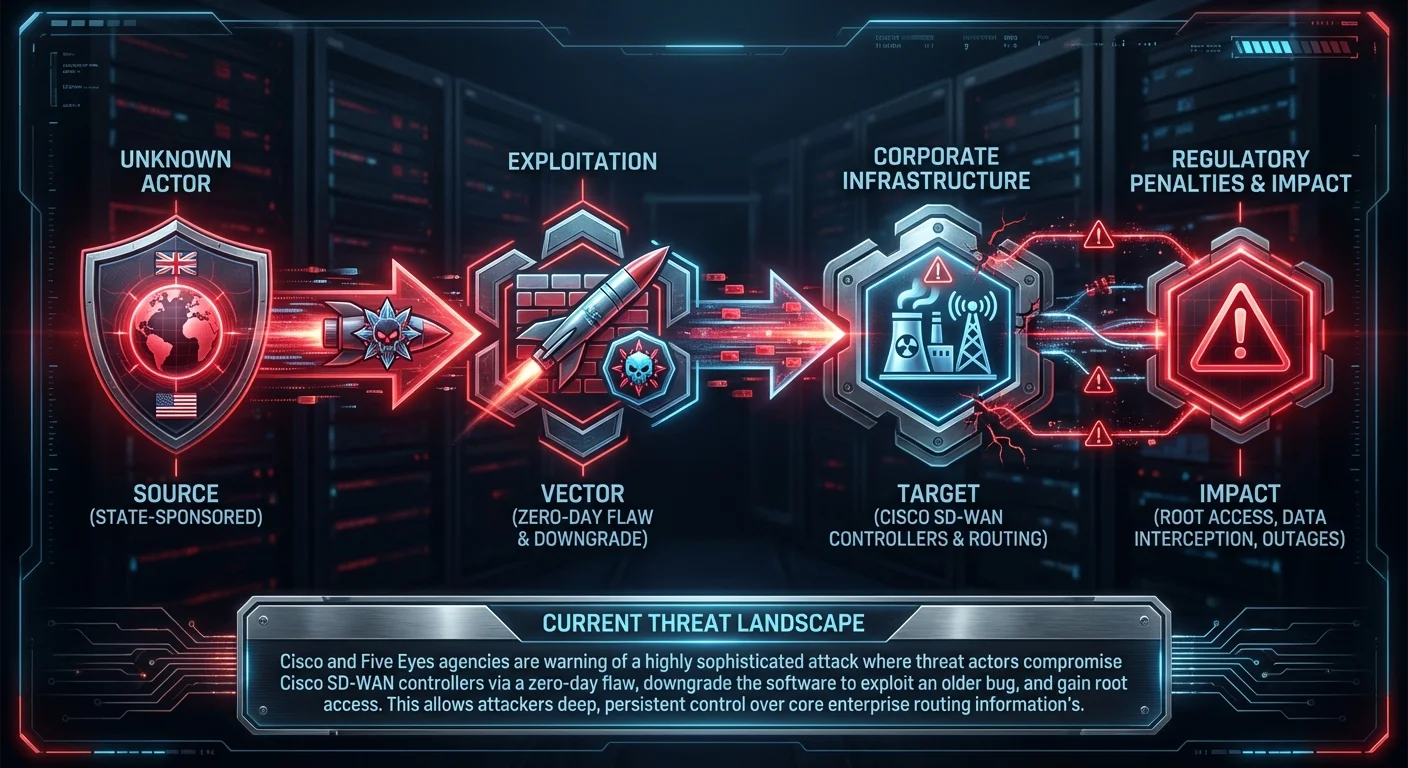
    Cisco and Five Eyes agencies are warning of a highly sophisticated attack where threat actors compromise Cisco SD-WAN controllers via a zero-day flaw, downgrade the software to exploit an older bug, and gain root access. This allows attackers deep, persistent control over core enterprise routing infrastructure.

    Business Impact

    If exploited, attackers can gain full root access to core network routing infrastructure, potentially leading to massive data interception, complete network outages, and severe regulatory penalties.

    Recommended Action

    Ask your IT team: Are our Cisco SD-WAN controllers exposed to the internet, and have we applied the latest vendor-recommended mitigations and patches?

    General Enterprise Security Boulevard ↗
New Dohdoor malware campaign targets education and health care

    Cisco Talos discovered an ongoing malicious campaign by threat actor UAT-10027 delivering a previously undisclosed backdoor named "Dohdoor." The malware utilizes DNS-over-HTTPS (DoH) to obscure its command-and-control traffic, specifically targeting education and healthcare sectors.

    Business Impact

    If infected, healthcare and education institutions could suffer devastating ransomware deployment, patient/student data theft, HIPAA/FERPA violations, and operational paralysis.

    Recommended Action

    Ask your IT team: Are we inspecting DNS-over-HTTPS traffic, and do our endpoint detection tools recognize the Dohdoor backdoor signatures?

    General Enterprise Cisco Talos ↗

High Severity

The 2026 CISO Mandate: Proactive, Passwordless, and Context-Aware Identity Assurance

    Identity security is shifting beyond perimeter controls to continuous, context-aware risk assessment and passwordless authentication to combat modern credential theft. The evolution is necessary as traditional point-in-time authentication fails against sophisticated phishing and MFA fatigue attacks.

    Business Impact

    Relying on legacy point-in-time authentication leaves the business highly vulnerable to credential stuffing and phishing, directly increasing the likelihood of a catastrophic data breach.

    Recommended Action

    Ask your IT team: What is our timeline for transitioning to passwordless authentication and continuous identity verification?

    General Enterprise HYPR ↗

Organizations struggle to secure and maintain Amazon Elastic Kubernetes Service (EKS) clusters, often running outdated versions due to fear of breaking production environments. This operational hesitation creates significant security debt in cloud-native infrastructure.

Business Impact

Running outdated Kubernetes clusters exposes the business to known container escape vulnerabilities, potentially allowing attackers to compromise the entire cloud environment and access sensitive customer databases.

Recommended Action

Ask your IT team: Are our EKS clusters fully up to date, and do we have a documented process for safely upgrading production container environments?

General Enterprise Fairwinds ↗

AWS introduced a multi-agent architecture for automated penetration testing, addressing traditional AI limitations by enabling autonomous operation and information retention. This represents a significant leap in continuous, automated cloud security validation.

Praetorian detailed a multi-agent AI pipeline built on Google's Agent Development Kit that automates vulnerability research, detection template generation, and exploitation analysis. This showcases the growing offensive and defensive capabilities of specialized AI models.

Other Noteworthy

AWS introduced a multi-agent architecture for automated penetration testing, addressing traditional AI limitations by enabling autonomous operation and information retention. This represents a significant leap in continuous, automated cloud security validation.

Praetorian detailed a multi-agent AI pipeline built on Google's Agent Development Kit that automates vulnerability research, detection template generation, and exploitation analysis. This showcases the growing offensive and defensive capabilities of specialized AI models.

Executive Briefing

Threat modeling AI applications

Microsoft emphasizes the critical need to proactively identify, assess, and address risks in AI systems. Acknowledging that not every misuse can be anticipated, systematic threat modeling is essential to design resilient systems and mitigate severe business impacts from AI hallucinations or data leaks.

Microsoft Security · 5:04 PM ·

Vendor Spotlight

Vendor

Nightfall AI (Specialized Vendor)

Specialization: Cloud Data Loss Prevention (DLP)

Why Nightfall AI Today: Nightfall AI is directly relevant to the highlighted Microsoft Copilot DLP bypass threat, as it specializes in cloud-native Data Loss Prevention (DLP) and securing sensitive data within AI applications. By providing deep data visibility and protection across SaaS and generative AI environments, Nightfall helps organizations mitigate the risk of AI tools inadvertently exposing or summarizing confidential enterprise data.

Key Capability: AI-powered data discovery and automated redaction to prevent sensitive data exposure across SaaS, cloud infrastructure, and generative AI tools.

Recommended Actions: 1. Navigate to Nightfall Console → Integrations → Microsoft 365 → Add Integration 2. Navigate to Nightfall Console → Policies → Create New Policy → Select 'Microsoft 365' 3. Navigate to Nightfall Console → Policies → [Select M365 Policy] → Remediation Actions

Verification Steps: - Upload a test document containing dummy sensitive data (e.g., fake credit card numbers) to a monitored SharePoint site, then attempt to query that document using Microsoft Copilot. - Navigate to Nightfall Console → Violations and filter by the Microsoft 365 integration.

Learn More About Nightfall AI ↗

Detection & Response

Detection & Response Kit (4 items)

⚠️ Disclaimer: Test all detection logic in non-production environments before deployment.

1. Vendor Platform Configuration - Nightfall AI

# Actionable Guidance for Nightfall AI # Generated: 2026-02-27 12:01:29 # Step 1: Navigate to Nightfall Console → Integrations → Microsoft 365 → Add Integration # Purpose: Address the root cause of Copilot data exposure by scanning the underlying Microsoft Graph data sources (SharePoint, OneDrive, Exchange) that Copilot indexes. # Expected: Nightfall will authenticate via OAuth and begin a historical scan of M365 environments to discover exposed sensitive data before Copilot can ingest and summarize it. # Step 2: Navigate to Nightfall Console → Policies → Create New Policy → Select 'Microsoft 365' # Purpose: Define strict detection rules (e.g., PII, PHI, Secrets, Customer Data) specifically targeted at the environments Copilot has access to. # Expected: A targeted DLP policy is established using Nightfall's machine learning detectors to identify high-risk data types with high accuracy and low false positives. # Step 3: Navigate to Nightfall Console → Policies → [Select M365 Policy] → Remediation Actions # Purpose: Configure automated responses to prevent Copilot from surfacing sensitive files to unauthorized users. # Expected: Automated actions such as 'Quarantine File', 'Restrict Access', or 'Redact' are enabled, ensuring sensitive files are immediately removed from Copilot's accessible knowledge base upon detection. # Verification Steps: # - Upload a test document containing dummy sensitive data (e.g., fake credit card numbers) to a monitored SharePoint site, then attempt to query that document using Microsoft Copilot. # Expected: Nightfall successfully detects the file and triggers the quarantine/restrict action. Copilot responds that it cannot access the file or find the requested sensitive information. # - Navigate to Nightfall Console → Violations and filter by the Microsoft 365 integration. # Expected: A violation event is logged showing the test file, the specific detector triggered (e.g., Credit Card Number), and a status confirming the automated remediation action was successfully executed.

2. YARA Rule for Dohdoor / General Malware

rule APT_UNC2814_Dohdoor_Malware_Detect { meta: description = "Detects artifacts related to Dohdoor backdoor and UNC2814 activity" author = "Threat Rundown" date = "2026-02-26" reference = "https://blog.talosintelligence.com/content/images/2026/02/threat_spotlight.jpg" severity = "high" tlp = "white" strings: $s1 = "Dohdoor" ascii wide nocase $s2 = "Malware" ascii wide $s3 = "User" ascii wide $h1 = { 4D 5A 90 00 03 00 00 00 } condition: any of ($s*) or $h1 }

3. SIEM Query — DNS-over-HTTPS Anomaly Detection (Dohdoor)

index=network sourcetype="suricata:eve" OR sourcetype="pan:traffic" app="dns-over-https" OR dest_port=443 | eval risk_score=case( app=="dns-over-https" AND dest_ip IN ("known_malicious_doh_resolvers"), 100, bytes_out > 50000 AND dest_port==443 AND is_unrecognized_cert=="true", 50, 1==1, 25) | where risk_score >= 50 | table _time, src_ip, dest_ip, app, bytes_out, risk_score | sort -_time

4. PowerShell Script — Check for Suspicious DoH Configurations

$computers = "localhost", "SERVER01", "WKSTN01" foreach ($computer in $computers) { if (Test-Connection -ComputerName $computer -Count 1 -Quiet) { Write-Host "Checking $computer for suspicious DoH configurations..." # Check for browsers configured to use specific DoH providers via registry $regPath = "HKLM:\SOFTWARE\Policies\Google\Chrome" $dohSetting = Get-ItemProperty -Path $regPath -Name "DnsOverHttpsMode" -ErrorAction SilentlyContinue if ($dohSetting) { Write-Host "ALERT: DoH policy found on $computer - $($dohSetting.DnsOverHttpsMode)" -ForegroundColor Red } else { Write-Host "No enforced DoH policy found on $computer." -ForegroundColor Green } } }

This rundown should provide a solid overview of the current threat landscape. Thank you to all our cyberheroes for your diligence and hard work. Stay vigilant!