Thursday, February 26, 2026

MikeGPT CyberSecurity

“Playbook for the Secure Enterprise”

MikeGPT Daily Threat Rundown

Heroes, your curated look at the current cybersecurity landscape for Feb 26, 2026.

Critical Threats

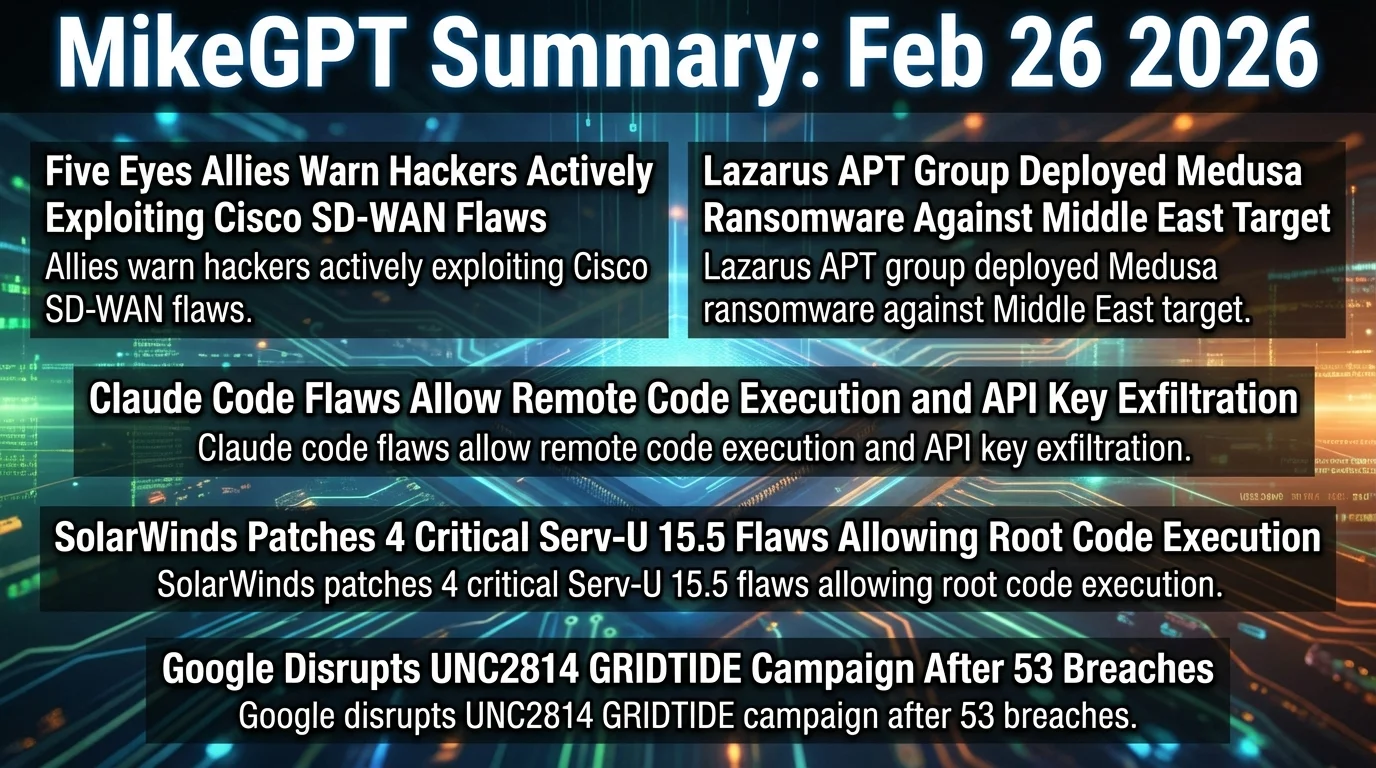
Five Eyes Allies Warn Hackers Actively Exploiting Cisco SD-WAN Flaws

    The U.S. CISA and Five Eyes allies have issued an emergency directive regarding active zero-day exploitation of a critical authentication bypass vulnerability in Cisco Catalyst SD-WAN. Attackers have been exploiting this flaw since 2023 to compromise controllers and introduce rogue peers into targeted networks.

    Business Impact

    If exploited, attackers gain deep network access allowing them to intercept sensitive corporate communications, steal proprietary data, and cause widespread operational downtime. This level of compromise could lead to severe regulatory fines, breach notification mandates, and significant reputational damage.

    Recommended Action

    Ask your IT team: Have we identified all Cisco Catalyst SD-WAN instances in our environment, and have we applied the emergency patches mandated by CISA?
    CVE-2026-20127 General Enterprise The Record ↗
Lazarus APT Group Deployed Medusa Ransomware Against Middle East Target

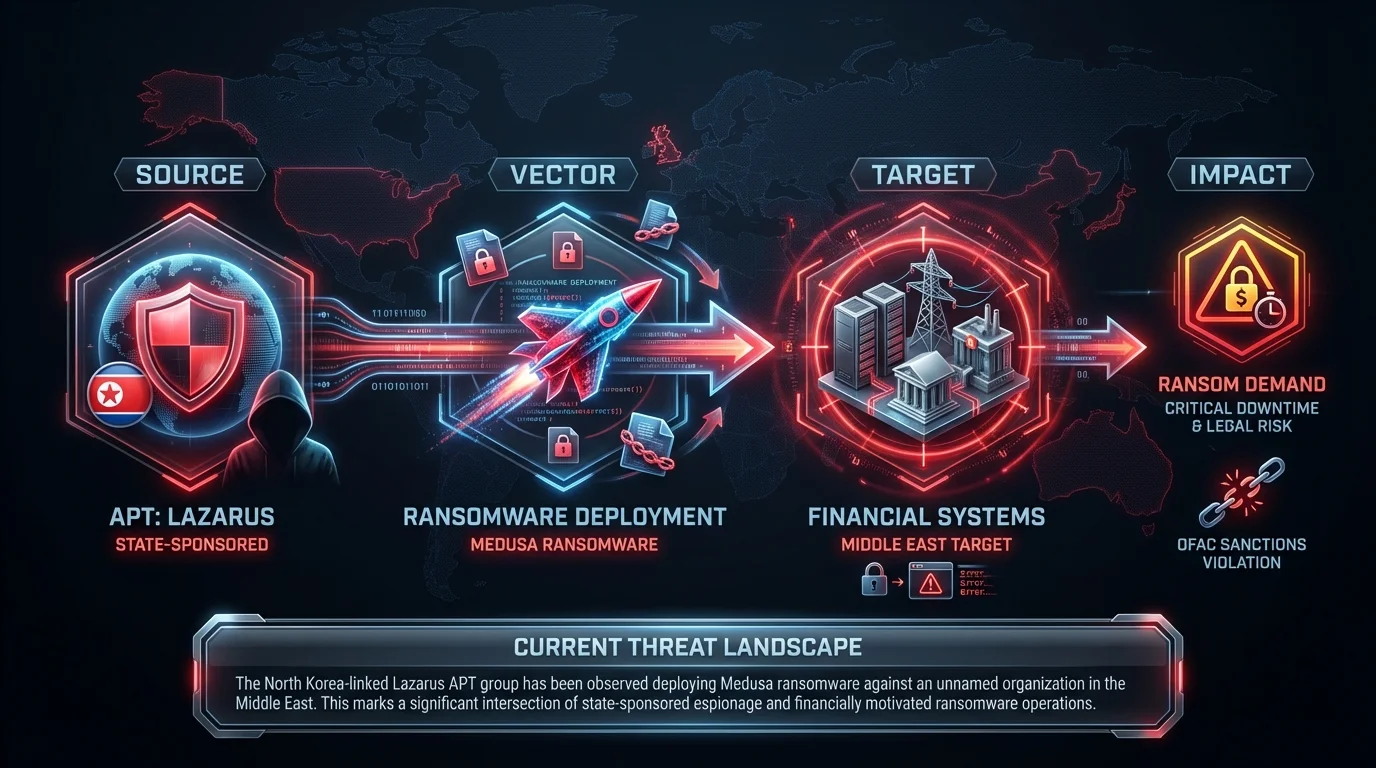
    The North Korea-linked Lazarus APT group has been observed deploying Medusa ransomware against an unnamed organization in the Middle East. This marks a significant intersection of state-sponsored espionage and financially motivated ransomware operations.

    Business Impact

    A successful ransomware attack by a sanctioned nation-state actor not only causes catastrophic operational downtime and revenue loss but also introduces severe legal complexities regarding ransom payments and OFAC sanctions violations.

    Recommended Action

    Ask your IT team: Are our endpoint detection systems configured to detect Medusa ransomware signatures, and are our critical backups isolated from the primary network?
    General Enterprise Security Affairs ↗
Claude Code Flaws Allow Remote Code Execution and API Key Exfiltration

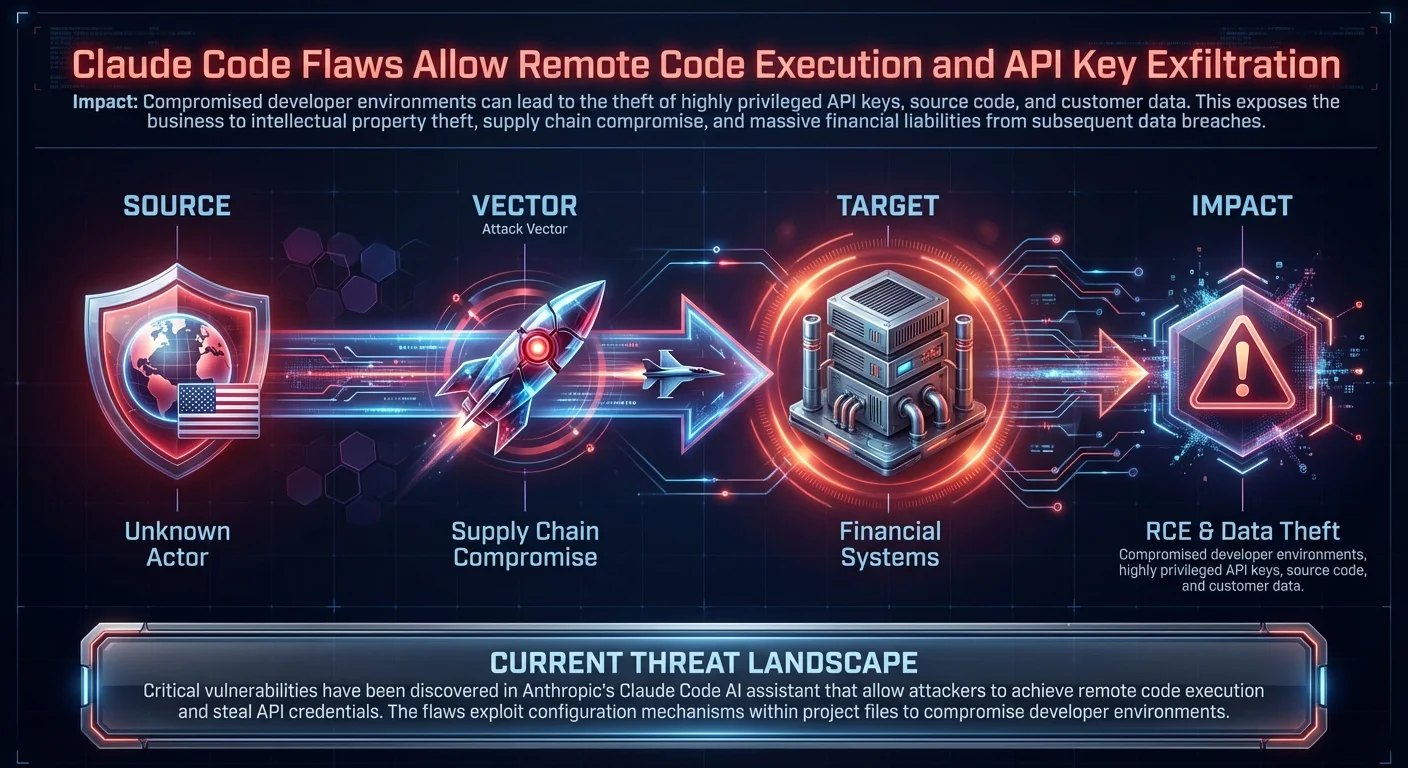
    Critical vulnerabilities have been discovered in Anthropic's Claude Code AI assistant that allow attackers to achieve remote code execution and steal API credentials. The flaws exploit configuration mechanisms within project files to compromise developer environments.

    Business Impact

    Compromised developer environments can lead to the theft of highly privileged API keys, source code, and customer data. This exposes the business to intellectual property theft, supply chain compromise, and massive financial liabilities from subsequent data breaches.

    Recommended Action

    Ask your IT team: Are our developers using Anthropic's Claude Code, and have we updated the tool to patch the remote code execution vulnerabilities?

SolarWinds has released updates to fix four critical vulnerabilities in its Serv-U file transfer software, including a broken access control flaw. If exploited, these vulnerabilities allow remote attackers to execute code with root privileges.

Business Impact

Exploitation allows attackers to take complete control of file transfer servers, enabling the theft of sensitive corporate and client data. This would trigger immediate breach notification requirements, loss of client trust, and potential class-action lawsuits.

Recommended Action

Ask your IT team: Do we use SolarWinds Serv-U for file transfers, and have we applied the version 15.5 security updates?

CVE-2025-40538 General Enterprise The Hacker News ↗

High Severity

Google Disrupts UNC2814 GRIDTIDE Campaign After 53 Breaches

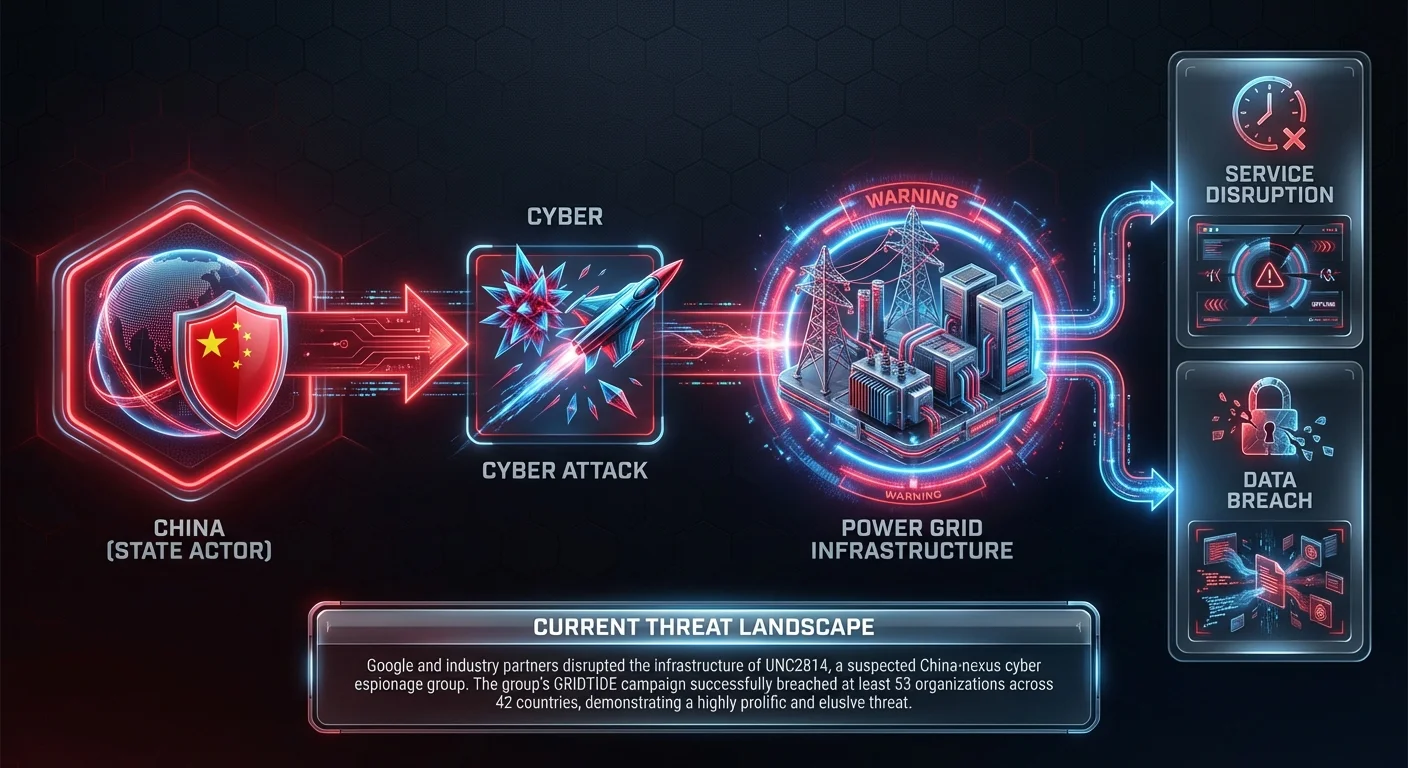
    Google and industry partners disrupted the infrastructure of UNC2814, a suspected China-nexus cyber espionage group. The group's GRIDTIDE campaign successfully breached at least 53 organizations across 42 countries, demonstrating a highly prolific and elusive threat.

    Business Impact

    State-sponsored espionage campaigns target intellectual property, strategic business plans, and sensitive communications. A breach could result in the loss of competitive advantage, compromised trade secrets, and long-term financial detriment.

    Recommended Action

    Ask your IT team: Have we ingested the latest threat intelligence indicators for the UNC2814 GRIDTIDE campaign into our security monitoring tools?

    General Enterprise The Hacker News ↗
Malicious StripeApi NuGet Package Mimicked Official Library

    A malicious package named StripeApi.Net was found on the NuGet Gallery, impersonating the legitimate Stripe.net library. It targets the financial sector by attempting to steal API tokens and payment processing credentials.

    Business Impact

    Stolen Stripe API tokens allow attackers to process fraudulent transactions, issue refunds to themselves, and access sensitive customer financial data. This guarantees massive direct financial losses, PCI-DSS compliance violations, and loss of merchant processing privileges.

    Recommended Action

    Ask your IT team: Are our developers strictly verifying the authenticity of financial API libraries, and have we audited our codebases for the malicious StripeApi.Net package?

    General Enterprise The Hacker News ↗

An internet archiving service operator allegedly weaponized their CAPTCHA page to launch a DDoS attack against a Finnish blogger. The incident highlights the unusual and vindictive ways web infrastructure can be abused to silence critics.

A cybersecurity professional shares a lighthearted perspective on incident response lessons learned from mixing up airports. The blog post draws parallels between travel mishaps and security incident management.

Other Noteworthy

An internet archiving service operator allegedly weaponized their CAPTCHA page to launch a DDoS attack against a Finnish blogger. The incident highlights the unusual and vindictive ways web infrastructure can be abused to silence critics.

A cybersecurity professional shares a lighthearted perspective on incident response lessons learned from mixing up airports. The blog post draws parallels between travel mishaps and security incident management.

Executive Briefing

How the CISO’s Role is Evolving From Technologist to Chief Educator

The modern CISO is transitioning from a purely technical expert to a strategic leader focused on risk communication, security culture, and executive alignment. Success in the role now heavily depends on influence, clarity, and the ability to educate the broader organization.

Security Boulevard · 10:11 AM ·
The Zero-Trust Perimeter: Optimizing OTP Authentication for Modern Identity Security

Optimizing One-Time Password (OTP) authentication within a zero-trust architecture is critical for strengthening modern identity security. Proper implementation reduces access risks and ensures that identity verification remains robust against credential stuffing and phishing.

MojoAuth · 9:30 AM ·
AI-Driven Behavioral Heuristics for Quantum-Era Threat Detection

As quantum computing advances, AI-driven behavioral heuristics and post-quantum security measures are becoming essential to protect Model Context Protocol (MCP) deployments. These technologies are necessary to defend against sophisticated, AI-age threats that bypass traditional signatures.

Gopher Security · 12:26 AM ·
It’s an East-West, North-South Thing: ColorTokens and Netskope Have You Covered

Security architectures must address both perimeter (North-South) and internal (East-West) traffic to effectively combat aggressive adversaries. Integrated solutions like ColorTokens and Netskope provide comprehensive visibility and control across all network directions.

ColorTokens · 6:56 AM ·
MSP vs MSSPs: Understanding the Difference

Understanding the distinction between Managed Service Providers (MSPs) and Managed Security Service Providers (MSSPs) is crucial for organizations outsourcing their IT. While MSPs focus on IT administration, MSSPs provide dedicated, advanced cybersecurity monitoring and incident response.

EasyDMARC · 8:50 AM ·

Vendor Spotlight

CrowdStrike

Specialization: Endpoint Detection & Response (EDR) and Threat Intelligence

Why CrowdStrike Today: State-sponsored actors are highly active, with the Lazarus APT deploying Medusa ransomware and the China-nexus UNC2814 breaching dozens of organizations globally. CrowdStrike's Falcon platform combines elite threat intelligence for tracking these specific APT groups with advanced endpoint detection and response (EDR) to block ransomware payloads and disrupt espionage-driven lateral movement.

Key Capability: APT behavior tracking and ransomware execution prevention

Recommended Actions: 1. Navigate to Endpoint security → Prevention policies → [Select active policies] → Edit → Sensor machine learning & Cloud machine learning 2. Navigate to Identity protection → Configuration → Policies → Add/Edit Rule 3. Navigate to Intelligence → Actors → Search for 'LABYRINTH CHOLLIMA' (Lazarus) and relevant China-nexus adversaries → Export IOCs → Endpoint security → IOC management

Verification Steps: - Navigate to Endpoint security → Prevention policies and verify the 'Assigned hosts' count for the hardened policies. - Navigate to Identity protection → Dashboard and review the 'Detections' and 'Incidents' tabs for lateral movement flags.

Learn More About CrowdStrike ↗

Detection & Response

Detection & Response Kit (4 items)

⚠️ Disclaimer: Test all detection logic in non-production environments before deployment.

1. Vendor Platform Configuration - CrowdStrike

# Actionable Guidance for CrowdStrike # Generated: 2026-02-26 16:30:47 # Step 1: Navigate to Endpoint security → Prevention policies → [Select active policies] → Edit → Sensor machine learning & Cloud machine learning # Purpose: Block Medusa ransomware payloads and novel malware variants deployed by the Lazarus APT # Expected: Machine Learning and Next-Gen AV settings for 'Malware' and 'Ransomware' are toggled to 'Block' with detection/prevention sliders set to at least 'Aggressive', ensuring pre-execution payload termination. # Step 2: Navigate to Identity protection → Configuration → Policies → Add/Edit Rule # Purpose: Disrupt espionage-driven lateral movement and credential abuse by UNC2814 # Expected: Rules are configured to enforce MFA or 'Block' for anomalous authentication protocols (e.g., unusual RDP, SMB, or NTLM traffic) and Pass-the-Hash attempts, stopping lateral spread. # Step 3: Navigate to Intelligence → Actors → Search for 'LABYRINTH CHOLLIMA' (Lazarus) and relevant China-nexus adversaries → Export IOCs → Endpoint security → IOC management # Purpose: Operationalize elite threat intelligence to proactively track and block specific APT infrastructure # Expected: Known malicious hashes, domains, and IPs associated with these state-sponsored actors are imported into Custom IOCs and explicitly set to 'Block' and 'Detect' across the fleet. # Verification Steps: # - Navigate to Endpoint security → Prevention policies and verify the 'Assigned hosts' count for the hardened policies. # Expected: 100% of active Windows, macOS, and Linux sensors are successfully assigned to the updated prevention policies with Ransomware blocking enabled. # - Navigate to Identity protection → Dashboard and review the 'Detections' and 'Incidents' tabs for lateral movement flags. # Expected: Anomalous authentication attempts matching UNC2814 behavioral profiles are actively challenged with MFA or blocked, with no successful unverified lateral movement events.

2. YARA Rule for Malicious NuGet Payload (msinit.exe)

rule Malicious_NuGet_ASP_NET_Stealer { meta: description = "Detects malicious payloads dropped by compromised NuGet packages targeting ASP.NET" author = "Threat Rundown" date = "2026-02-26" reference = "https://thehackernews.com/2026/02/malicious-nuget-packages-stole-aspnet.html" severity = "high" tlp = "white" strings: $s1 = "msinit.exe" ascii wide nocase $s2 = "NCryptYo" ascii wide $s3 = "Poseidon" ascii wide $s4 = "Apfell" ascii wide $s5 = "SimpleWriter" ascii wide $s6 = "Yandex" ascii wide $h1 = { 4D 5A 90 00 03 00 00 00 } // MZ header condition: $h1 at 0 and any of ($s*) }

3. SIEM Query — UNC2814 GRIDTIDE Campaign Detection

index=network sourcetype="suricata:eve" OR sourcetype="pan:traffic" url="*/usr/sbin/xapt*" OR app="SoftEther" | eval risk_score=case( url="*/usr/sbin/xapt*", 100, app="SoftEther" AND dest_zone="external", 75, 1==1, 25) | where risk_score >= 75 | stats count min(_time) as firstTime max(_time) as lastTime by src_ip, dest_ip, url, app, risk_score | eval threat_actor="UNC2814", campaign="GRIDTIDE" | sort -risk_score

4. PowerShell Script — Detect Malicious NuGet Dropper

$computers = "localhost", "SERVER01", "WKSTN01" $maliciousFile = "msinit.exe" foreach ($computer in $computers) { if (Test-Connection -ComputerName $computer -Count 1 -Quiet) { Write-Host "Checking $computer for $maliciousFile..." # Check common drop locations for the malicious executable $paths = @("C:\Windows\Temp\$maliciousFile", "C:\Users\*\AppData\Local\Temp\$maliciousFile") foreach ($path in $paths) { $found = Invoke-Command -ComputerName $computer -ScriptBlock { Test-Path $using:path } -ErrorAction SilentlyContinue if ($found) { Write-Host "[!] WARNING: $maliciousFile found on $computer at $path" -ForegroundColor Red # Optional: Isolate host or kill process # Invoke-Command -ComputerName $computer -ScriptBlock { Stop-Process -Name "msinit" -Force } } else { Write-Host "[+] Clean: $maliciousFile not found on $computer." -ForegroundColor Green } } } else { Write-Host "[-] $computer is unreachable." -ForegroundColor Yellow } }

This rundown should provide a solid overview of the current threat landscape. Thank you to all our cyberheroes for your diligence and hard work. Stay vigilant!