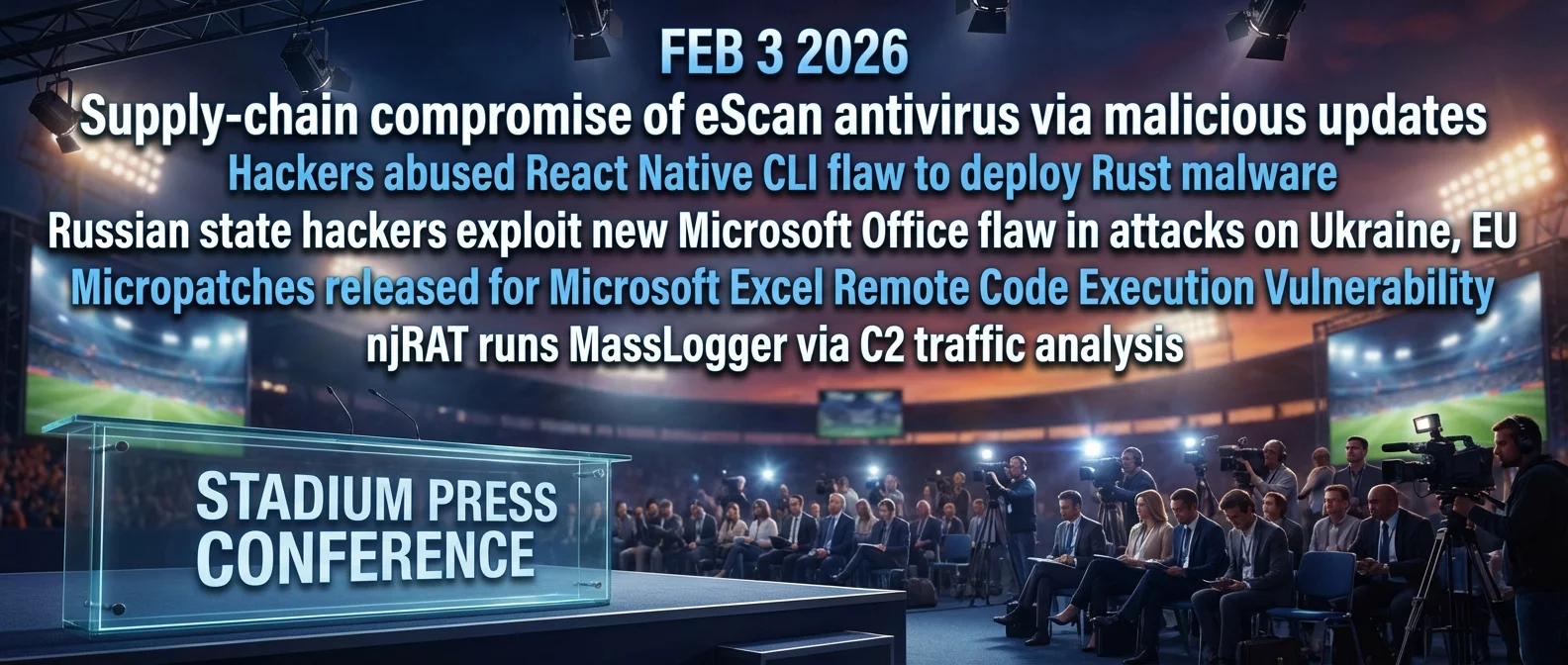
Tuesday, February 3, 2026

MikeGPT CyberSecurity

“Playbook for the Secure Enterprise”

MikeGPT Daily Threat Rundown

Heroes, your curated look at the current cybersecurity landscape for Feb 03, 2026.

Critical Threats

Supply-chain compromise of eScan antivirus via malicious updates

    MicroWorld Technologies, the maker of eScan antivirus, suffered a supply-chain compromise where malicious updates were pushed to users via the legitimate update mechanism. This allows attackers to distribute malware under the guise of trusted security software updates.

    Business Impact

    Using compromised security software grants attackers high-level privileges on your network, potentially bypassing all other defenses and leading to total system takeover and data loss.

    Recommended Action

    Ask your IT Manager: "Do we use eScan antivirus products, and if so, have we isolated those systems and verified the integrity of the latest updates?"
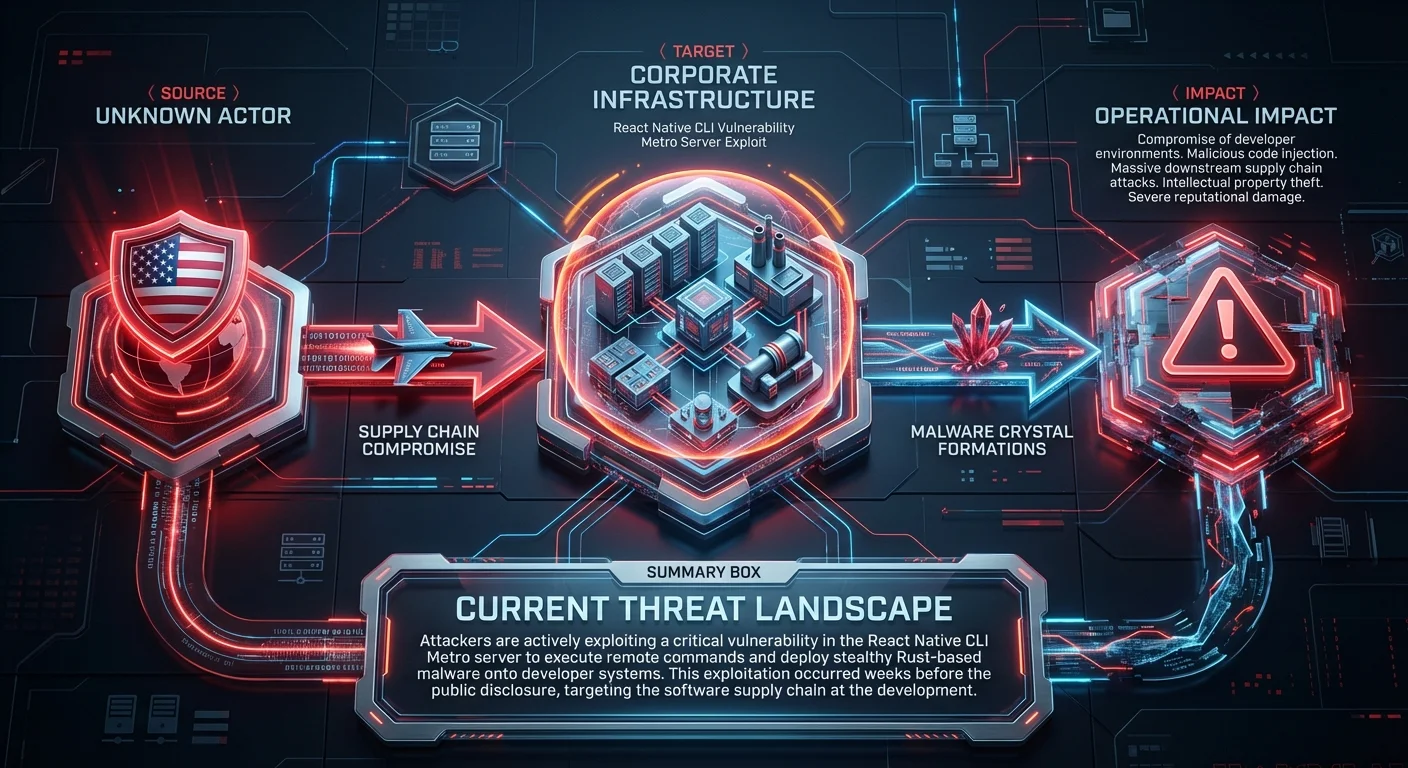
Hackers abused React Native CLI flaw to deploy Rust malware

    Attackers are actively exploiting a critical vulnerability in the React Native CLI Metro server to execute remote commands and deploy stealthy Rust-based malware onto developer systems. This exploitation occurred weeks before the public disclosure, targeting the software supply chain at the development level.

    Business Impact

    Compromise of developer environments can lead to the injection of malicious code into your proprietary software, resulting in massive downstream supply chain attacks, intellectual property theft, and severe reputational damage.

    Recommended Action

    Ask your Development Lead: "Have we updated our React Native CLI tools to patch CVE-2025-11953, and are we scanning our development environments for unauthorized Rust binaries?"
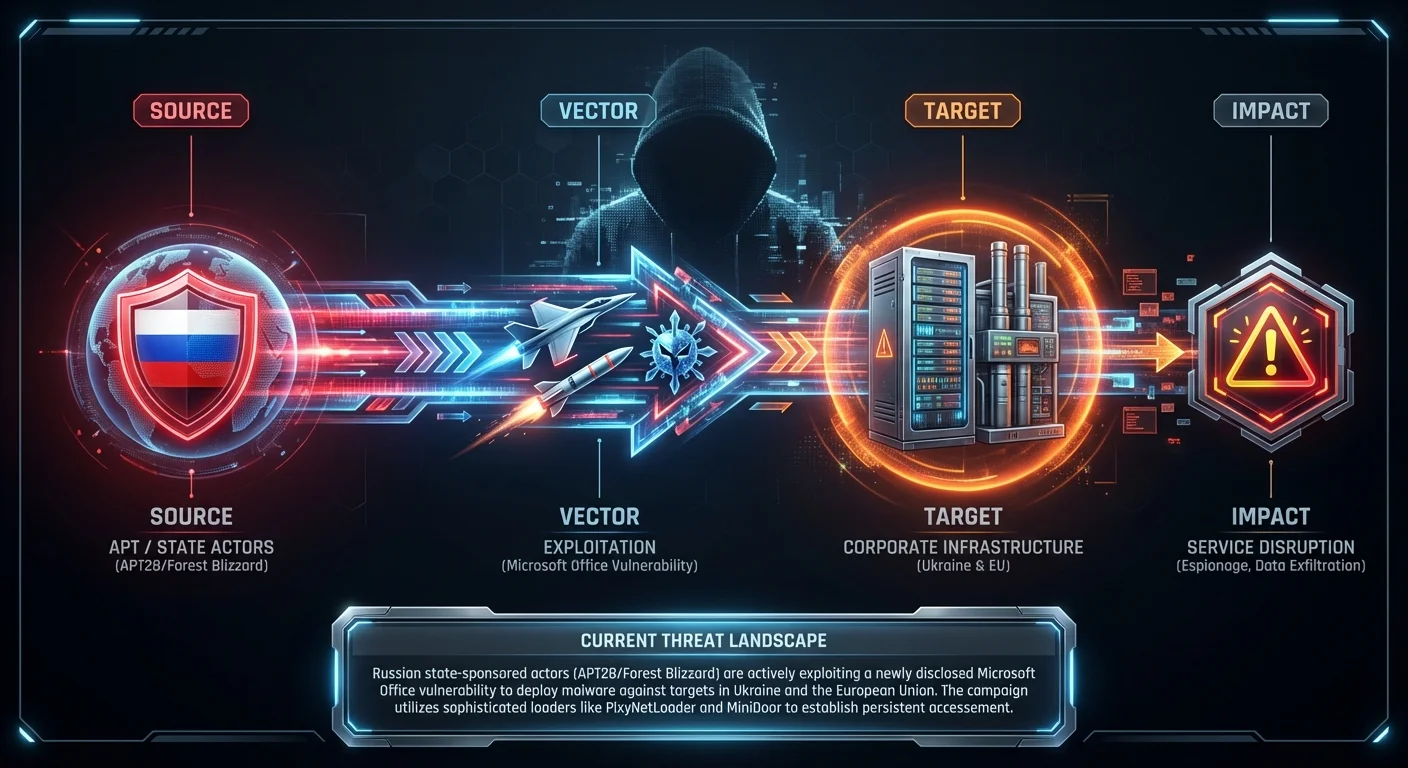
Russian state hackers exploit new Microsoft Office flaw in attacks on Ukraine, EU

    Russian state-sponsored actors (APT28/Forest Blizzard) are actively exploiting a newly disclosed Microsoft Office vulnerability to deploy malware against targets in Ukraine and the European Union. The campaign utilizes sophisticated loaders like PixyNetLoader and MiniDoor to establish persistent access.

    Business Impact

    Successful exploitation allows foreign adversaries to gain a foothold in corporate networks, leading to espionage, data exfiltration, and potential disruption of critical business operations in regulated regions.

    Recommended Action

    Ask your CISO: "Have we prioritized patching for CVE-2026-21509 across all endpoints, and are our endpoint detection tools configured to block the 'MiniDoor' and 'PixyNetLoader' signatures?"

A critical remote code execution vulnerability in Microsoft Excel is being addressed with micropatches after being discovered in November 2025 updates. Opening a malicious Excel file can allow remote attackers to execute arbitrary code on the victim's machine.

Business Impact

Employees opening financial spreadsheets or reports from external sources could inadvertently grant attackers control over their workstations, leading to ransomware deployment or financial fraud.

Recommended Action

Ask your IT Security team: "Have we applied the patch for CVE-2025-62203, or are we using micropatching solutions to mitigate this Excel vulnerability?"

High Severity

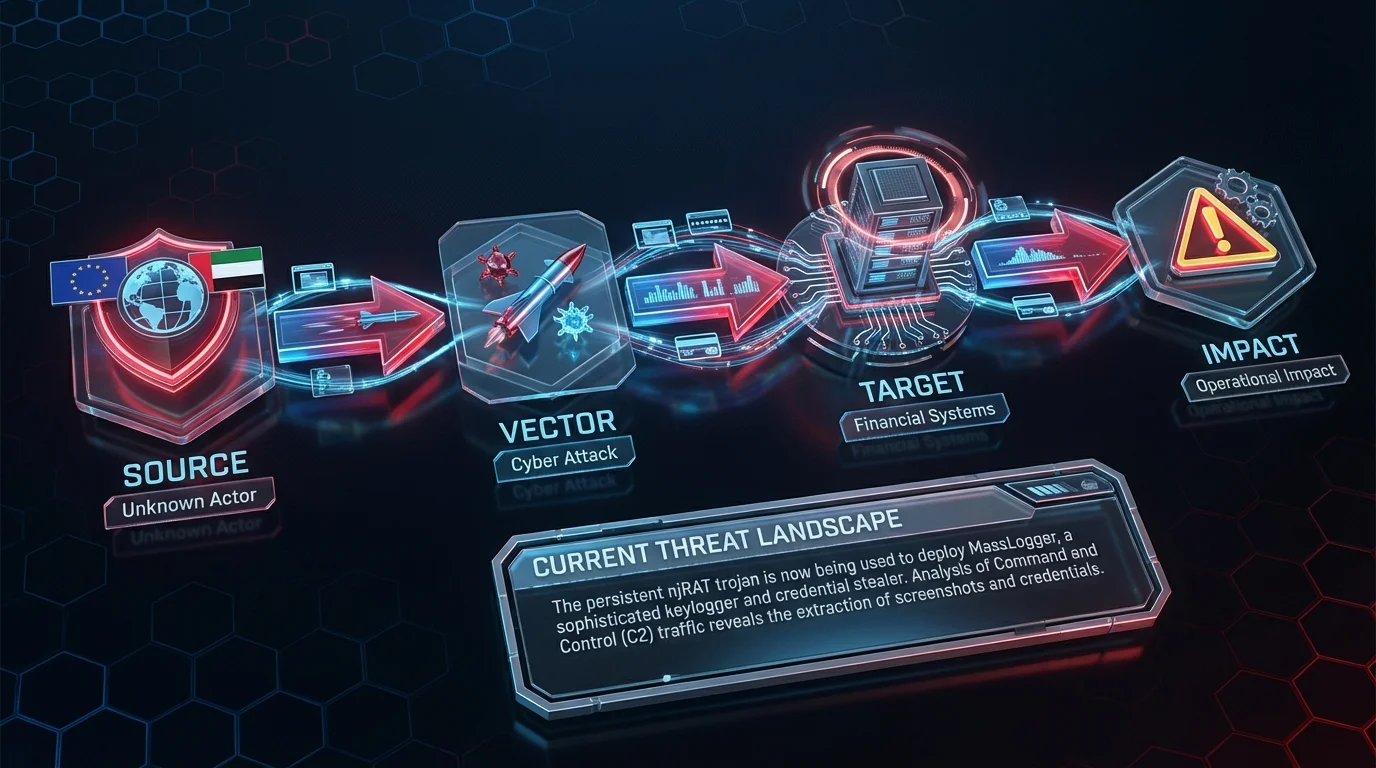
njRAT runs MassLogger via C2 traffic analysis

    The persistent njRAT trojan is now being used to deploy MassLogger, a sophisticated keylogger and credential stealer. Analysis of Command and Control (C2) traffic reveals the extraction of screenshots and credentials.

    Business Impact

    This malware combination poses a severe risk of credential theft, potentially granting attackers access to banking, email, and internal corporate systems.

    Recommended Action

    Ask your SOC Manager: "Can our network monitoring tools detect and block njRAT C2 traffic patterns to prevent the download of secondary payloads like MassLogger?"

AWS has released new privileged permissions focused on Network Firewall, Route 53, and EC2 networking. This expansion of privileges increases the attack surface if cloud roles are not properly scoped and monitored.

Business Impact

Misconfigured cloud permissions are a leading cause of data breaches; new unmonitored privileges could allow attackers to silently reroute traffic or bypass firewalls.

Recommended Action

Ask your Cloud Security Architect: "Have we reviewed the new AWS permissions for Network Firewall and Route 53 to ensure our Least Privilege policies are updated?"

A local vulnerability in macOS allows attackers with low-privileged code execution to disclose sensitive information via the AppleIntelKBLGraphics component. While it requires local access, it can be chained with other exploits.

Other Noteworthy

A local vulnerability in macOS allows attackers with low-privileged code execution to disclose sensitive information via the AppleIntelKBLGraphics component. While it requires local access, it can be chained with other exploits.

Executive Briefing

Experts on Experts – Season One Roundup

Rapid7 leaders discuss shaping cybersecurity trends, including agentic AI and the ROI of Managed Detection and Response (MDR). These insights are valuable for strategic planning and budget allocation in 2026.

YouTube · 2:23 PM ·
What is Autonomous Penetration Testing and How Does it Work?

A look into the growing field of autonomous penetration testing, which leverages AI to simulate attacks continuously. This technology offers a way to scale security validation beyond traditional manual testing cycles.

Cybersecurity Ventures · 1:39 PM ·

Vendor Spotlight

SentinelOne

Specialization: Endpoint Protection (EPP) & XDR

Why SentinelOne Today: Russian state hackers are exploiting the new Microsoft Office flaw (CVE-2026-21509) and deploying stealthy Rust-based malware via the React Native exploit. SentinelOne's Singularity platform relies on behavioral AI rather than just signatures, making it highly effective at blocking novel Rust malware and preventing zero-day document exploits on endpoints.

Key Capability: Behavioral AI detection for novel Rust malware and zero-day exploits

Recommended Actions: 1. Navigate to Sentinels → Policy → [Target Group] → Protection Mode 2. Navigate to Sentinels → Policy → [Target Group] → Engines 3. Navigate to Visibility → STAR → New Rule

Verification Steps: - Navigate to Sentinels → Endpoints and filter by 'Policy Status' - Review Incidents → Threat Details for any blocked Office-based executions

Learn More About SentinelOne ↗

Detection & Response

Detection & Response Kit (4 items)

⚠️ Disclaimer: Test all detection logic in non-production environments before deployment.

1. Vendor Platform Configuration - SentinelOne

# Actionable Guidance for SentinelOne # Generated: 2026-02-03 17:42:41 # Step 1: Navigate to Sentinels → Policy → [Target Group] → Protection Mode # Purpose: Enforce automated mitigation against the zero-day Office exploit and Rust payload # Expected: Ensure 'Malicious Threat' and 'Suspicious Threat' are both set to 'Protect' (Kill & Quarantine). This authorizes the Behavioral AI to autonomously terminate the Office process immediately upon detecting the exploit sequence. # Step 2: Navigate to Sentinels → Policy → [Target Group] → Engines # Purpose: Maximize detection for document-based exploits and novel binaries # Expected: Verify that 'Anti-Exploitation' is toggled ON (specifically covering MS Office applications) and 'Executables' is ON for Static AI to analyze the Rust binary structure pre-execution. # Step 3: Navigate to Visibility → STAR → New Rule # Purpose: Create a Custom Detection Rule for Office apps spawning suspicious child processes (React Native/Rust indicators) # Expected: Deploy a query such as `SrcProcName In ('winword.exe', 'excel.exe', 'powerpnt.exe') AND TgtProcCmdLine Contains Anycase ('rust', 'cargo', 'react')` to trigger alerts on specific behavioral anomalies associated with this campaign. # Verification Steps: # - Navigate to Sentinels → Endpoints and filter by 'Policy Status' # Expected: All targeted endpoints should display 'Up to date' indicating the aggressive Protection Mode and Engine settings have successfully propagated to the agents. # - Review Incidents → Threat Details for any blocked Office-based executions # Expected: Look for 'Classification: Malware' or 'Exploit' with 'Engine: Dynamic' or 'Behavioral AI'. The Storyline should show the Office parent process attempting to spawn the Rust payload, marked as 'Mitigated'.

2. YARA Rule for Russian State Malware (Covenant/MiniDoor)

rule APT28_Covenant_MiniDoor_Indicators { meta: description = "Detects artifacts related to APT28/Forest Blizzard campaign exploiting CVE-2026-21509" author = "Threat Rundown" date = "2026-02-03" reference = "https://therecord.media/russian-state-hackers-exploit-new-microsoft-flaw" severity = "high" tlp = "white" strings: $s1 = "MiniDoor" ascii wide $s2 = "PixyNetLoader" ascii wide $s3 = "NotDoor" ascii wide $s4 = "BlueDelta" ascii wide $s5 = "Forest Blizzard" ascii wide $m1 = "Covenant" ascii wide condition: any of ($s*) or $m1 }

3. SIEM Query — React Native CLI / Rust Malware Activity

index=security sourcetype="process_execution" (process_name="*metro*" OR process_name="*react-native*") (command_line="*rust*" OR command_line="*cargo*" OR command_line="*DeepData*" OR command_line="*LightSpy*") | eval risk_score=case( like(command_line, "%DeepData%"), 100, like(command_line, "%LightSpy%"), 100, like(process_name, "%metro%") AND like(command_line, "%rust%"), 75, 1==1, 25) | where risk_score >= 75 | table _time, src_ip, user, process_name, command_line, risk_score | sort -_time

4. PowerShell Script — Check for mObywatel Vulnerability Exposure (iOS Mgmt)

# Note: This script simulates checking an MDM inventory for vulnerable app versions # Requires MDM API access or exported CSV inventory $vulnerableVersion = "4.52.0" # Hypothetical vulnerable version based on CVE-2025-11598 context $devices = Import-Csv "C:\Temp\MobileDeviceInventory.csv" foreach ($device in $devices) { if ($device.AppName -eq "mObywatel" -and $device.AppVersion -le $vulnerableVersion) { Write-Host "CRITICAL: Device $($device.DeviceName) ($($device.User)) has vulnerable mObywatel version $($device.AppVersion)" -ForegroundColor Red } }

This rundown should provide a solid overview of the current threat landscape. Thank you to all our cyberheroes for your diligence and hard work. Stay vigilant!