
Thursday, January 29, 2026

MikeGPT CyberSecurity

“Playbook for the Secure Enterprise”

MikeGPT Daily Threat Rundown

Heroes, your curated look at the current cybersecurity landscape for Jan 29, 2026.

Critical Threats

Breaking: Microsoft Office Zero-Day Actively Exploited

    A high-severity zero-day vulnerability in Microsoft Office (2016 through LTSC 2024) is being actively exploited in the wild via malicious documents. The attack requires user interaction (opening a file), but successful exploitation grants the attacker code execution privileges.

    Business Impact

    Since Office is ubiquitous in enterprise environments, this zero-day presents a high risk of widespread infection via phishing campaigns. A successful breach could lead to endpoint compromise, data exfiltration, and the need for expensive incident response and forensic investigations.

    Recommended Action

    Ask your IT team: "Have we deployed the emergency Microsoft Office patches released for CVE-2026-21509, and are our email filters configured to quarantine suspicious document attachments?"
    CVE-2026-21509 General Enterprise Orca Security ↗
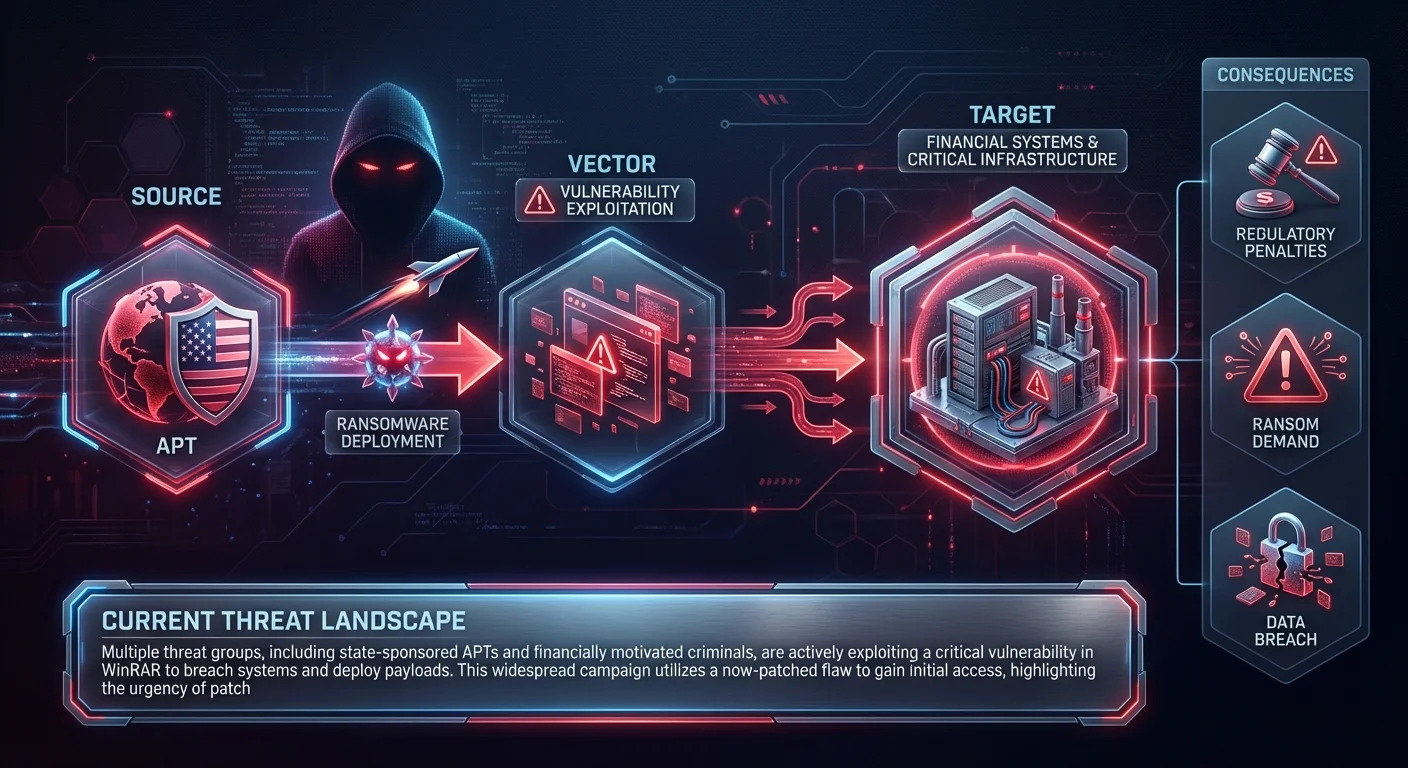
Nation-state and criminal actors leverage WinRAR flaw in attacks

    Multiple threat groups, including state-sponsored APTs and financially motivated criminals, are actively exploiting a critical vulnerability in WinRAR to breach systems and deploy payloads. This widespread campaign utilizes a now-patched flaw to gain initial access, highlighting the urgency of patching archive utilities often overlooked in maintenance cycles.

    Business Impact

    Successful exploitation allows attackers to execute arbitrary code on employee workstations, leading to ransomware deployment, data theft, or long-term espionage. This directly threatens the confidentiality of sensitive data and can result in significant operational downtime and regulatory penalties under HIPAA and SOX.

    Recommended Action

    Ask your IT team: "Have we verified that all instances of WinRAR across the enterprise are updated to the latest version, and are we blocking the download of unauthorized archive tools?"

SolarWinds Fixes Four Critical Web Help Desk Flaws

    SolarWinds has issued emergency updates for its Web Help Desk product to fix four critical vulnerabilities that allow unauthenticated attackers to bypass authentication and execute remote code. These flaws pose a severe risk as they enable full system compromise without requiring any valid credentials.

    Business Impact

    An unauthenticated RCE vulnerability in a help desk system can grant attackers administrative control over IT service management infrastructure. This could lead to the compromise of internal tickets containing sensitive user data, credentials, and potential lateral movement across the corporate network, triggering major SOX compliance failures.

    Recommended Action

    Ask your IT team: "Is our SolarWinds Web Help Desk instance isolated from the public internet, and have we applied the latest hotfix to address CVE-2025-40536 immediately?"

U.S. CISA adds Fortinet and VMware flaws to KEV Catalog

    CISA has added a critical vulnerability in Broadcom VMware vCenter Server and flaws in Fortinet products to its Known Exploited Vulnerabilities (KEV) catalog. This mandates federal agencies to patch by a specific deadline and signals to the private sector that active exploitation is occurring.

    Business Impact

    Failure to patch these actively exploited vulnerabilities leaves critical infrastructure (virtualization management and network security appliances) open to compromise. This can result in total control over virtualized environments or network perimeters, leading to catastrophic data loss and SOX/FISMA non-compliance.

    Recommended Action

    Ask your IT team: "Have we prioritized the patching of our VMware vCenter servers against CVE-2026-24858 and reviewed our Fortinet appliances for the newly listed KEV vulnerabilities?"

High Severity
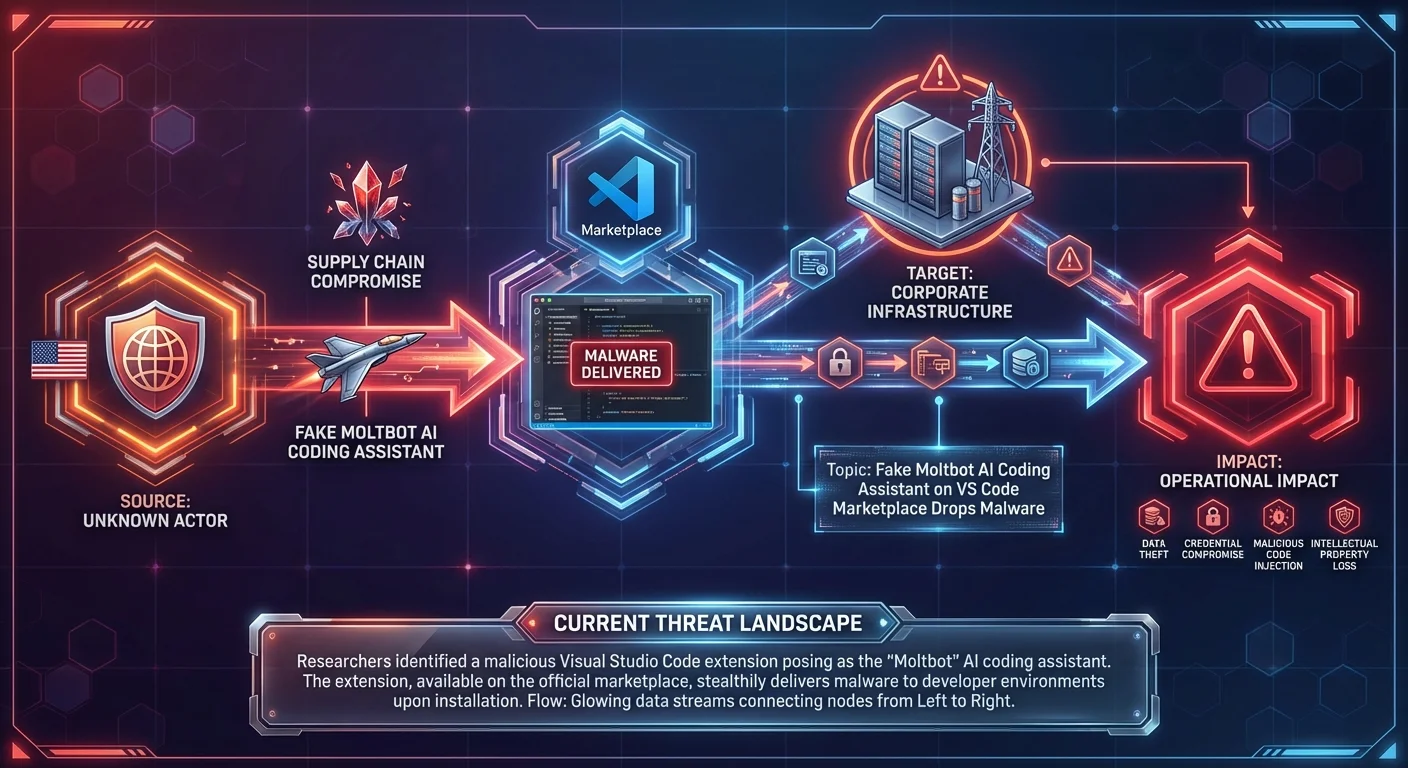
Fake Moltbot AI Coding Assistant on VS Code Marketplace Drops Malware

    Researchers identified a malicious Visual Studio Code extension posing as the "Moltbot" AI coding assistant. The extension, available on the official marketplace, stealthily delivers malware to developer environments upon installation.

    Business Impact

    Compromised developer workstations are a direct path to supply chain attacks, allowing attackers to inject malicious code into proprietary software or steal intellectual property and production credentials.

    Recommended Action

    Ask your IT team: "Do we have a policy or tool in place to vet VS Code extensions, and can we scan our developer environments for the 'Moltbot' extension immediately?"

CrowdStrike reports that a veteran North Korean threat group has splintered into three distinct entities (including "Labyrinth Chollima"), each with specialized malware and objectives. This specialization likely indicates an increase in operational tempo and sophistication in targeting financial and espionage sectors.

Business Impact

The diversification of state-sponsored threat groups increases the complexity of defense, as organizations may face multiple distinct attack vectors simultaneously. This heightens the risk of IP theft and financial fraud.

Recommended Action

Ask your IT team: "Have we updated our threat intelligence feeds to include the new indicators of compromise associated with Labyrinth Chollima and its splinter groups?"

SOX, GDPR CyberScoop ↗

A class action lawsuit has been filed against xAI regarding its Grok tool's generation of non-consensual deepfake imagery. This highlights the growing legal and reputational risks associated with Generative AI governance.

HIPAA, GDPR CyberScoop ↗

Other Noteworthy

A class action lawsuit has been filed against xAI regarding its Grok tool's generation of non-consensual deepfake imagery. This highlights the growing legal and reputational risks associated with Generative AI governance.

HIPAA, GDPR CyberScoop ↗

Executive Briefing

A Lack of Spending Isn’t the Problem With Cloud Security, Structural Complexity Is

A new Fortinet study argues that increasing security budgets is not solving cloud security challenges; rather, the structural complexity of multi-cloud environments and AI adoption is the core issue. Executives should focus on consolidation and simplification of security tools rather than just acquiring more point solutions.

Security Boulevard · 6:31 AM ·
PwC and Google Cloud Ink $400 Million Deal to Scale AI-Powered Defense

PwC and Google Cloud have signed a major deal to integrate AI-powered security operations. This trend signals a market shift towards managed AI-driven defense, suggesting enterprises should evaluate if their current MSSP partners are leveraging similar advanced capabilities.

SecurityWeek · 7:41 AM ·

Vendor Spotlight

Rapid7

Specialization: Vulnerability Risk Management & XDR

Why Rapid7 Today: The summary highlights a surge of critical CVEs in WinRAR, SolarWinds, and Fortinet, with CISA adding several to its Known Exploited Vulnerabilities catalog. Rapid7's vulnerability management solutions excel at prioritizing these specific flaws based on real-world exploitability (such as the active nation-state attacks mentioned by GTIG), ensuring teams patch what matters most first.

Key Capability: Risk-based vulnerability prioritization

Recommended Actions: 1. Navigate to InsightVM Console → Vulnerabilities → Filter 2. Navigate to InsightVM Console → Projects → Create a Project → Static 3. Navigate to InsightVM Console → Dashboards → Default Dashboard → Add Card → 'Real Risk Score of Assets'

Verification Steps: - Execute a targeted credentialed scan on the affected Asset Group - Review Remediation Project Status in InsightVM

Learn More About Rapid7 ↗

Detection & Response

Detection & Response Kit (4 items)

⚠️ Disclaimer: Test all detection logic in non-production environments before deployment.

1. Vendor Platform Configuration - Rapid7

# Actionable Guidance for Rapid7 # Generated: 2026-01-29 12:49:16 # Step 1: Navigate to InsightVM Console → Vulnerabilities → Filter # Purpose: Isolate assets affected by the specific CISA KEV vulnerabilities for WinRAR, SolarWinds, and Fortinet. # Expected: A filtered list of critical vulnerabilities. Use the query: `vulnerability.categories CONTAINS 'CISA Known Exploited' AND (vulnerability.title CONTAINS 'WinRAR' OR vulnerability.title CONTAINS 'SolarWinds' OR vulnerability.title CONTAINS 'Fortinet')` to display only the relevant, high-risk flaws. # Step 2: Navigate to InsightVM Console → Projects → Create a Project → Static # Purpose: Operationalize the remediation by assigning specific patching tasks to IT/Engineering teams based on the filtered view created in step 1. # Expected: A generated Remediation Project containing the specific solutions (patches/upgrades) for the identified assets, with assigned owners and due dates aligned with critical SLA windows (e.g., 48 hours). # Step 3: Navigate to InsightVM Console → Dashboards → Default Dashboard → Add Card → 'Real Risk Score of Assets' # Purpose: Visualize the risk reduction impact and monitor the specific threat landscape for the affected vendors. # Expected: A visual representation of the 'Real Risk' score associated with the WinRAR, SolarWinds, and Fortinet assets, allowing you to track the score decrease as patching occurs. # Verification Steps: # - Execute a targeted credentialed scan on the affected Asset Group # Expected: The specific CVEs for WinRAR, SolarWinds, and Fortinet no longer appear in the vulnerability results for those assets, and the asset's risk score decreases significantly. # - Review Remediation Project Status in InsightVM # Expected: The status of the solutions within the created Project transitions from 'Open' to 'Closed/Fixed' as the Insight Agent reports back new state data.

2. YARA Rule for WinRAR/RomCom Exploitation

rule WinRAR_RomCom_Exploit_Jan2026 { meta: description = "Detects artifacts associated with WinRAR CVE-2025-8088 and RomCom malware campaigns" author = "Threat Rundown" date = "2026-01-29" reference = "https://securityaffairs.com/?p=187451" severity = "high" tlp = "white" strings: $s1 = "payload.exe" ascii wide $s2 = "RomCom" ascii wide $s3 = "NESTPACKER" ascii wide $s4 = "STOCKSTAY" ascii wide $s5 = "POISONIVY" ascii wide $cve1 = "CVE-2025-8088" ascii wide $cve2 = "CVE-2023-38831" ascii wide condition: any of ($s*) or any of ($cve*) }

3. SIEM Query — Ivanti/MobileIron Exploitation Attempts

index=security sourcetype="web_proxy" OR sourcetype="firewall" uri_path="*/mifs/asfV3/api/v2/*" OR user_agent="*Ivanti*" OR user_agent="*MobileIron*" | eval risk_score=case( uri_path LIKE "%/mifs/asfV3/api/v2/%", 100, user_agent LIKE "*Ivanti*", 50, 1==1, 0) | where risk_score >= 50 | table _time, src_ip, dest_ip, uri_path, user_agent, risk_score | sort -_time

4. PowerShell Script — SolarWinds Web Help Desk Version Check

$computers = "localhost", "SERVER01", "WKSTN01" foreach ($computer in $computers) { if (Test-Connection -ComputerName $computer -Count 1 -Quiet) { Write-Host "Checking $computer for SolarWinds Web Help Desk..." Invoke-Command -ComputerName $computer -ScriptBlock { $app = Get-WmiObject -Class Win32_Product | Where-Object { $_.Name -like "*SolarWinds Web Help Desk*" } if ($app) { Write-Host "FOUND: $($app.Name) - Version: $($app.Version)" -ForegroundColor Red Write-Host "ACTION REQUIRED: Verify patch status for CVE-2025-40536" -ForegroundColor Yellow } else { Write-Host "Not found on this host." -ForegroundColor Green } } } }

This rundown should provide a solid overview of the current threat landscape. Thank you to all our cyberheroes for your diligence and hard work. Stay vigilant!