Thursday, January 22, 2026

MikeGPT CyberSecurity

“Playbook for the Secure Enterprise”

MikeGPT Daily Threat Rundown

Heroes, here's the curated threat landscape for Jan 22, 2026.

Critical Threats

Cisco Patches Actively Exploited Zero-Day in Unified Communications

    Cisco has released an emergency patch for a critical vulnerability in its Unified Communications and Webex Calling products that is currently being exploited in the wild. CISA has added this flaw to its Known Exploited Vulnerabilities (KEV) catalog, mandating immediate action for federal agencies.

    Business Impact

    If exploited, attackers gain remote code execution capabilities without authentication. This could lead to total compromise of communication infrastructure, eavesdropping on sensitive calls, and a pivot point for ransomware deployment, resulting in severe operational disruption and regulatory fines.

    Recommended Action

    Ask your IT team: "Have we verified the version of our Cisco Unified Communications Manager today, and is the patch for CVE-2026-20045 applied?" Isolate vulnerable instances immediately if patching is delayed.
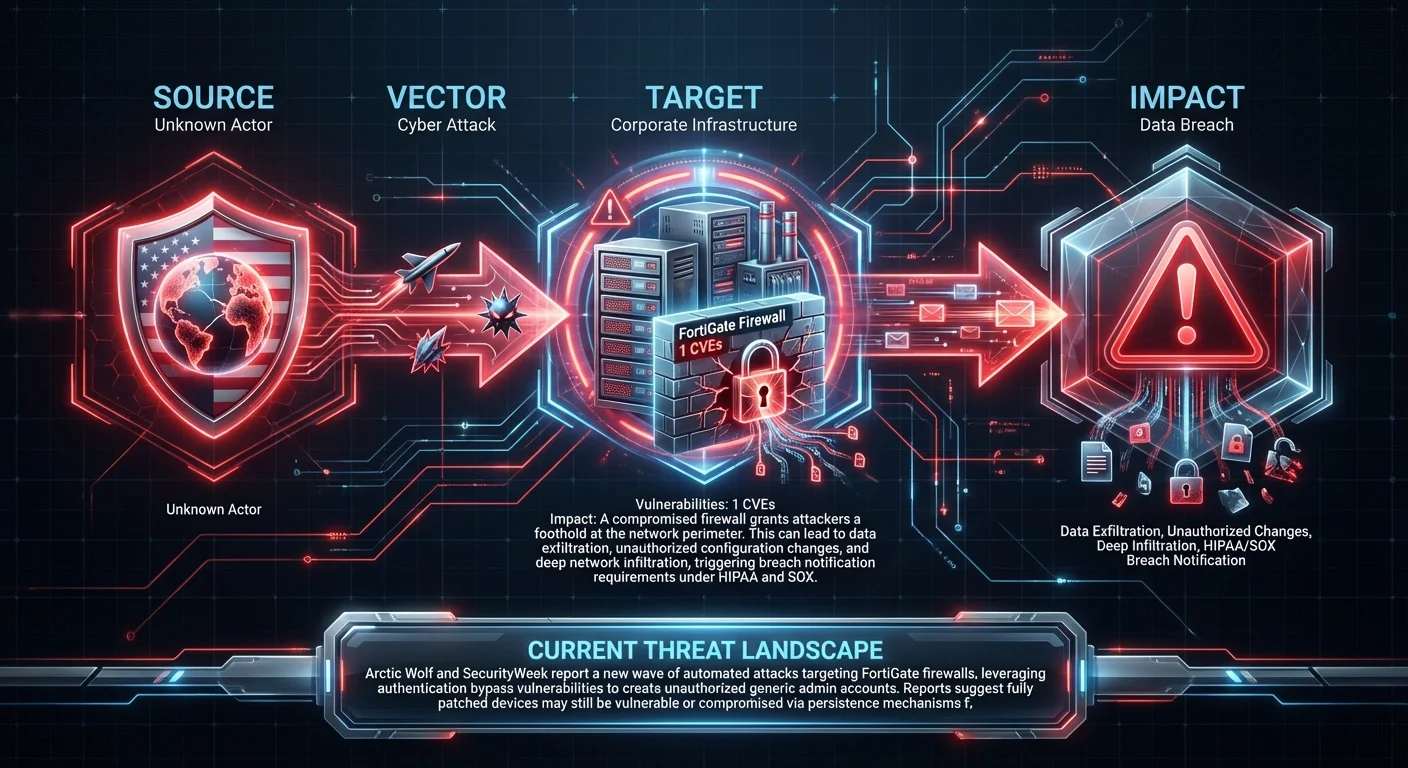
Surge in Automated Attacks Targeting FortiGate Firewalls

    Arctic Wolf and SecurityWeek report a new wave of automated attacks targeting FortiGate firewalls, leveraging authentication bypass vulnerabilities to create unauthorized generic admin accounts. Reports suggest fully patched devices may still be vulnerable or compromised via persistence mechanisms from CVE-2025-59718.

    Business Impact

    A compromised firewall grants attackers a foothold at the network perimeter. This can lead to data exfiltration, unauthorized configuration changes, and deep network infiltration, triggering breach notification requirements under HIPAA and SOX.

    Recommended Action

    Ask your security operations team: "Have we audited our FortiGate user list for unknown generic accounts in the last 24 hours?" Verify firmware integrity beyond standard patch levels.

BlueNoroff APT Shifts Focus to MacOS and Financial Targets

    BlueNoroff, a financially motivated subgroup of the Lazarus collective, is intensifying operations against financial institutions and cryptocurrency assets, with a notable shift toward targeting MacOS environments. They are known for high-profile heists like the Bangladesh SWIFT hack.

    Business Impact

    Financial institutions face direct monetary loss and severe reputational damage. The shift to MacOS targeting means traditional Windows-centric defenses may miss their initial access vectors.

    Recommended Action

    Ask your threat intelligence team: "Are our detection rules updated to identify BlueNoroff's specific MacOS tradecraft?"

    SOX, HIPAA Reddit ↗

High Severity

Critical Gaps Identified in Google Workspace Security

    Agile companies often rely on default Google Workspace configurations that prioritize growth over resilience, leaving gaps in incident response and compliance. Security teams are struggling to manage these environments effectively without specialized tools.

    Business Impact

    Misconfigured workspace settings can lead to accidental data leaks and failed compliance audits (SOX). Inadequate logging hampers incident investigation capabilities.

    Recommended Action

    Ask your IT Director: "When was the last time we performed a configuration review of our Google Workspace tenant against security best practices?"
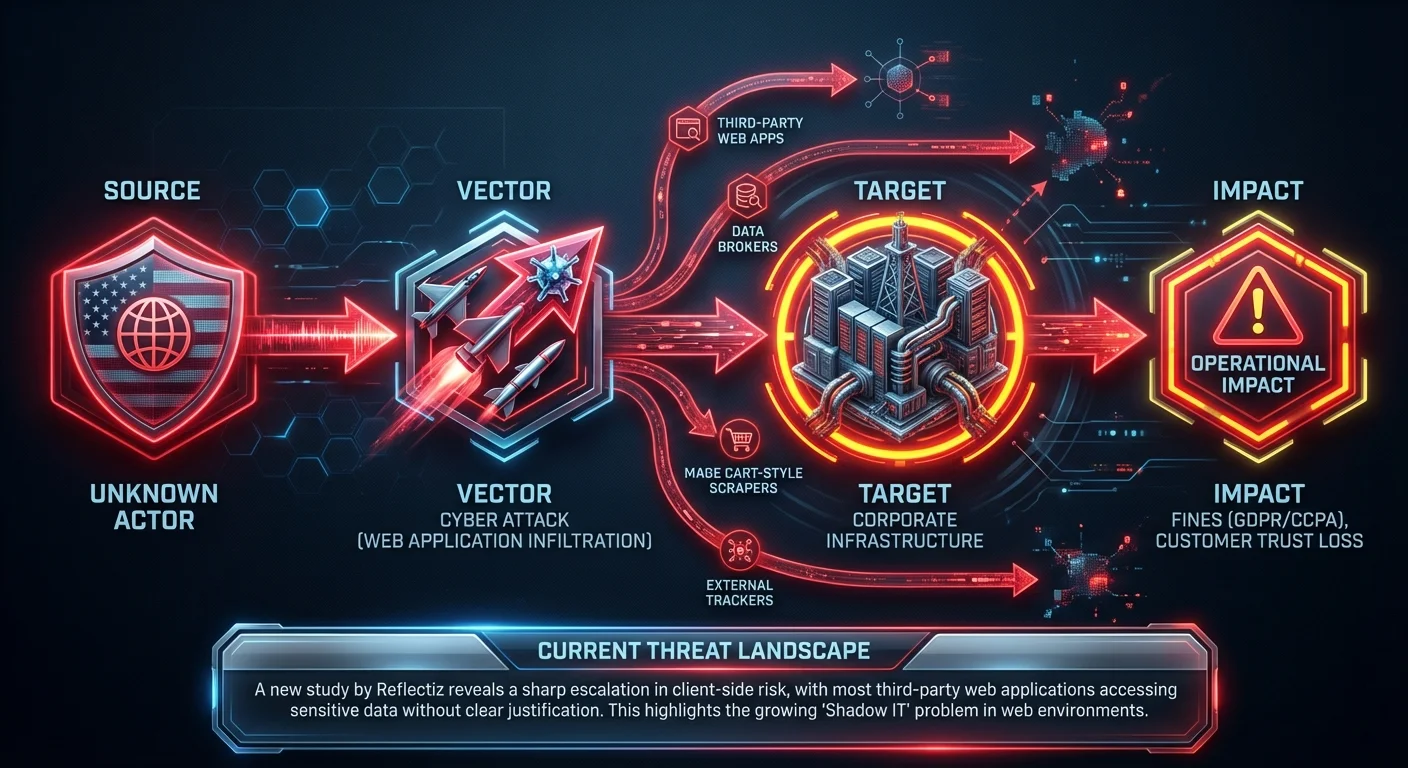
Third-Party Web Apps Accessing Sensitive Data Without Justification

    A new study by Reflectiz reveals a sharp escalation in client-side risk, with most third-party web applications accessing sensitive data without clear justification. This highlights the growing "Shadow IT" problem in web environments.

    Business Impact

    Unchecked third-party scripts on corporate websites can scrape customer data (Magecart-style attacks), leading to GDPR/CCPA fines and loss of customer trust.

    Recommended Action

    Verify which third-party scripts are running on your payment and login pages.
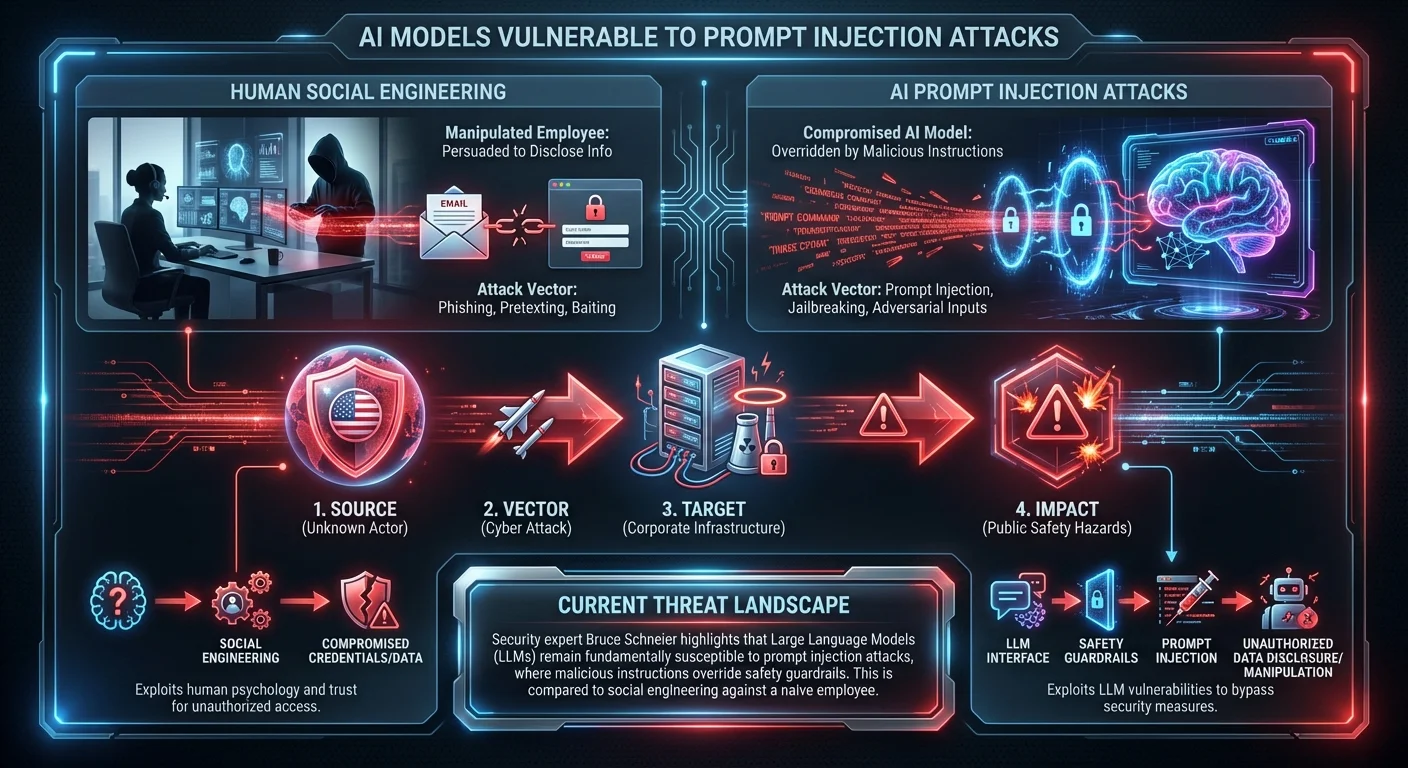
AI Models Vulnerable to Prompt Injection Attacks

    Security expert Bruce Schneier highlights that Large Language Models (LLMs) remain fundamentally susceptible to prompt injection attacks, where malicious instructions override safety guardrails. This is compared to social engineering against a naive employee.

    Business Impact

    As organizations integrate LLMs into customer service and internal tools, prompt injection could lead to unauthorized data disclosure or manipulation of business logic.

    Recommended Action

    Review all AI implementations for "human-in-the-loop" verification before executing sensitive actions.

NIST is starting 2026 with reduced staff and budget, potentially slowing down critical updates to encryption standards and cybersecurity guidance. This could delay industry-wide adoption of post-quantum cryptography standards.

SOX, FISMA CyberScoop ↗

A technical comparison of SAML and LDAP protocols for authentication and directory services. Useful for architects planning Enterprise SSO scalability.

A benchmark of 30 AI models in Red Team scenarios shows the gap between experimental tech and viable cyber weapons is closing. Security teams should anticipate AI-assisted attacks becoming more sophisticated.

Other Noteworthy

NIST is starting 2026 with reduced staff and budget, potentially slowing down critical updates to encryption standards and cybersecurity guidance. This could delay industry-wide adoption of post-quantum cryptography standards.

SOX, FISMA CyberScoop ↗

A technical comparison of SAML and LDAP protocols for authentication and directory services. Useful for architects planning Enterprise SSO scalability.

A benchmark of 30 AI models in Red Team scenarios shows the gap between experimental tech and viable cyber weapons is closing. Security teams should anticipate AI-assisted attacks becoming more sophisticated.

Vendor Spotlight

Vendor

Valence Security (Specialized Vendor)

Specialization: SaaS Security Posture Management (SSPM)

Why Valence Security Today: Valence Security specializes in SaaS Security Posture Management (SSPM), which is directly relevant to the threat regarding 'Filling the Most Common Gaps in Google Workspace Security.' Their platform is designed to secure business-critical SaaS applications like Google Workspace by detecting misconfigurations, identity risks, and third-party integration vulnerabilities.

Key Capability: Automated remediation of SaaS misconfigurations and third-party integration risks in platforms like Google Workspace.

Recommended Actions: 1. Navigate to Inventory → Third-Party Integrations → Filter by 'Google Workspace' → Sort by 'Risk Level: High' 2. Navigate to Posture → Misconfigurations → Select 'Google Workspace' → Filter by 'Severity: Critical' 3. Navigate to Data Security → External Sharing → Filter by 'Link Sharing: Public/Anyone with link'

Verification Steps: - Navigate to Workflows → Activity Log after initiating a remediation action (e.g., revoking a token) - Review the 'Security Score' or 'Posture Trends' widget on the main Dashboard

Learn More About Valence Security ↗

Detection & Response

Detection & Response Kit (4 items)

⚠️ Disclaimer: Test all detection logic in non-production environments before deployment.

1. Vendor Platform Configuration - Valence Security

# Actionable Guidance for Valence Security # Generated: 2026-01-22 15:08:15 # Step 1: Navigate to Inventory → Third-Party Integrations → Filter by 'Google Workspace' → Sort by 'Risk Level: High' # Purpose: Identify and revoke over-privileged OAuth tokens and shadow IT applications connected to the Google Workspace environment that bypass standard security controls. # Expected: A prioritized list of high-risk third-party applications with wide scopes (e.g., 'Full Drive Access' or 'Gmail Read/Write') ready for immediate revocation or end-user justification workflows. # Step 2: Navigate to Posture → Misconfigurations → Select 'Google Workspace' → Filter by 'Severity: Critical' # Purpose: Detect drift from security best practices, such as MFA enforcement gaps, permissive external sharing settings, or lack of DKIM/DMARC configuration. # Expected: A dashboard view of failing security controls mapped against CIS Benchmarks or Valence best practices, with direct 'Fix' instructions for the Google Admin Console. # Step 3: Navigate to Data Security → External Sharing → Filter by 'Link Sharing: Public/Anyone with link' # Purpose: Locate sensitive files in Google Drive that are publicly accessible to the internet, a common gap in Workspace data hygiene. # Expected: A report of specific files and folders exposed publicly, allowing for bulk remediation to restrict access to 'Domain Only' or specific users. # Verification Steps: # - Navigate to Workflows → Activity Log after initiating a remediation action (e.g., revoking a token) # Expected: The status of the specific remediation task should transition from 'In Progress' to 'Completed', and the associated risk should disappear from the main dashboard. # - Review the 'Security Score' or 'Posture Trends' widget on the main Dashboard # Expected: An observable increase in the Google Workspace security score percentage, reflecting the resolution of identified misconfigurations and third-party risks.

2. YARA Rule for FortiGate Config Attacks

rule FortiGate_Config_Attack_CVE_2025_59718 { meta: description = "Detects artifacts related to automated FortiGate config attacks and CVE-2025-59718 exploitation" author = "Threat Rundown" date = "2026-01-22" reference = "https://securityaffairs.com/?p=187194" severity = "high" tlp = "white" strings: $s1 = "CVE-2025-59718" ascii wide $s2 = "CVE-2025-59719" ascii wide $s3 = "Automated" ascii wide $s4 = "admin" ascii wide fullword $h1 = { 48 89 E5 48 83 EC 20 48 89 7D F8 } /* Generic shellcode header pattern for verification */ condition: any of ($s*) or $h1 }

3. SIEM Query — Cisco Unified Comm Exploitation (CVE-2026-20045)

index=security sourcetype="cisco:ios" OR sourcetype="cisco:ucm" (msg="*CVE-2026-20045*" OR msg="*unauthorized access*" OR status=401) | eval risk_score=case( match(_raw, "CVE-2026-20045"), 100, match(_raw, "unauthorized"), 50, 1==1, 25) | where risk_score >= 50 | table _time, src_ip, dest_ip, msg, risk_score | sort -_time

4. PowerShell Script — Detect Inkscape MacOS Presence (For Hybrid Mgmt)

$computers = "localhost", "WKSTN01", "WKSTN02" foreach ($computer in $computers) { if (Test-Connection -ComputerName $computer -Count 1 -Quiet) { # Check for Inkscape process or file presence (Simulated for MacOS context in hybrid env) Invoke-Command -ComputerName $computer -ScriptBlock { if (Test-Path "/Applications/Inkscape.app") { Write-Host "ALERT: Inkscape found on $env:COMPUTERNAME - Verify Version for CVE-2025-15523" } } } }

This rundown should provide a solid overview of the current threat landscape. Thank you to all our cyberheroes for your diligence and hard work. Stay vigilant!