
Wednesday, January 14, 2026

MikeGPT CyberSecurity

“Playbook for the Secure Enterprise”

MikeGPT Daily Threat Rundown

Heroes, here's info your security rundown for Jan 14, 2026.

Critical Threats

ServiceNow patches critical AI platform flaw that could allow user impersonation

    ServiceNow has patched a critical vulnerability (CVSS 9.3) in its AI platform that allows unauthenticated attackers to impersonate legitimate users. This flaw bypasses standard authentication controls, potentially granting full access to sensitive workflows and data.

    Business Impact

    If exploited, attackers could bypass access controls to view sensitive HR, legal, or customer data without credentials - expect immediate compliance violations (HIPAA/SOX), potential data breach notifications, and loss of trust in automated workflows.

    Recommended Action

    Ask your IT team: Have we applied the latest ServiceNow patches to our AI platform components, and are we monitoring logs for anomalous user impersonation events?
Microsoft Patch Tuesday security updates for January 2026 fixed actively exploited zero-day

    Microsoft's first major update of 2026 addresses 112 vulnerabilities across the ecosystem, including 8 critical flaws and one zero-day vulnerability currently being exploited in the wild. The update covers Windows, Office, Azure, and Edge components.

    Business Impact

    Failure to patch immediately leaves the organization exposed to known, active attacks that can lead to ransomware deployment or data theft - expect operational downtime and significant remediation costs if the zero-day is leveraged against your endpoints.

    Recommended Action

    Ask your IT team: Have we prioritized the patch deployment for the actively exploited zero-day across all Windows workstations and servers?

    SOX, FISMA SecurityAffairs ↗
Fortinet Patches Critical Vulnerabilities in FortiFone, FortiSIEM

    Fortinet has released patches for critical security defects in FortiFone and FortiSIEM that allow remote attackers to execute code or leak configurations without authentication. These vulnerabilities are often targeted by initial access brokers to breach network perimeters.

    Business Impact

    If exploited, attackers gain a foothold in your security management infrastructure - expect potential full network compromise, theft of security logs, and manipulation of phone systems, leading to severe operational disruption.

    Recommended Action

    Ask your IT team: Are our FortiSIEM and FortiFone appliances accessible from the public internet, and have the emergency patches been applied?

Critical Node.js Vulnerability Can Cause Server Crashes via async_hooks Stack Overflow

    A critical vulnerability in Node.js allows attackers to trigger a Denial of Service (DoS) by exhausting the stack space via the `async_hooks` component. This affects virtually every production Node.js application.

    Business Impact

    If exploited, customer-facing web applications and backend services will crash repeatedly - expect immediate revenue loss from downtime and degradation of customer experience.

    Recommended Action

    Ask your DevOps team: Have we updated our Node.js runtime environments to the latest stable version to mitigate the stack overflow vulnerability?
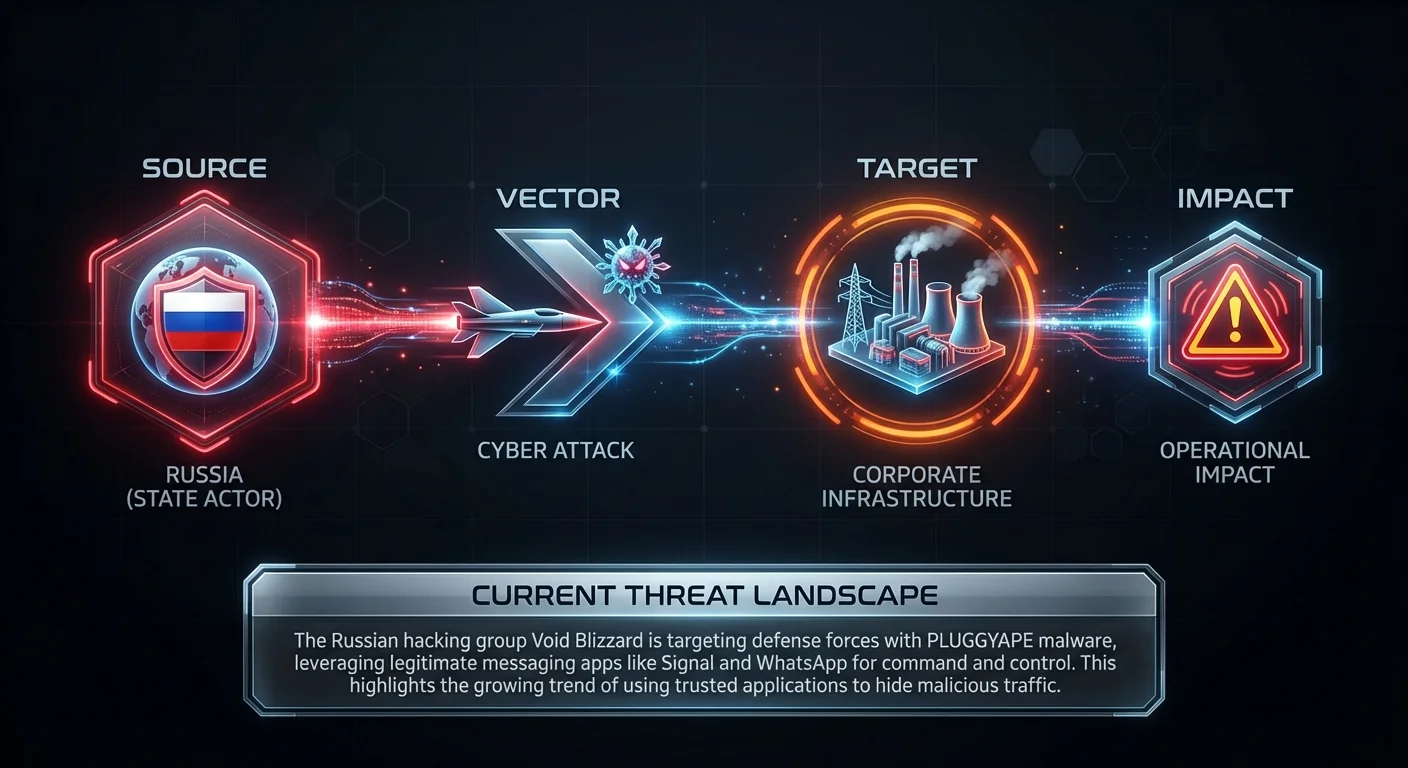
PLUGGYAPE Malware Uses Signal and WhatsApp to Target Ukrainian Defense Forces

    The Russian hacking group Void Blizzard is targeting defense forces with PLUGGYAPE malware, leveraging legitimate messaging apps like Signal and WhatsApp for command and control. This highlights the growing trend of using trusted applications to hide malicious traffic.

    Business Impact

    While targeted at defense, this technique bypasses standard network monitoring - expect potential espionage or data exfiltration if your organization operates in high-risk geopolitical sectors.

    Recommended Action

    Ask your Security team: Do we have visibility into data exfiltration attempts occurring through encrypted messaging applications on corporate devices?

    General Enterprise TheHackerNews ↗

High Severity

President Trump has re-nominated Sean Plankey to lead CISA, signaling potential shifts in federal cybersecurity priorities. This follows previous legislative hurdles and comes amid discussions on offensive vs. defensive cyber strategies.

Business Impact

Leadership changes at CISA may influence regulatory focus and public-private partnership initiatives - expect potential changes in reporting requirements or critical infrastructure guidance.

Recommended Action

Ask your Compliance officer: Are we prepared for potential shifts in CISA guidance regarding critical infrastructure protection?

SOX, FISMA CyberScoop ↗

Vendor Spotlight

Vendor

AppOmni (Specialized Vendor)

Specialization: SaaS Security Posture Management (SSPM)

Why AppOmni Today: AppOmni is a leader in SaaS Security Posture Management (SSPM), specifically securing platforms like ServiceNow and Microsoft 365. This is directly relevant to the reported critical ServiceNow AI platform flaw (CVE-2025-12420), as AppOmni helps organizations monitor SaaS configurations, permissions, and activity logs to detect user impersonation and unauthorized access.

Key Capability: Continuous monitoring of SaaS configurations and permissions to detect security drifts and data exposure risks.

Recommended Actions: 1. Navigate to Posture → Policies → Library → Filter by 'ServiceNow' and Source 'AO Labs' 2. Navigate to Threat Detection → Events → Filter by Event Type 'Impersonation' AND Service 'ServiceNow' 3. Navigate to Posture → Inventory → Data Access → Public Access

Verification Steps: - Trigger a manual policy scan via Posture → Overview → Scan Now - Review Threat Detection Rule Status in Settings → Rules

Learn More About AppOmni ↗

Detection & Response

Detection & Response Kit (4 items)

⚠️ Disclaimer: Test all detection logic in non-production environments before deployment.

1. Vendor Platform Configuration - AppOmni

# Actionable Guidance for AppOmni # Generated: 2026-01-14 11:39:50 # Step 1: Navigate to Posture → Policies → Library → Filter by 'ServiceNow' and Source 'AO Labs' # Purpose: Enable specific detection policies for CVE-2025-12420 released by AppOmni Labs. These policies specifically target misconfigured ACLs and public access settings related to ServiceNow AI/Now Assist components. # Expected: Activation of targeted policy checks that will flag instances where the vulnerable AI components are exposed to unauthenticated users. # Step 2: Navigate to Threat Detection → Events → Filter by Event Type 'Impersonation' AND Service 'ServiceNow' # Purpose: Investigate logs for unauthorized user impersonation attempts, which is the primary exploit vector of this CVE. Look for anomalies where 'System' or 'Guest' accounts initiate impersonation of privileged users. # Expected: Identification of any historical or active exploitation attempts where the AI flaw was used to bypass authentication controls. # Step 3: Navigate to Posture → Inventory → Data Access → Public Access # Purpose: Audit public-facing widgets and API endpoints. Specifically, search for 'sn_now_assist' or AI-related tables to ensure the vulnerability has not resulted in unintentional data exposure. # Expected: A list of publicly accessible resources. Success is achieved when no AI-related tables or processors appear in the 'Public' or 'Guest' access lists. # Verification Steps: # - Trigger a manual policy scan via Posture → Overview → Scan Now # Expected: The specific AO Labs policy for CVE-2025-12420 returns a 'Passed' status, confirming that the ServiceNow instance configuration no longer exposes the vulnerable AI endpoints. # - Review Threat Detection Rule Status in Settings → Rules # Expected: Verify that 'ServiceNow - Suspicious Impersonation' and 'ServiceNow - Anomalous Unauthenticated Access' rules are set to 'Enabled' and 'High Severity'.

2. YARA Rule for Ni8mare Malware

rule Ni8mare_Malware_Detection { meta: description = "Detects Ni8mare malware associated with Fortinet exploitation (CVE-2026-21858)" author = "Threat Rundown" date = "2026-01-15" reference = "https://www.securityweek.com/?p=44951" severity = "high" tlp = "white" strings: $s1 = "Ni8mare" ascii wide $s2 = "/v1/webhook" ascii wide $s3 = "FortiSIEM_Exploit" ascii wide $h1 = { 4D 5A 90 00 03 00 00 00 04 00 00 00 FF FF 00 00 } condition: uint16(0) == 0x5A4D and (any of ($s*) or $h1) }

3. SIEM Query — Fortinet Exploitation Attempt

index=security sourcetype="fortinet:firewall" OR sourcetype="fortinet:fortisiem" uri_path="/v1/webhook" OR threat_name="Ni8mare" | eval risk_score=case( uri_path=="/v1/webhook" AND action=="allowed", 100, threat_name=="Ni8mare", 100, 1==1, 25) | where risk_score >= 50 | table _time, src_ip, dest_ip, uri_path, action, risk_score | sort -_time

4. PowerShell Script — Node.js Version Audit

$computers = "localhost", "SERVER01", "WKSTN01" foreach ($computer in $computers) { if (Test-Connection -ComputerName $computer -Count 1 -Quiet) { Write-Host "Checking Node.js version on $computer..." Invoke-Command -ComputerName $computer -ScriptBlock { try { $nodeVer = node --version Write-Output "Node.js Version: $nodeVer" } catch { Write-Output "Node.js not found or error querying version." } } } }

This rundown should provide a solid overview of the current threat landscape. Thank you to all our cyberheroes for your diligence and hard work. Stay vigilant!