Researchers have demonstrated a performance-counter attack on AMD's Secure Encrypted Virtualization (SEV-SNP), a technology designed to isolate cloud workloads. This breaks the fundamental promise of trusted execution environments in the cloud.
Business Impact
For cloud-heavy organizations, this means sensitive workloads assumed to be hardware-isolated from the cloud provider or other tenants may be exposed, invalidating compliance assumptions for highly regulated data.
Recommended Action
Ask your cloud infrastructure team: "Are our high-security workloads relying solely on AMD SEV-SNP for isolation, and do we need to apply firmware updates or migrate critical instances?"
Systemic Risk: Secrets Vaulting and Non-Human Identities
Entro Security·10:00 PM
▾
New intelligence suggests that secrets vaulting solutions and unmanaged Non-Human Identities (NHIs) are becoming the primary vector for attacks, rather than human error. Machine identities often possess over-privileged access that bypasses standard MFA controls.
Business Impact
An unchecked machine identity can allow an attacker to silently persist in the network, exfiltrating data without triggering user-behavior alarms, leading to massive undetected breaches.
Recommended Action
Conduct an immediate audit of machine identities. Ask your IAM team: "Do we have visibility into all non-human identities and are their secrets rotated automatically?"
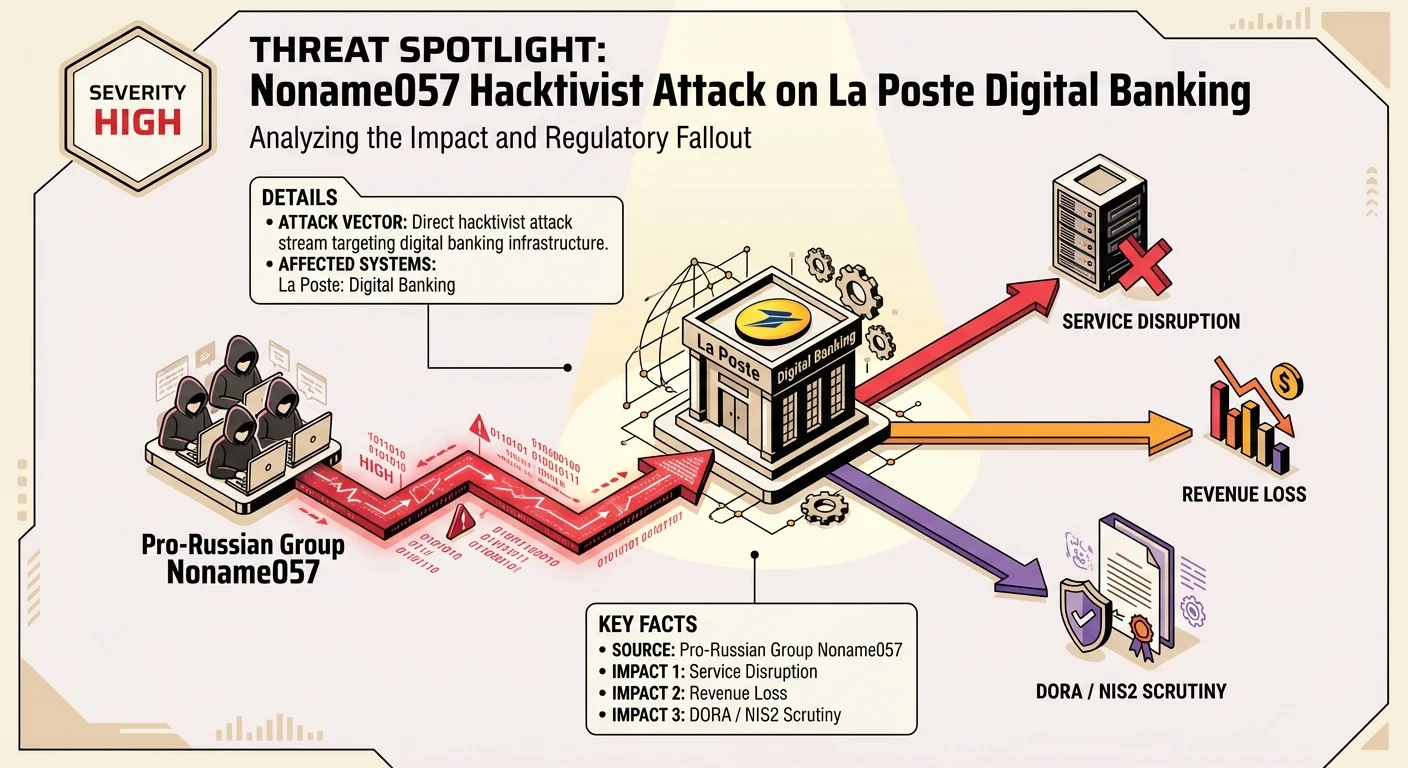
The hacktivist group Noname057 has claimed responsibility for a major cyberattack disrupting La Poste's digital banking and online services. This highlights the continued geopolitical targeting of national critical infrastructure.
Business Impact
Service disruptions of this magnitude cause immediate revenue loss, customer dissatisfaction, and potential regulatory scrutiny regarding operational resilience (DORA/NIS2).
Recommended Action
Review DDoS mitigation strategies and geo-blocking policies. Ask your security team: "Is our perimeter resilient against the specific flooding techniques used by Noname057?"
Trust Wallet has confirmed a security incident in version 2.68 of its Chrome extension where malicious code led to a $7 million loss. Users are urged to update immediately.
Business Impact
For financial institutions or employees using corporate devices for crypto-assets, this represents a direct financial loss risk and a vector for endpoint compromise.
Recommended Action
Audit browser extensions across the enterprise. Ask your endpoint security team: "Can we block or audit the installation of the Trust Wallet extension version 2.68 across our fleet?"
A null pointer dereference vulnerability in the Linux Kernel's RDMA/rxe driver can lead to a system crash (DoS). This affects systems using Remote Direct Memory Access.
Effective Cloud Native Application Protection Platforms (CNAPP) must integrate with CI/CD pipelines, SIEM, and compliance frameworks to secure multi-cloud environments. Isolated security tools are failing to catch real-time threats.
Business Impact
Fragmented cloud security leads to blind spots where attackers can exploit misconfigurations, resulting in data breaches that go undetected until it is too late.
Recommended Action
Evaluate your cloud security stack. Ask your CISO: "Does our CNAPP solution integrate directly with our CI/CD pipeline to catch vulnerabilities before deployment?"
A null pointer dereference vulnerability in the Linux Kernel's RDMA/rxe driver can lead to a system crash (DoS). This affects systems using Remote Direct Memory Access.
A comprehensive look at industry predictions, helping executives align long-term security strategy with emerging trends in threat vectors and defensive technologies.
As organizations rush to adopt AI, maintaining regulatory compliance is critical. This intelligence outlines strategies for leveraging AI without violating SOX or other frameworks.
Spotlight Rationale: With multiple intelligence items today (Entro Security) highlighting the critical risks of **Non-Human Identities (NHIs)** and the failure of traditional secrets vaulting, CyberArk is selected for its specialized focus on securing these exact identity types.
CyberArk moves beyond traditional PAM by securing Non-Human Identities (NHIs)—the machine credentials identified in today's intelligence as a primary attack vector. Their platform automates credential rotation and isolates sessions, directly mitigating the risks of static secrets in CI/CD pipelines and cloud environments.
Actionable Platform Guidance: Ensure the 'Privileged Session Manager' is configured to audit machine-to-machine access, not just human access. Verify that the 'Central Credential Provider' is serving dynamic secrets to applications rather than static keys.
$computers = "localhost", "WKSTN01", "WKSTN02"
$targetExtId = "[Insert_TrustWallet_ID_Here]" # Replace with actual ID if known, or search by name
foreach ($computer in $computers) {
if (Test-Connection -ComputerName $computer -Count 1 -Quiet) {
Invoke-Command -ComputerName $computer -ScriptBlock {
$extensions = Get-ChildItem "C:\Users\*\AppData\Local\Google\Chrome\User Data\Default\Extensions" -ErrorAction SilentlyContinue
foreach ($ext in $extensions) {
# Check for suspicious manifest or version 2.68 artifacts
if ($ext.Name -eq "Trust Wallet" -or $ext.FullName -match "2.68") {
Write-Host "ALERT: Potentially malicious Trust Wallet version found on $env:COMPUTERNAME"
}
}
}
}
}
This rundown should provide a solid overview of the current threat landscape. Thank you to all our cyberheroes for your diligence and hard work. Stay vigilant!
Cookie Notice
We use essential cookies to provide our cybersecurity newsletter service and analytics cookies to improve your experience.
About STIX 2.1: Structured Threat Information eXpression (STIX) is the machine language of cybersecurity. This bundle contains validated threat objects, indicators, and relationships that can be directly imported into your SIEM, TIP, or security orchestration platform.
Usage: Download or copy the JSON below and import it directly into your threat intelligence platform, SIEM, or security orchestration tools for automated threat detection and response.