Heroes, publications will be as needed this week. Here's a curated look at the current cybersecurity landscape for December 22, 2025.
Critical Threats
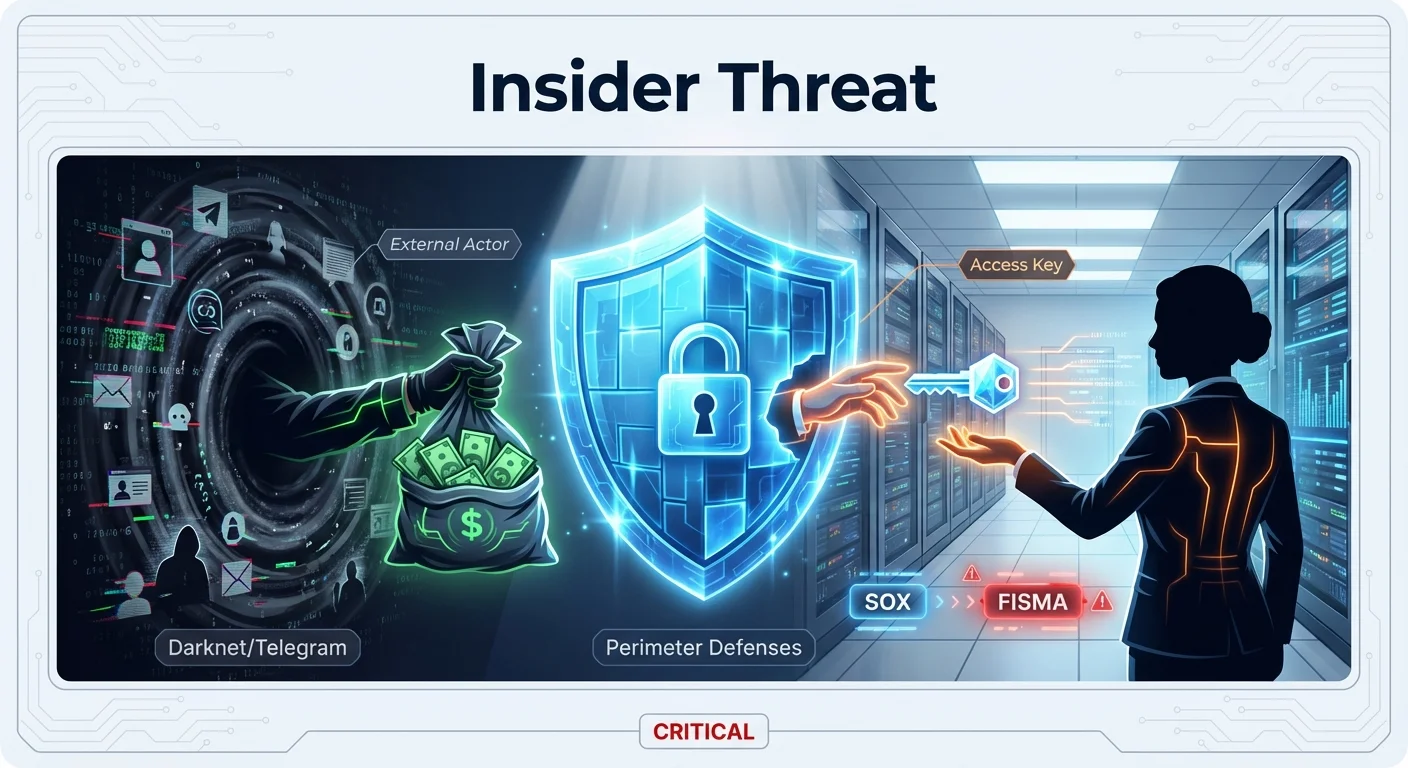
Insider Threat: Hackers Paying Company Insiders to Bypass Security
HackRead·11:44 AM
▾
A new intelligence report indicates a surge in cybercriminals actively recruiting employees from major financial, telecom, and tech sectors via Telegram and the darknet. Attackers are offering substantial cash payouts (up to $15,000) for credentials or direct internal access, bypassing traditional perimeter defenses.
Business Impact
A compromised insider renders most technical defenses useless, leading to undetectable data theft or sabotage; this significantly increases liability under SOX and FISMA due to failure in access governance.
Recommended Action
Ask your Security Operations team: "Do we have behavioral monitoring in place to detect anomalous data access by privileged users, and have we reminded staff of our whistleblower policies?"
WatchGuard Patches Firebox Zero-Day Exploited in the Wild
SecurityWeek·9:44 AM
▾
WatchGuard has released emergency patches for a critical vulnerability in its Firebox firewall appliances that allows attackers to execute malicious code remotely without logging in. This flaw is currently being actively exploited by attackers to breach corporate networks at the perimeter.
Business Impact
If exploited, attackers gain full control of your network perimeter, allowing them to intercept traffic, deploy ransomware, or pivot internally to steal sensitive data—expect immediate operational disruption and potential regulatory fines.
Recommended Action
Ask your IT team: "Have we identified all WatchGuard Firebox appliances in our network and confirmed the installation of the emergency patch for the 'iked' process vulnerability?"
Security Affairs Malware Newsletter: Active Botnet Campaigns
SecurityAffairs·1:13 PM·CVE-2021-41773
▾
Recent intelligence highlights the resurgence of the AndroxGh0st botnet and "Operation MoneyMount-ISO," targeting cloud credentials and deploying phantom malware. These campaigns leverage known vulnerabilities in web frameworks to steal AWS and SendGrid keys.
Business Impact
Successful infection leads to cloud resource hijacking (cryptomining) and mass data exfiltration, resulting in unexpected cloud bills and potential GDPR breaches involving customer data.
Recommended Action
Ask your Cloud Security team: "Are we scanning for exposed .env files and AWS keys in our public-facing web applications?"
A major blackout in San Francisco forced Waymo to suspend its autonomous robotaxi service after vehicles were left stranded. This incident underscores the fragility of IoT and autonomous systems when physical infrastructure (power) fails.
Business Impact
For organizations relying on autonomous logistics or IoT, physical infrastructure failures can lead to immediate revenue cessation and operational paralysis.
Recommended Action
Ask your Operations Director: "Do our critical IoT and autonomous systems have fail-safe protocols for extended power loss scenarios?"
Google's latest Android security bulletin has triggered a complex staggered rollout of patches addressing critical flaws, alongside renewed scrutiny on related ecosystem vulnerabilities like those in FortiManager. The fragmentation of these updates creates a window of exposure for enterprise mobile fleets.
Business Impact
Unpatched mobile devices and management servers can serve as entry points for attackers to access corporate email and 2FA codes, potentially compromising the entire authentication chain.
Recommended Action
Ask your MDM administrator: "What is our compliance status for the latest Android security patch level, and have we verified our FortiManager instances are not exposed?"
Wiz has expanded its Cloud Infrastructure Entitlement Management (CIEM) to Oracle Cloud Infrastructure (OCI). This allows for unified visibility into permissions and identities across multi-cloud environments, reducing the attack surface of Non-Human Identities.
Man Boards Flight Without Ticket in Security Breach
Hacker News·1:27 AM
▾
A significant physical security breach occurred at Heathrow Airport where an individual boarded a flight without any documentation. This highlights failures in physical access controls that often mirror gaps in digital identity verification.
A new Docker-based CTF platform aligned with MITRE ATT&CK techniques has opened for early access. While not a threat, it represents a new resource for training security teams on real-world exploits.
Wiz has expanded its Cloud Infrastructure Entitlement Management (CIEM) to Oracle Cloud Infrastructure (OCI). This allows for unified visibility into permissions and identities across multi-cloud environments, reducing the attack surface of Non-Human Identities.
Man Boards Flight Without Ticket in Security Breach
Hacker News·1:27 AM
▾
A significant physical security breach occurred at Heathrow Airport where an individual boarded a flight without any documentation. This highlights failures in physical access controls that often mirror gaps in digital identity verification.
A new Docker-based CTF platform aligned with MITRE ATT&CK techniques has opened for early access. While not a threat, it represents a new resource for training security teams on real-world exploits.
Spotlight Rationale: With the surge in cloud-based threats and the specific focus on "Non-Human Identities" (NHIs) in today's intelligence, securing cross-cloud permissions is critical.
Wiz has introduced unified visibility for Oracle Cloud Infrastructure (OCI) identities, directly addressing the challenge of managing permissions across fragmented cloud environments. By mapping permissions and policies into a Security Graph, Wiz enables teams to detect the exact type of excessive agency that botnets like AndroxGh0st exploit to pivot from a compromised web app to full cloud takeover.
Actionable Platform Guidance: Enable the OCI connector in the Wiz portal to immediately ingest identity metadata. Use the Security Graph to query for "OCI Users with Admin privileges" and correlate them with "Publicly Exposed Instances" to prioritize remediation of high-risk identities.
index=security sourcetype="fortinet:firewall"
(msg="*FortiManager*" OR app="FortiManager")
(cve="CVE-2024-47575" OR action="blocked" OR threat_name="*FortiManager*")
| eval risk_score=case(
match(_raw, "CVE-2024-47575"), 100,
action=="blocked", 50,
1==1, 25)
| where risk_score >= 50
| table _time, src_ip, dest_ip, threat_name, action, risk_score
| sort -_time
4. PowerShell Script — Check for Suspicious Port Activity (AndroxGh0st context)
$computers = "localhost"
foreach ($computer in $computers) {
if (Test-Connection -ComputerName $computer -Count 1 -Quiet) {
# Check for processes listening on common web framework ports often targeted
$ports = Get-NetTCPConnection -State Listen | Where-Object { $_.LocalPort -eq 80 -or $_.LocalPort -eq 443 -or $_.LocalPort -eq 8080 }
if ($ports) {
Write-Host "[!] Web ports active on $computer - Verify application integrity against AndroxGh0st indicators."
$ports | Select-Object LocalAddress, LocalPort, OwningProcess, State
}
}
}
This rundown should provide a solid overview of the current threat landscape. Thank you to all our cyberheroes for your diligence and hard work. Stay vigilant!
Cookie Notice
We use essential cookies to provide our cybersecurity newsletter service and analytics cookies to improve your experience.
About STIX 2.1: Structured Threat Information eXpression (STIX) is the machine language of cybersecurity. This bundle contains validated threat objects, indicators, and relationships that can be directly imported into your SIEM, TIP, or security orchestration platform.
Usage: Download or copy the JSON below and import it directly into your threat intelligence platform, SIEM, or security orchestration tools for automated threat detection and response.